Ch. 4 - Inverse, Exponential, and Logarithmic Functions
Lial - College Algebra 13th Edition
Lial13th EditionCollege AlgebraISBN: 9780136881063Not the one you use?Change textbook
Chapter 5, Problem 35

Graph each function. ƒ(x) = 4-x

Verified step by step guidance
1
Identify the base of the exponential function. Here, the function is given as \(f(x) = 4^{-x}\), where the base is 4 and the exponent is \(-x\).
Rewrite the function to better understand its behavior. Recall that \(a^{-x} = \frac{1}{a^x}\), so \(f(x) = 4^{-x}\) can be rewritten as \(f(x) = \frac{1}{4^x}\).
Determine key points to plot by substituting values of \(x\) such as \(-2\), \(-1\), \(0\), \(1\), and \(2\) into the function \(f(x) = \frac{1}{4^x}\). Calculate the corresponding \(y\) values (without final numeric evaluation here).
Analyze the behavior of the graph: since the base 4 is greater than 1 and the exponent is negative, the function represents exponential decay. The graph will approach zero as \(x\) increases and grow larger as \(x\) decreases.
Sketch the graph using the points found and the behavior analysis. Remember to include the horizontal asymptote at \(y=0\), since exponential functions of this form never touch the x-axis.

Verified video answer for a similar problem:

This video solution was recommended by our tutors as helpful for the problem above.
Video duration:
6m
Was this helpful?

Key Concepts

Here are the essential concepts you must grasp in order to answer the question correctly.

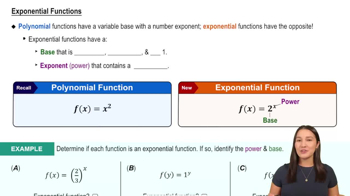
Exponential Functions

An exponential function has the form f(x) = a^x, where the base a is a positive constant. These functions model rapid growth or decay depending on the base and the exponent's sign. Understanding the behavior of exponential functions is essential for graphing them accurately.
Recommended video:
6:13
Exponential Functions

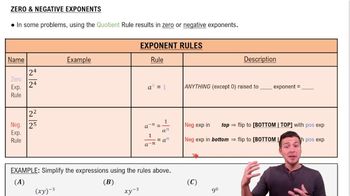
Negative Exponents

A negative exponent indicates the reciprocal of the base raised to the positive exponent, i.e., a^{-x} = 1 / a^x. This concept helps in rewriting and understanding functions like f(x) = 4^{-x}, which reflects the graph of 4^x across the y-axis.
Recommended video:
Guided course
6:37
Zero and Negative Rules

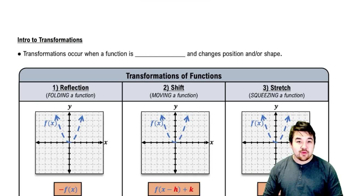
Graphing Transformations

Graphing transformations involve shifting, reflecting, stretching, or compressing the graph of a function. For f(x) = 4^{-x}, the negative exponent causes a reflection of the basic exponential graph f(x) = 4^x across the y-axis, changing its growth to decay.
Recommended video:
5:25
Intro to Transformations