Ch. 1 - Equations and Inequalities
Lial - College Algebra 13th Edition
Lial13th EditionCollege AlgebraISBN: 9780136881063Not the one you use?Change textbook
Chapter 2, Problem 43

Solve each equation or inequality. |4x + 3| - 2 = -1

Verified step by step guidance
1
Start by isolating the absolute value expression on one side of the equation. Add 2 to both sides to get: \(|4x + 3| = -1 + 2\).
Simplify the right side of the equation to find the value that the absolute value expression equals.
Recall that the absolute value of any real number is always greater than or equal to zero. Therefore, check if the equation \(|4x + 3| = \text{(value from step 2)}\) is possible given the properties of absolute value.
If the value from step 2 is negative, conclude that there is no solution because an absolute value cannot be negative.
If the value from step 2 is zero or positive, set up two separate equations to solve for \(x\): \(4x + 3 = \text{value}\) and \(4x + 3 = -\text{value}\), then solve each for \(x\).

Verified video answer for a similar problem:

This video solution was recommended by our tutors as helpful for the problem above.
Video duration:
3m
Was this helpful?

Key Concepts

Here are the essential concepts you must grasp in order to answer the question correctly.

Absolute Value Definition

The absolute value of a number represents its distance from zero on the number line, always yielding a non-negative result. For an expression |A| = B, B must be non-negative, and the equation splits into two cases: A = B or A = -B.
Recommended video:
08:07
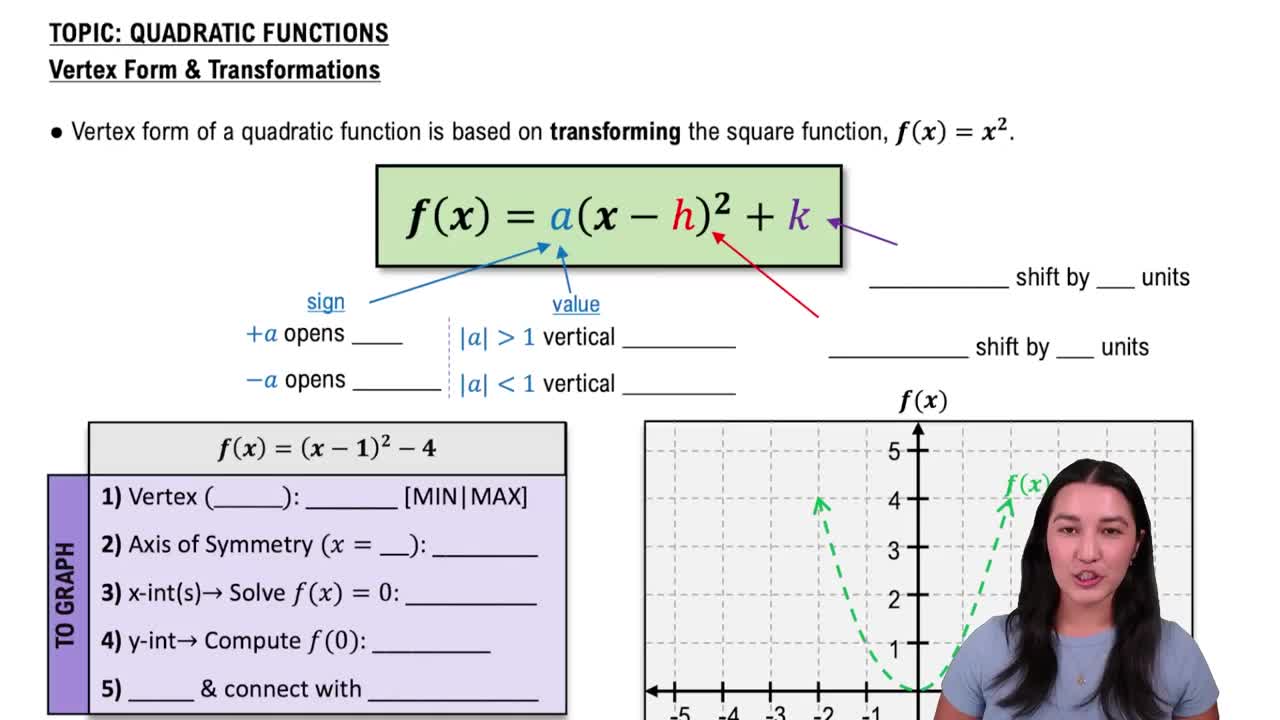
Vertex Form

Solving Absolute Value Equations

To solve equations involving absolute values, isolate the absolute value expression first. Then, set up two separate equations based on the definition: one where the inside equals the positive value, and one where it equals the negative value, solving each for the variable.
Recommended video:
5:02
Solving Logarithmic Equations

Checking for Extraneous Solutions

After solving, substitute solutions back into the original equation to verify validity. Some solutions may not satisfy the original equation, especially when dealing with absolute values and negative results, so this step ensures only true solutions are accepted.
Recommended video:
05:21
Restrictions on Rational Equations