Let U = {0, 1, 2, 3, 4, 5, 6, 7, 8, 9, 10, 11, 12, 13}, M = {0, 2, 4, 6, 8}, N = {1, 3, 5, 7, 9, 11, 13}, Q = {0, 2, 4, 6, 8, 10, 12}, and R = {0, 1, 2, 3, 4}.Use these sets to find each of the following. Identify any disjoint sets. (M ∩ N) ∪ R
Ch. R - Review of Basic Concepts

Chapter 1, Problem 97a
Simplify each rational expression. Assume all variable expressions represent positive real numbers. (Hint: Use factoring and divide out any common factors as a first step.) [4(x2- 1)3 + 8x(x2-1)4] / [16(x2-1)3]
Verified step by step guidance1
Start by examining the given rational expression: \(\frac{4(x^2 - 1)^3 + 8x(x^2 - 1)^4}{16(x^2 - 1)^3}\). Notice that both the numerator and denominator contain powers of the expression \((x^2 - 1)\).
Factor out the greatest common factor (GCF) from the numerator. The GCF is \$4(x^2 - 1)^3$, so rewrite the numerator as \(4(x^2 - 1)^3 \left[1 + 2x(x^2 - 1)\right]\).
Rewrite the entire expression using the factored numerator: \(\frac{4(x^2 - 1)^3 \left[1 + 2x(x^2 - 1)\right]}{16(x^2 - 1)^3}\).
Cancel out the common factors in the numerator and denominator. Since both have \$4(x^2 - 1)^3$, divide numerator and denominator by this term to simplify the expression to \(\frac{1 + 2x(x^2 - 1)}{4}\).
Finally, expand the term \$2x(x^2 - 1)\( in the numerator to get \)2x^3 - 2x$, then write the simplified expression as \(\frac{1 + 2x^3 - 2x}{4}\). This is the simplified form of the original rational expression.

Verified video answer for a similar problem:
This video solution was recommended by our tutors as helpful for the problem above.
Video duration:
3mWas this helpful?
Key Concepts
Here are the essential concepts you must grasp in order to answer the question correctly.
Factoring Polynomials
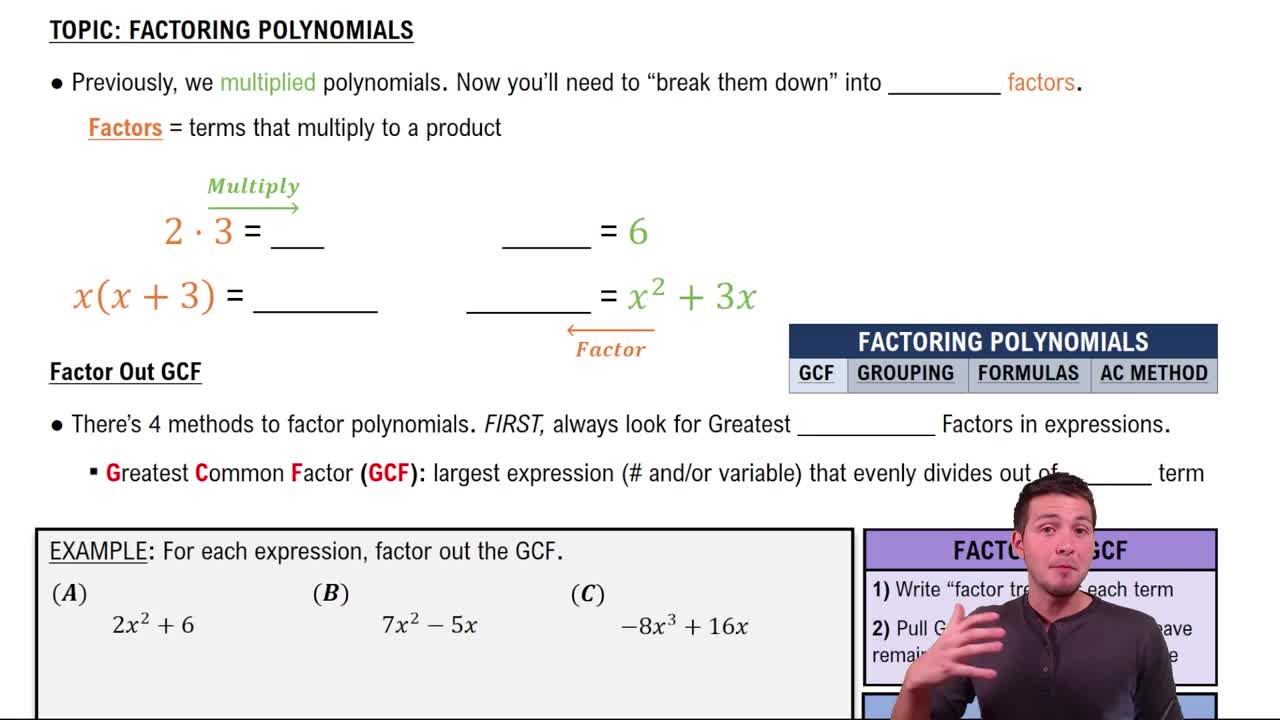
Factoring involves rewriting a polynomial as a product of simpler polynomials or expressions. Recognizing common patterns like difference of squares or factoring out the greatest common factor helps simplify expressions and is essential before performing operations like division.
Recommended video:
Guided course
Introduction to Factoring Polynomials
Simplifying Rational Expressions
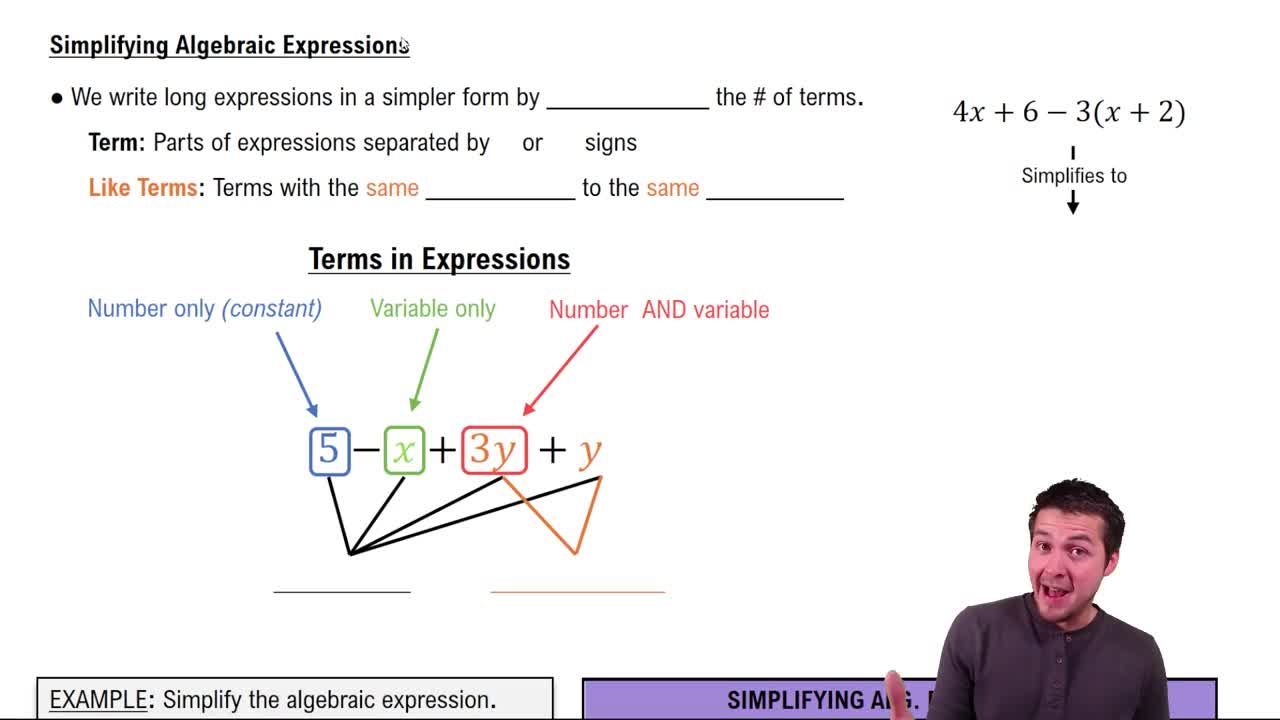
A rational expression is a fraction where the numerator and denominator are polynomials. Simplifying involves factoring both parts and canceling out common factors, reducing the expression to its simplest form while considering domain restrictions.
Recommended video:
Guided course
Simplifying Algebraic Expressions
Properties of Exponents
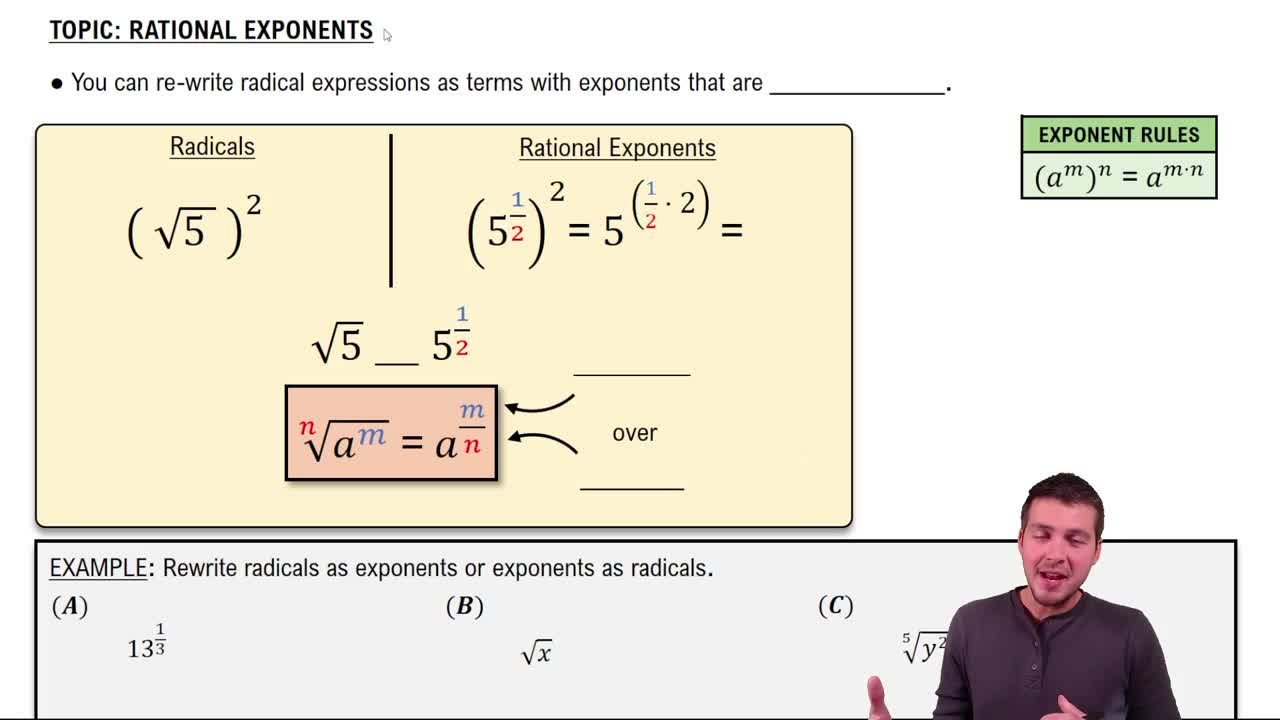
Understanding how to manipulate expressions with exponents, such as multiplying powers with the same base or factoring out common powers, is crucial. This helps in combining like terms and simplifying expressions involving powers efficiently.
Recommended video:
Guided course
Rational Exponents
Related Practice
Textbook Question
946
views
Textbook Question
Evaluate each expression.
1147
views
Textbook Question
Simplify each expression. Write answers without negative exponents. Assume all variables represent positive real numbers. (z3/4)/(z5/4)(z-2)
966
views
Textbook Question
Factor by any method. See Examples 1–7. x2+xy-5x-5y
1073
views
Textbook Question
Let U = {0, 1, 2, 3, 4, 5, 6, 7, 8, 9, 10, 11, 12, 13}, M = {0, 2, 4, 6, 8}, N = {1, 3, 5, 7, 9, 11, 13}, Q = {0, 2, 4, 6, 8, 10, 12}, and R = {0, 1, 2, 3, 4}.Use these sets to find each of the following. Identify any disjoint sets. (N ∪ R) ∩ M
1041
views
Textbook Question
Add or subtract as indicated. 345.1 - 56.31
1141
views
