In Exercises 5–9, graph f and g in the same rectangular coordinate system. Use transformations of the graph of f to obtain the graph of g. Graph and give equations of all asymptotes. Use the graphs to determine each function's domain and range. f(x) = ex and g(x) = 2ex/2
Ch. 4 - Exponential and Logarithmic Functions

Chapter 5, Problem 9
Solve each exponential equation in Exercises 1–22 by expressing each side as a power of the same base and then equating exponents. 32x=8
Verified step by step guidance1
Identify the bases on both sides of the equation: the left side is and the right side is .
Express both 32 and 8 as powers of the same base. Since both are powers of 2, rewrite them as for 32 and for 8.
Rewrite the equation using these powers: .
Simplify the left side by multiplying the exponents: .
Since the bases are the same, set the exponents equal to each other: , then solve for .

Verified video answer for a similar problem:
This video solution was recommended by our tutors as helpful for the problem above.
Video duration:
2mWas this helpful?
Key Concepts
Here are the essential concepts you must grasp in order to answer the question correctly.
Exponential Equations
An exponential equation is an equation where variables appear as exponents. Solving such equations often involves rewriting expressions to have the same base, allowing the exponents to be set equal to each other for simplification.
Recommended video:
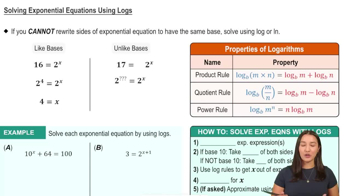
Solving Exponential Equations Using Logs
Expressing Numbers as Powers of the Same Base
To solve exponential equations, rewrite each side as a power of the same base. For example, 32 and 8 can both be expressed as powers of 2 (32 = 2^5, 8 = 2^3), which helps in comparing and equating the exponents.
Recommended video:
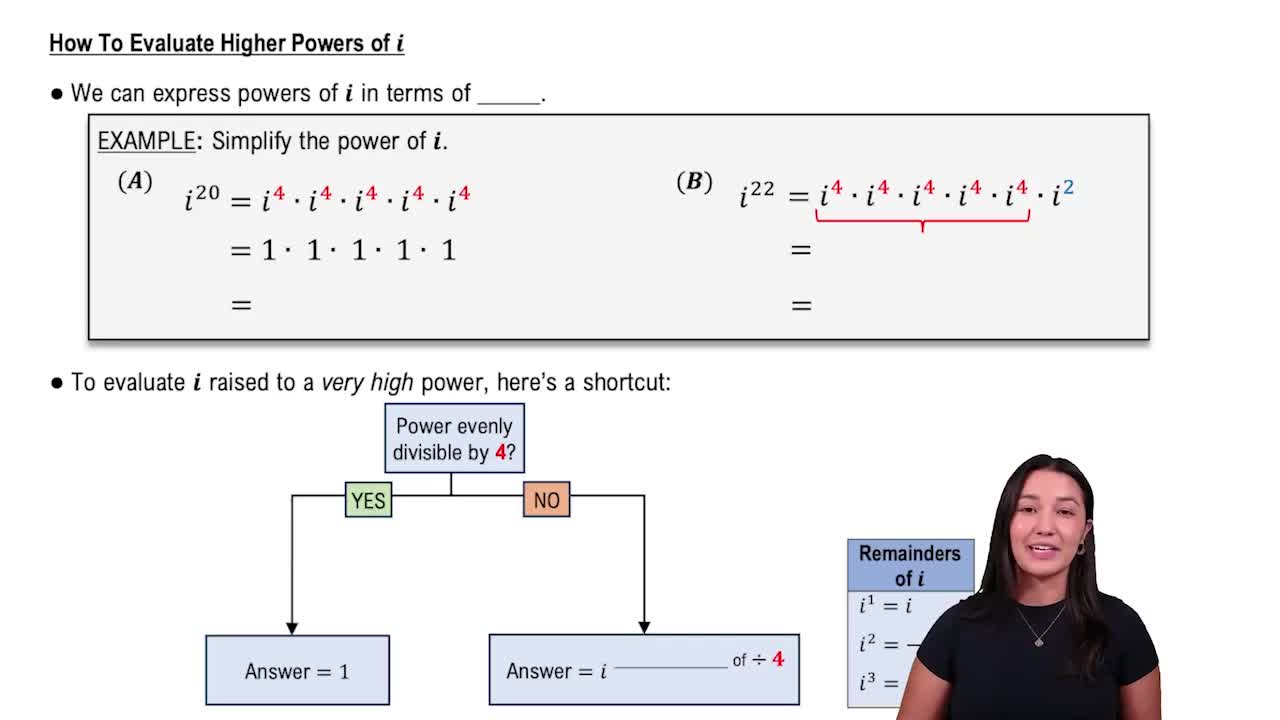
Higher Powers of i
Equating Exponents
Once both sides of an exponential equation have the same base, the equation reduces to setting the exponents equal. This step transforms the problem into a simpler algebraic equation that can be solved for the variable.
Recommended video:
Guided course
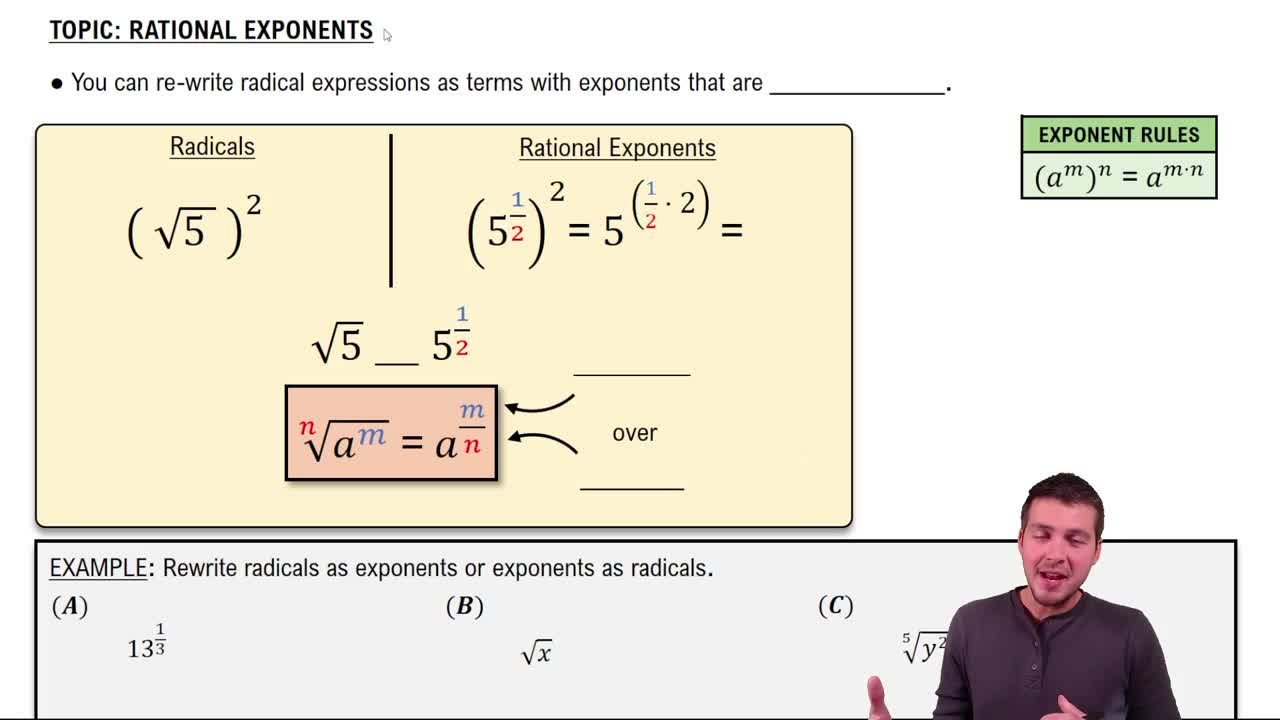
Rational Exponents
Related Practice
Textbook Question
761
views
Textbook Question
Solve each exponential equation in Exercises 1–22 by expressing each side as a power of the same base and then equating exponents. 42x−1=64
747
views
Textbook Question
Use properties of logarithms to expand each logarithmic expression as much as possible. Where possible, evaluate logarithmic expressions without using a calculator. log(x/100)
1085
views
Textbook Question
Use the compound interest formulas to solve Exercises 10–11. Suppose that you have \$5000 to invest. Which investment yields the greater return over 5 years: 1.5% compounded semiannually or 1.45% compounded monthly?
1319
views
Textbook Question
In Exercises 1–10, approximate each number using a calculator. Round your answer to three decimal places. e-0.95
882
views
Textbook Question
Write each equation in its equivalent logarithmic form. 54 = 625
801
views
