
Textbook Question
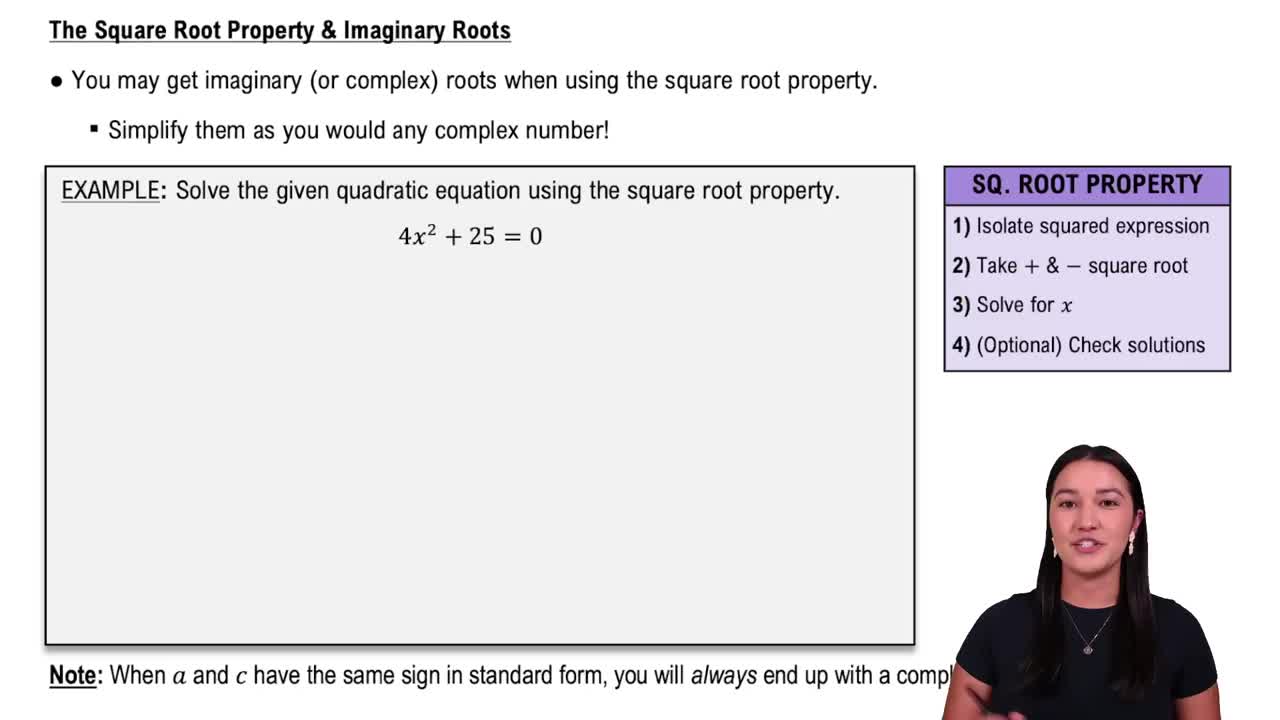
Write each number as the product of a real number and i. √-288
129
views

 Verified step by step guidance
 02:20
02:20
 05:28 02:20
Write each number as the product of a real number and i. √-288
Perform each operation. Write answers in standard form. (5-11i)(5+11i)
Solve each equation. See Example 2. (4x+3)/(x+1) + 2/x = 1/(x2+x)
Solve each problem. See Example 2. Callie took 20 min to drive her boat upstream to water-ski at her favorite spot. Coming back later in the day, at the same boat speed, took her 15 min. If the current in that part of the river is 5 km per hr, what was her boat speed?
Solve each equation using the square root property. 27 - x2 = 0
Volume of a Box. A rectangular piece of metal is 10 in. longer than it is wide. Squares with sides 2 in. long are cut from the four corners, and the flaps are folded upward to form an open box. If the volume of the box is 835 in.3, what were the original dimensions of the piece of metal?