Ch. 1 - Equations and Inequalities
Lial - College Algebra 13th Edition
Lial13th EditionCollege AlgebraISBN: 9780136881063Not the one you use?Change textbook
Chapter 2, Problem 41

Solve each inequality. Give the solution set in interval notation. | 0.01x + 1 | < 0.01

Verified step by step guidance
1
Recognize that the inequality involves an absolute value expression: \(|0.01x + 1| < 0.01\). Recall that for any expression \(|A| < B\) (where \(B > 0\)), this means \(-B < A < B\).
Apply this property to the given inequality: \(-0.01 < 0.01x + 1 < 0.01\).
Next, solve the compound inequality by isolating \(x\). Start by subtracting 1 from all parts: \(-0.01 - 1 < 0.01x < 0.01 - 1\).
Simplify the inequalities: \(-1.01 < 0.01x < -0.99\).
Finally, divide all parts by \(0.01\) to solve for \(x\). Since \(0.01\) is positive, the inequality signs remain the same: \(\frac{-1.01}{0.01} < x < \frac{-0.99}{0.01}\). Express the solution set in interval notation based on these bounds.

Verified video answer for a similar problem:

This video solution was recommended by our tutors as helpful for the problem above.
Video duration:
4m
Was this helpful?

Key Concepts

Here are the essential concepts you must grasp in order to answer the question correctly.

Absolute Value Inequalities

Absolute value inequalities involve expressions where the absolute value of a variable or expression is compared to a number. To solve |A| < B, where B > 0, rewrite it as a double inequality: -B < A < B. This approach helps isolate the variable within a range.
Recommended video:
06:07
Linear Inequalities

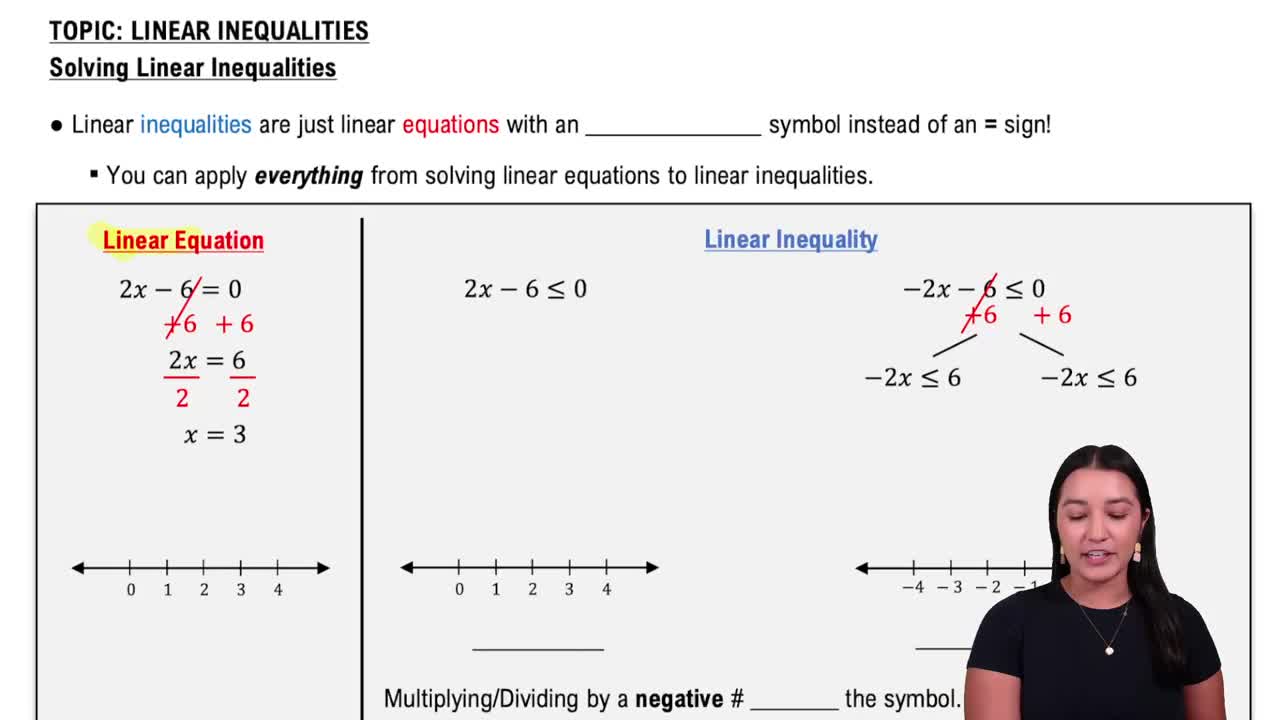
Solving Linear Inequalities

Solving linear inequalities requires isolating the variable on one side by performing algebraic operations such as addition, subtraction, multiplication, or division. When multiplying or dividing by a negative number, the inequality sign must be reversed to maintain a true statement.
Recommended video:
06:07
Linear Inequalities

Interval Notation

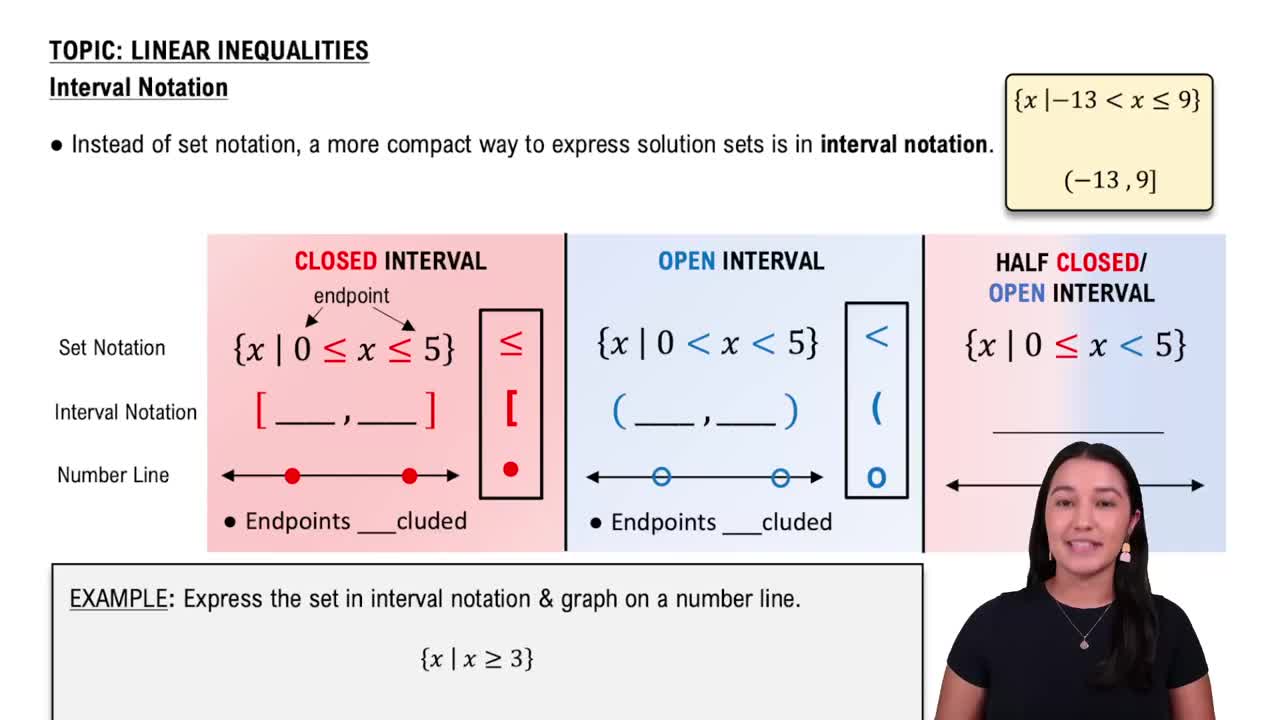
Interval notation is a concise way to represent solution sets of inequalities. It uses parentheses for values not included (open intervals) and brackets for values included (closed intervals). For example, (a, b) means all numbers between a and b, excluding endpoints.
Recommended video:
05:18
Interval Notation