Ch. 4 - Inverse, Exponential, and Logarithmic Functions
Lial - College Algebra 13th Edition
Lial13th EditionCollege AlgebraISBN: 9780136881063Not the one you use?Change textbook
Chapter 5, Problem 62

Graph each function. Give the domain and range. ƒ(x)=(13)x+32ƒ(x)=(\(\frac\)13)^{x+3}-2

Verified step by step guidance
1
Identify the base function and transformations: The base function is an exponential function of the form \(f(x) = \left(\frac{1}{3}\right)^x\). Here, the function is modified to \(f(x) = -\left(\frac{1}{3}\right)^{x+3} - 2\).
Analyze the horizontal shift: The term \(x + 3\) inside the exponent indicates a horizontal shift to the left by 3 units. This means the graph of \(\left(\frac{1}{3}\right)^x\) is shifted left 3 units.
Consider the reflection and vertical shift: The negative sign in front of the exponential reflects the graph across the x-axis, flipping it upside down. The \(-2\) outside the exponential shifts the entire graph down by 2 units.
Determine the domain: Since exponential functions are defined for all real numbers, the domain of \(f(x)\) is all real numbers, expressed as \((-\infty, \infty)\).
Find the range: The base function \(\left(\frac{1}{3}\right)^x\) is always positive. After reflection, the values become negative, and then shifting down by 2 moves the graph further down. So, the range will be all real numbers less than \(-2\), expressed as \((-\infty, -2)\).

Verified video answer for a similar problem:

This video solution was recommended by our tutors as helpful for the problem above.
Video duration:
6m
Was this helpful?

Key Concepts

Here are the essential concepts you must grasp in order to answer the question correctly.

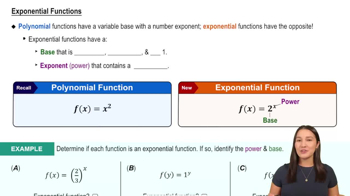
Exponential Functions

An exponential function has the form f(x) = a^x, where the variable is in the exponent. It models rapid growth or decay depending on the base. In this question, the base is 1/3, which is between 0 and 1, indicating exponential decay. Understanding how the exponent affects the graph is essential for sketching the function.
Recommended video:
6:13
Exponential Functions

Transformations of Functions

Function transformations include shifts, reflections, and stretches/compressions. Here, the function is shifted horizontally by -3 (inside the exponent), reflected vertically (due to the negative sign in front), and shifted downward by 2. Recognizing these changes helps in accurately graphing the function and determining domain and range.
Recommended video:
4:22
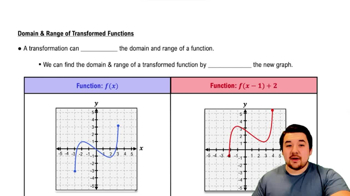
Domain & Range of Transformed Functions

Domain and Range of Exponential Functions

The domain of exponential functions is all real numbers since any real x can be input. The range depends on transformations; for the base function (1/3)^x, the range is positive real numbers. After reflection and vertical shift, the range changes accordingly. Identifying these helps specify the correct domain and range for the given function.
Recommended video:
4:22
Domain & Range of Transformed Functions