Ch. R - Review of Basic Concepts
Lial - College Algebra 13th Edition
Lial13th EditionCollege AlgebraISBN: 9780136881063Not the one you use?Change textbook
Chapter 1, Problem 149

Rationalize each denominator. Assume all variables represent nonnegative numbers and that no denominators are 0. 1/(2 + √5)

Verified step by step guidance
1
Identify the denominator that needs to be rationalized: \(2 + \sqrt{5}\). The goal is to eliminate the square root from the denominator.
Multiply both the numerator and the denominator by the conjugate of the denominator. The conjugate of \(2 + \sqrt{5}\) is \(2 - \sqrt{5}\), so multiply by \(\frac{2 - \sqrt{5}}{2 - \sqrt{5}}\).
Apply the multiplication in the numerator: \(1 \times (2 - \sqrt{5}) = 2 - \sqrt{5}\).
Apply the multiplication in the denominator using the difference of squares formula: \((2 + \sqrt{5})(2 - \sqrt{5}) = 2^2 - (\sqrt{5})^2 = 4 - 5\).
Simplify the denominator expression \$4 - 5\( to get \)-1\(, and write the rationalized expression as \(\frac{2 - \sqrt{5}}{-1}\). You can then simplify the fraction by dividing numerator and denominator by \)-1$.

Verified video answer for a similar problem:

This video solution was recommended by our tutors as helpful for the problem above.
Video duration:
2m
Was this helpful?

Key Concepts

Here are the essential concepts you must grasp in order to answer the question correctly.

Rationalizing the Denominator

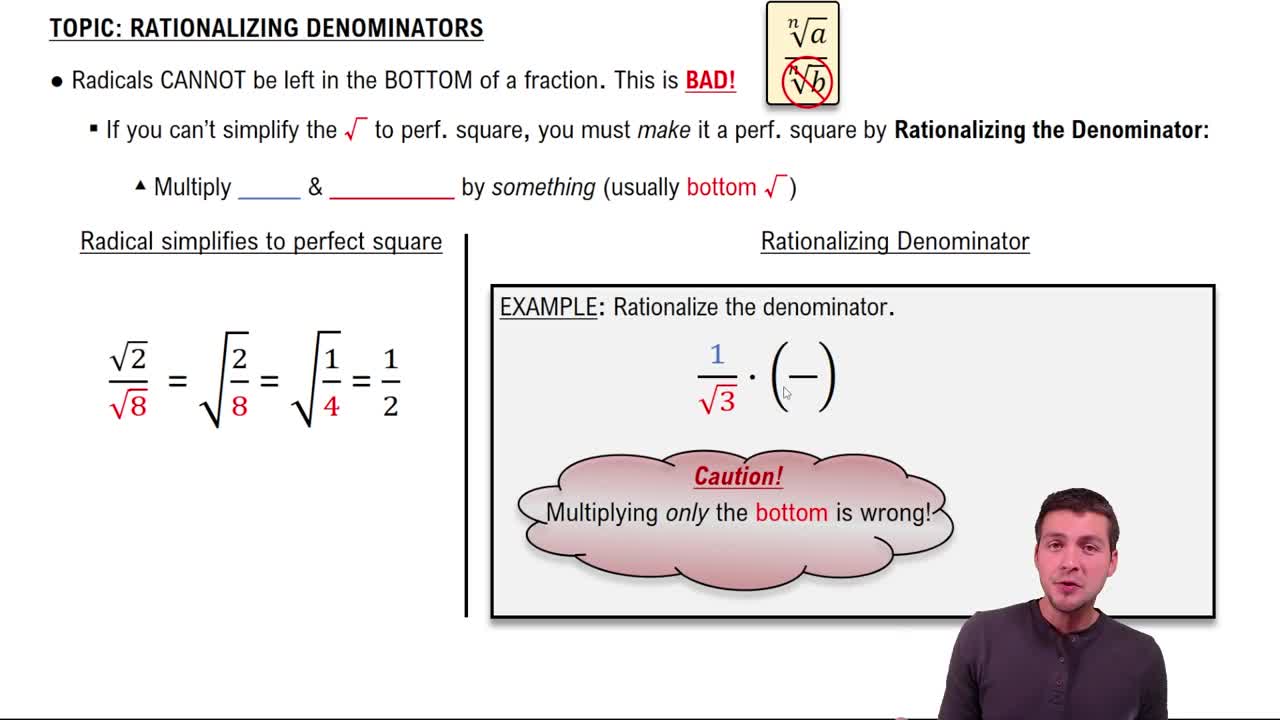
Rationalizing the denominator involves rewriting a fraction so that its denominator contains no radicals. This is done to simplify expressions and make them easier to work with. For denominators with square roots, multiplying numerator and denominator by a suitable expression removes the radical from the denominator.
Recommended video:
Guided course
02:58
Rationalizing Denominators

Conjugates of Binomials

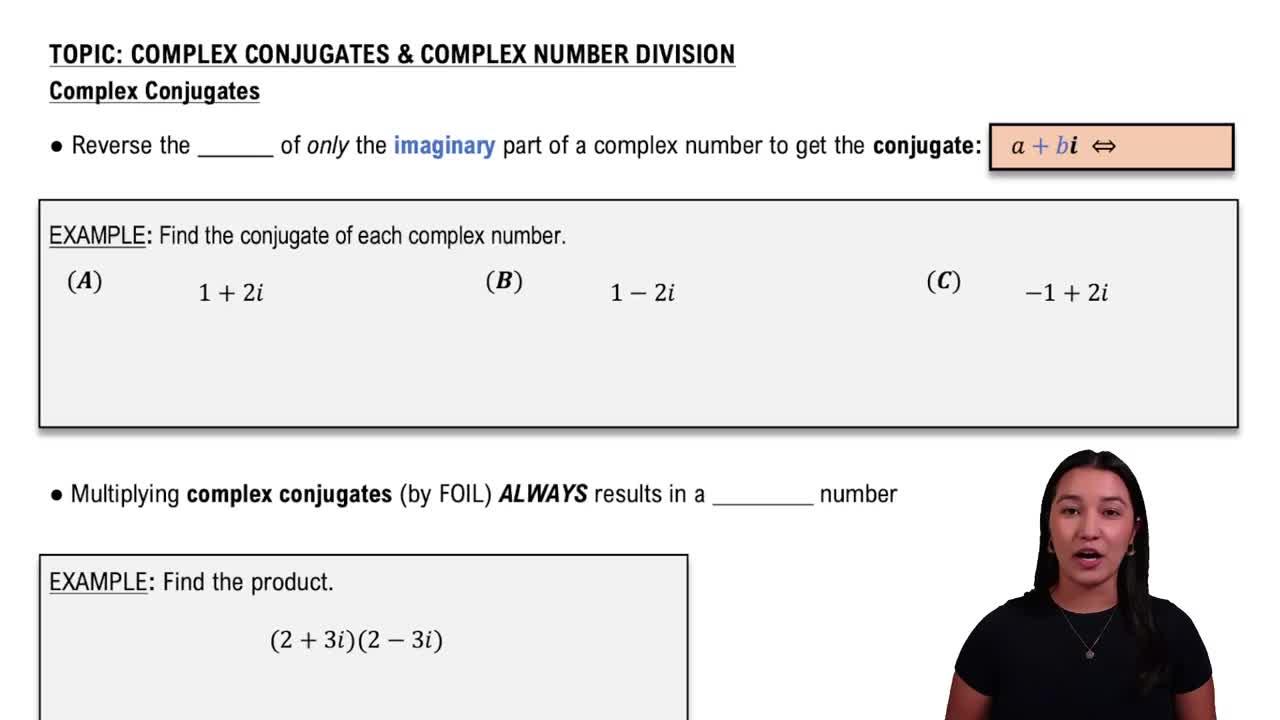
The conjugate of a binomial expression like (a + √b) is (a - √b). Multiplying a binomial by its conjugate results in a difference of squares, eliminating the square root terms. This technique is essential for rationalizing denominators that are sums or differences involving radicals.
Recommended video:
05:33
Complex Conjugates

Properties of Square Roots and Nonnegative Variables

Square roots represent nonnegative values, and assuming variables are nonnegative ensures expressions remain defined and simplifies manipulation. This assumption allows us to avoid absolute value considerations when simplifying radicals and rationalizing denominators.
Recommended video:
02:20
Imaginary Roots with the Square Root Property