Ch. 2 - Graphs and Functions
Lial - College Algebra 13th Edition
Lial13th EditionCollege AlgebraISBN: 9780136881063Not the one you use?Change textbook
Chapter 3, Problem 31

Graph each function. See Examples 1 and 2. h(x)=√(4x)

Verified step by step guidance
1
Identify the function given: \(h(x) = \sqrt{4x}\). This is a square root function where the expression inside the root is \$4x$.
Determine the domain of the function by setting the expression inside the square root greater than or equal to zero: \(4x \geq 0\). Solve for \(x\) to find the domain.
Create a table of values by choosing several \(x\) values from the domain and calculating the corresponding \(h(x)\) values using the formula \(h(x) = \sqrt{4x}\).
Plot the points from the table on the coordinate plane, where the \(x\)-values are the inputs and the \(h(x)\) values are the outputs.
Draw a smooth curve through the plotted points starting from the smallest \(x\) in the domain, showing the shape of the square root function, which increases gradually as \(x\) increases.

Verified video answer for a similar problem:

This video solution was recommended by our tutors as helpful for the problem above.
Video duration:
8m
Was this helpful?

Key Concepts

Here are the essential concepts you must grasp in order to answer the question correctly.

Square Root Function

A square root function involves the principal square root of an expression, such as h(x) = √(4x). It is defined only for values where the expression inside the root is non-negative, ensuring the output is a real number. Understanding its domain and range is essential for graphing.
Recommended video:
02:20
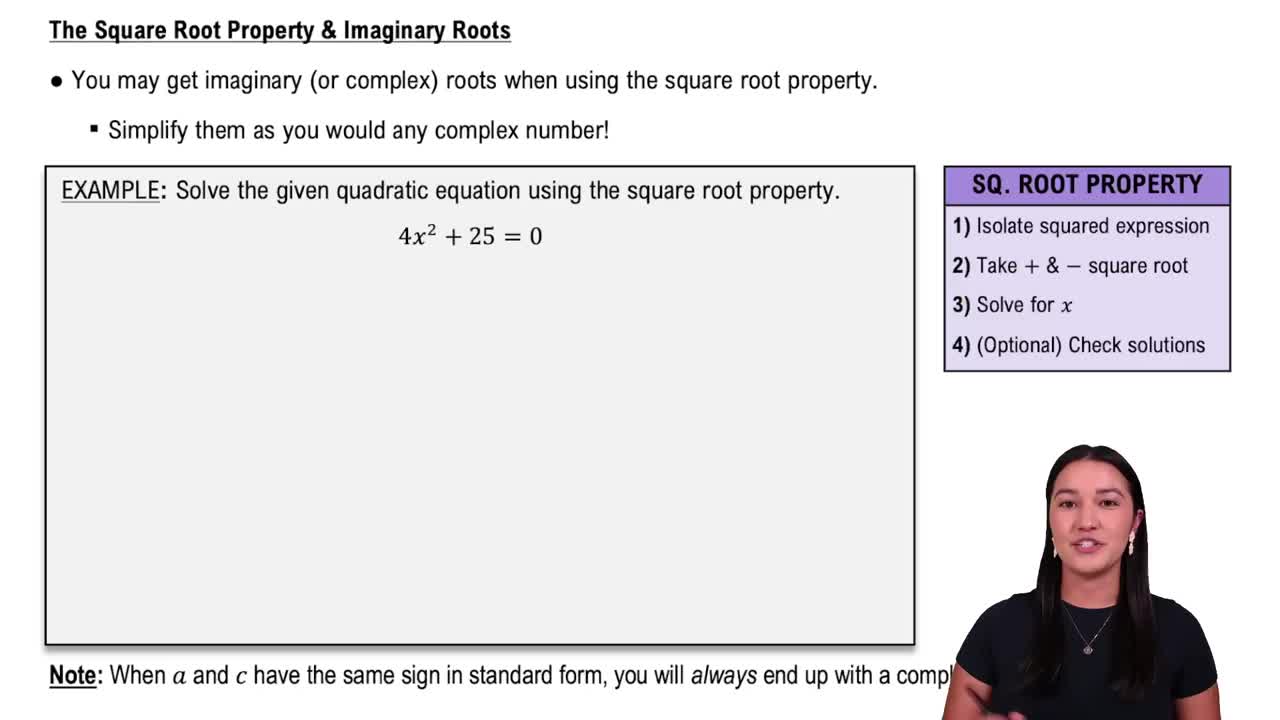
Imaginary Roots with the Square Root Property

Domain of a Function

The domain is the set of all input values (x-values) for which the function is defined. For h(x) = √(4x), the expression inside the root, 4x, must be greater than or equal to zero, so the domain is x ≥ 0. Identifying the domain helps determine where to plot the graph.
Recommended video:
3:51
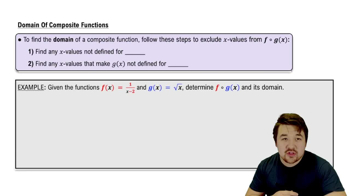
Domain Restrictions of Composed Functions

Graphing Transformations

Graphing transformations involve shifting, stretching, or compressing the basic graph of a function. Since h(x) = √(4x) can be seen as √(x) scaled horizontally by a factor of 1/4, understanding how multiplication inside the root affects the graph helps in sketching the correct shape.
Recommended video:
5:25
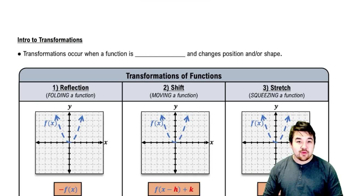
Intro to Transformations