Ch. 1 - Equations and Inequalities
Lial - College Algebra 13th Edition
Lial13th EditionCollege AlgebraISBN: 9780136881063Not the one you use?Change textbook
Chapter 2, Problem 119

Solve each equation or inequality.
4x123|4x-12| ≥ -3

Verified step by step guidance
1
Recall that the absolute value of any expression, denoted as \(|a|\), is always greater than or equal to zero. This means \(|4x - 12| \geq 0\) for all real values of \(x\).
Given the inequality \(|4x - 12| \geq -3\), observe that the right side is a negative number, \(-3\).
Since the absolute value expression \(|4x - 12|\) is always non-negative and the inequality requires it to be greater than or equal to a negative number, this inequality will hold true for all real numbers.
Therefore, the solution set includes all real numbers, which can be written as \((-\infty, \infty)\).
To summarize, no further algebraic manipulation is needed because the absolute value expression is always greater than or equal to any negative number.

Verified video answer for a similar problem:

This video solution was recommended by our tutors as helpful for the problem above.
Video duration:
51s
Was this helpful?

Key Concepts

Here are the essential concepts you must grasp in order to answer the question correctly.

Absolute Value Definition

The absolute value of a number represents its distance from zero on the number line, always yielding a non-negative result. For any expression |A|, the value is either zero or positive, never negative. This property is crucial when solving equations or inequalities involving absolute values.
Recommended video:
08:07
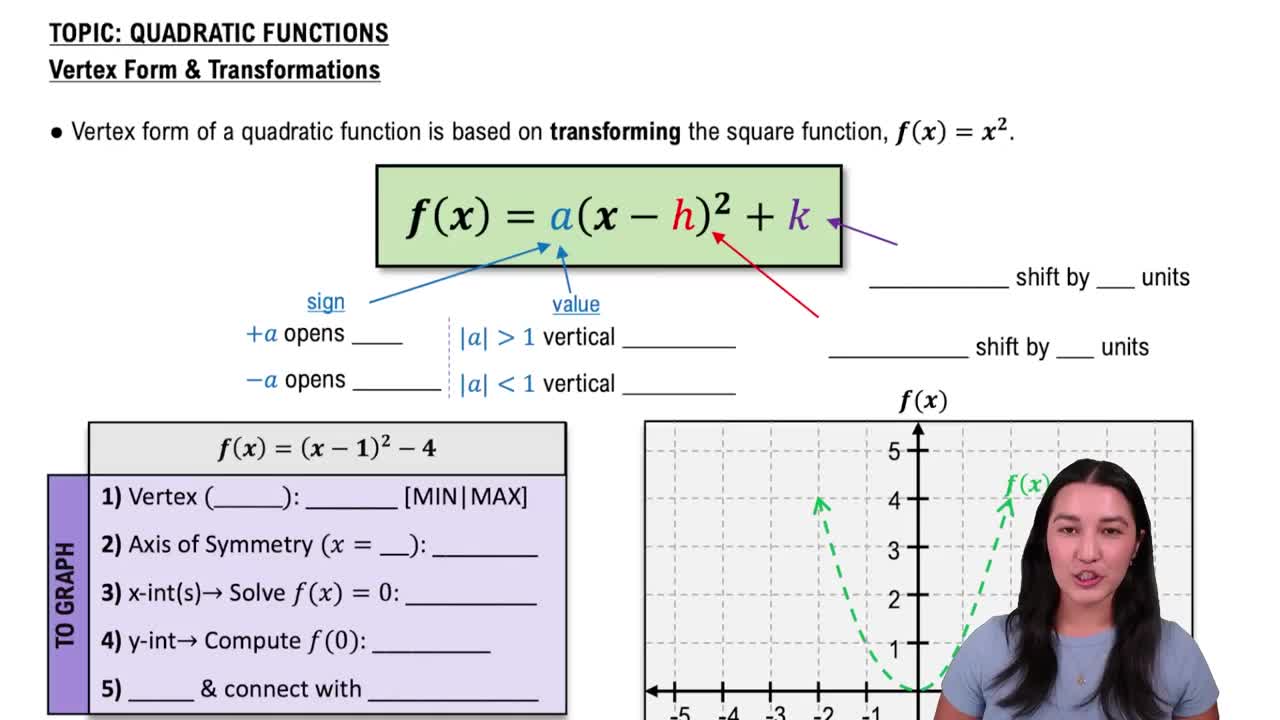
Vertex Form

Properties of Inequalities

Inequalities compare two expressions and can involve symbols like ≥, ≤, >, or <. Understanding how to manipulate inequalities, including adding, subtracting, multiplying, or dividing both sides by positive or negative numbers, is essential. Also, recognizing when an inequality is always true or false helps in solving problems efficiently.
Recommended video:
06:07
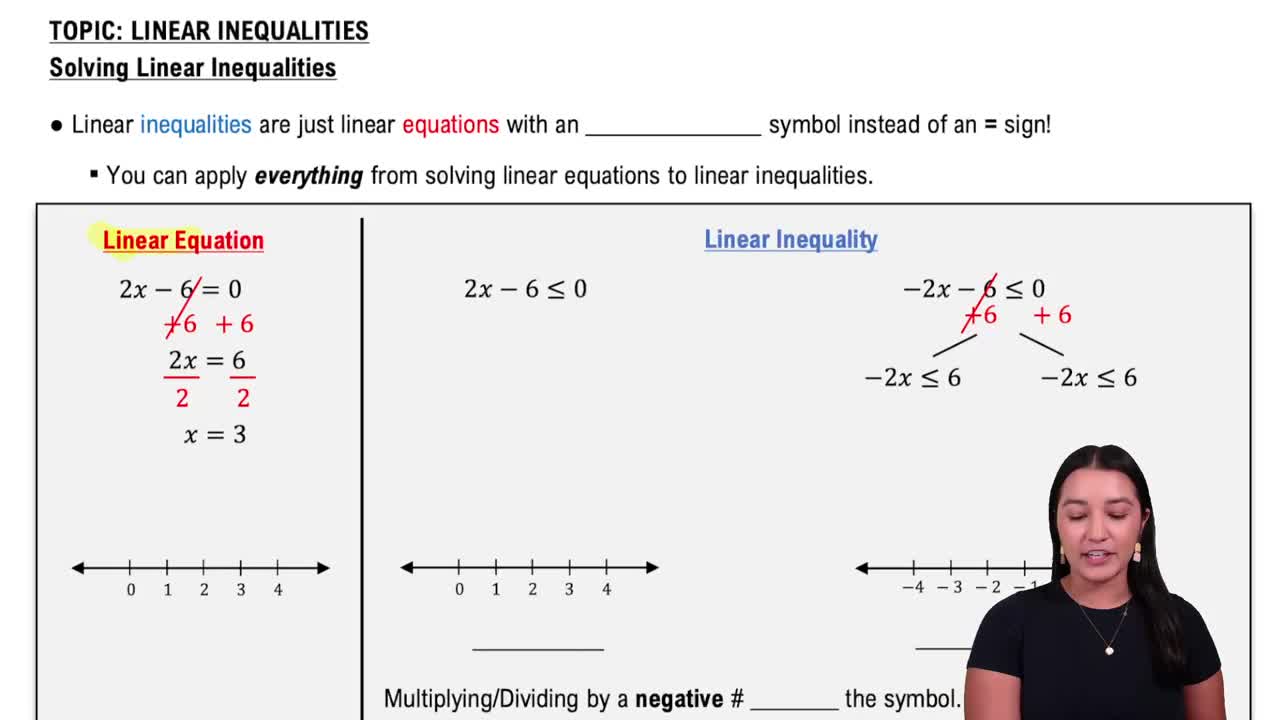
Linear Inequalities

Solving Absolute Value Inequalities

When solving inequalities involving absolute values, consider the nature of the inequality and the absolute value expression. For example, since absolute values are always non-negative, inequalities like |expression| ≥ negative numbers are always true. Breaking down the inequality into cases or using properties of absolute values aids in finding the solution set.
Recommended video:
06:07
Linear Inequalities