Solve each rational inequality. Give the solution set in interval notation. 3 /{4 - x} > 6 /{ 1 - x}
Ch. 3 - Polynomial and Rational Functions

Chapter 4, Problem 65
Graph each rational function. ƒ(x)=4/(x-1)
Verified step by step guidance1
Identify the rational function given: \(f(x) = \frac{4}{x - 1}\). Notice that the denominator \(x - 1\) cannot be zero, so \(x \neq 1\).
Determine the vertical asymptote by setting the denominator equal to zero: solve \(x - 1 = 0\), which gives \(x = 1\). This means the graph will have a vertical asymptote at \(x = 1\).
Find the horizontal asymptote by analyzing the behavior of \(f(x)\) as \(x\) approaches infinity or negative infinity. Since the degree of the numerator (0) is less than the degree of the denominator (1), the horizontal asymptote is \(y = 0\).
Calculate a few key points by substituting values of \(x\) into the function, such as \(x = 0\), \(x = 2\), and \(x = -1\), to understand the shape and position of the graph relative to the asymptotes.
Sketch the graph using the vertical asymptote at \(x = 1\), the horizontal asymptote at \(y = 0\), and the plotted points. Remember the graph will approach but never touch the asymptotes.

Verified video answer for a similar problem:
This video solution was recommended by our tutors as helpful for the problem above.
Video duration:
8mWas this helpful?
Key Concepts
Here are the essential concepts you must grasp in order to answer the question correctly.
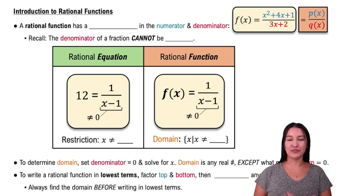
Rational Functions
A rational function is a ratio of two polynomials, expressed as f(x) = P(x)/Q(x). Understanding its domain, where the denominator Q(x) ≠ 0, is essential to avoid undefined points. Graphing involves analyzing asymptotes, intercepts, and behavior near discontinuities.
Recommended video:
Intro to Rational Functions
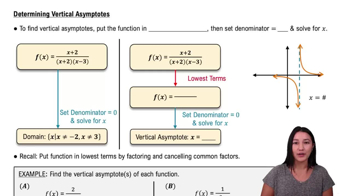
Vertical Asymptotes
Vertical asymptotes occur where the denominator of a rational function equals zero, causing the function to approach infinity or negative infinity. For f(x) = 4/(x-1), the vertical asymptote is at x = 1, indicating the graph will never cross this line but will approach it closely.
Recommended video:
Determining Vertical Asymptotes
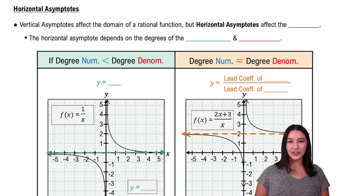
Horizontal Asymptotes
Horizontal asymptotes describe the end behavior of a rational function as x approaches infinity or negative infinity. For f(x) = 4/(x-1), since the degree of the numerator is less than the denominator, the horizontal asymptote is y = 0, meaning the graph approaches the x-axis at extreme values.
Recommended video:
Determining Horizontal Asymptotes
Related Practice
Textbook Question
413
views
Textbook Question
The remainder theorem indicates that when a polynomial ƒ(x) is divided by x-k, the remainder is equal to ƒ(k). Consider the polynomial function ƒ(x) = x3 - 2x2 - x+2. Use the remainder theorem to find each of the following. Then determine the coordinates of the corresponding point on the graph of ƒ(x). ƒ (-2)
506
views
Textbook Question
Solve each rational inequality. Give the solution set in interval notation. See Examples 4 and 5.
451
views
Textbook Question
Find a polynomial function f of least degree having the graph shown. (Hint: See the NOTE following Example 4.)
1159
views
Textbook Question
Graph each rational function. ƒ(x)=(6-3x)/(4-x)
553
views
Textbook Question
Solve each rational inequality. Give the solution set in interval notation. 2 /(x - 2) ≥ 1 / x
515
views