For each polynomial function, find all zeros and their multiplicities.
Ch. 3 - Polynomial and Rational Functions

Chapter 4, Problem 51
Work each problem. Which function has a graph that does not have a vertical asymptote?
A. ƒ(x)=1/(x2+2)
B. ƒ(x)=1/(x2-2)
C. ƒ(x)=3/x2
D. ƒ(x)=(2x+1)/(x-8)
Verified step by step guidance1
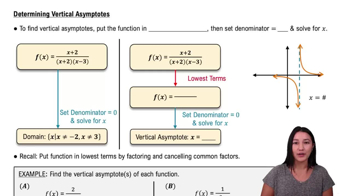
Recall that vertical asymptotes occur where the denominator of a rational function is equal to zero, causing the function to be undefined at those points.
For each function, identify the denominator and set it equal to zero to find potential vertical asymptotes.
For option A: The denominator is \(x^2 + 2\). Set \(x^2 + 2 = 0\) and solve for \(x\).
For option B: The denominator is \(x^2 - 2\). Set \(x^2 - 2 = 0\) and solve for \(x\).
For option C: The denominator is \(x^2\). Set \(x^2 = 0\) and solve for \(x\). For option D: The denominator is \(x - 8\). Set \(x - 8 = 0\) and solve for \(x\). Then determine which function's denominator has no real solutions, indicating no vertical asymptotes.

Verified video answer for a similar problem:
This video solution was recommended by our tutors as helpful for the problem above.
Video duration:
4mWas this helpful?
Key Concepts
Here are the essential concepts you must grasp in order to answer the question correctly.
Vertical Asymptotes
Vertical asymptotes occur in the graph of a function where the function approaches infinity or negative infinity as the input approaches a specific value, typically where the denominator of a rational function is zero and the numerator is nonzero.
Recommended video:
Determining Vertical Asymptotes
Domain of Rational Functions
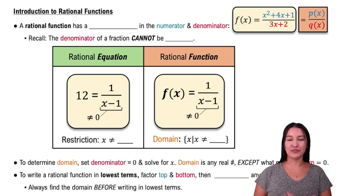
The domain of a rational function includes all real numbers except where the denominator equals zero, since division by zero is undefined. Identifying these values helps determine where vertical asymptotes may exist.
Recommended video:
Intro to Rational Functions
Analyzing Quadratic Expressions in Denominators
Quadratic expressions in denominators can be factored or analyzed using the discriminant to find real roots. If the quadratic has no real roots, the denominator never equals zero, meaning no vertical asymptotes occur.
Recommended video:
Guided course
Rationalizing Denominators
Related Practice
Textbook Question
399
views
Textbook Question
Use synthetic division to determine whether the given number k is a zero of the polynomial function. If it is not, give the value of ƒ(k). ƒ(x) = 2x3 - 6x2 -9x + 4; k=1
389
views
Textbook Question
Work each problem. Choices A–D below show the four ways in which the graph of a rational function can approach the vertical line x=2 as an asymptote. Identify the graph of each rational function defined in parts (a) – (d).
225
views
Textbook Question
Connecting Graphs with Equations Find a quadratic function f having the graph shown. (Hint: See the Note following Example 3.)
1311
views
Textbook Question
For each polynomial function, find all zeros and their multiplicities.
660
views
Textbook Question
Use the intermediate value theorem to show that each polynomial function has a real zero between the numbers given. ƒ(x)=2x4-4x2+4x-8; 1 and 2
1058
views