Join thousands of students who trust us to help them ace their exams!
Multiple Choice
Solve the inequality. Express the solution set in interval notation and graph. 31(x+1)≥51(3+2x)
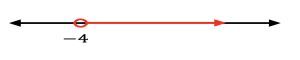
A
(−4,∞)
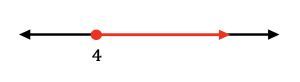
B
[4,∞)
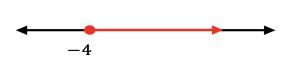
C
[−4,∞)
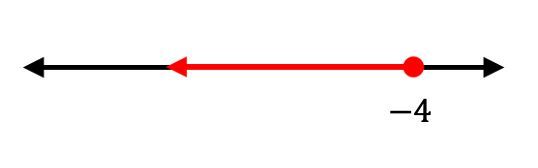
D
(−∞,−4]
0 Comments
Verified step by step guidance
1
Start by distributing the constants in the inequality: \(13(x+1) \geq 15(3+2x)\). This becomes \(13x + 13 \geq 45 + 30x\).
Next, move all terms involving \(x\) to one side of the inequality. Subtract \(13x\) from both sides to get \(13 \geq 45 + 17x\).
Subtract 45 from both sides to isolate the term with \(x\): \(13 - 45 \geq 17x\), which simplifies to \(-32 \geq 17x\).
Divide both sides by 17 to solve for \(x\): \(-\frac{32}{17} \geq x\). This can be rewritten as \(x \leq -\frac{32}{17}\).
Express the solution in interval notation. Since \(x\) is less than or equal to \(-\frac{32}{17}\), the interval is \((-\infty, -\frac{32}{17}]\). The graph of this solution is a line extending to the left from \(-\frac{32}{17}\) with a closed circle at \(-\frac{32}{17}\), indicating that \(-\frac{32}{17}\) is included in the solution set.




 Verified step by step guidance

