Join thousands of students who trust us to help them ace their exams!
Multiple Choice
Solve the inequality. Express the solution set in interval notation and graph. 2x+12>19
A
(−∞,27)
B
(−∞,27]
C
[27,∞)
D
(27,∞)
4 Comments
Verified step by step guidance
1
Start by isolating the variable on one side of the inequality. Given the inequality \(2x + 12 > 19\), subtract 12 from both sides to get \(2x > 7\).
Next, divide both sides of the inequality by 2 to solve for \(x\). This gives \(x > \frac{7}{2}\).
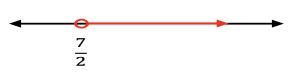
Express the solution set in interval notation. Since \(x\) is greater than \(\frac{7}{2}\), the interval notation is \((\frac{7}{2}, \infty)\).
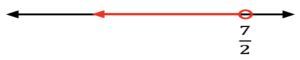
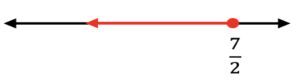
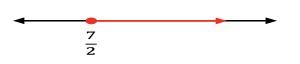
To graph the solution, draw a number line. Mark \(\frac{7}{2}\) on the number line and use an open circle to indicate that \(\frac{7}{2}\) is not included in the solution set.
Shade the region to the right of \(\frac{7}{2}\) to represent all values greater than \(\frac{7}{2}\). This visualizes the solution \((\frac{7}{2}, \infty)\).




 Verified step by step guidance

