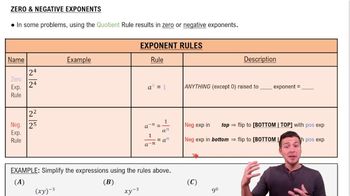
Rewrite the expression using the property of exponents for negative powers: a^(-n) = 1/(a^n). This gives 27^(-4/3) = 1/(27^(4/3)).
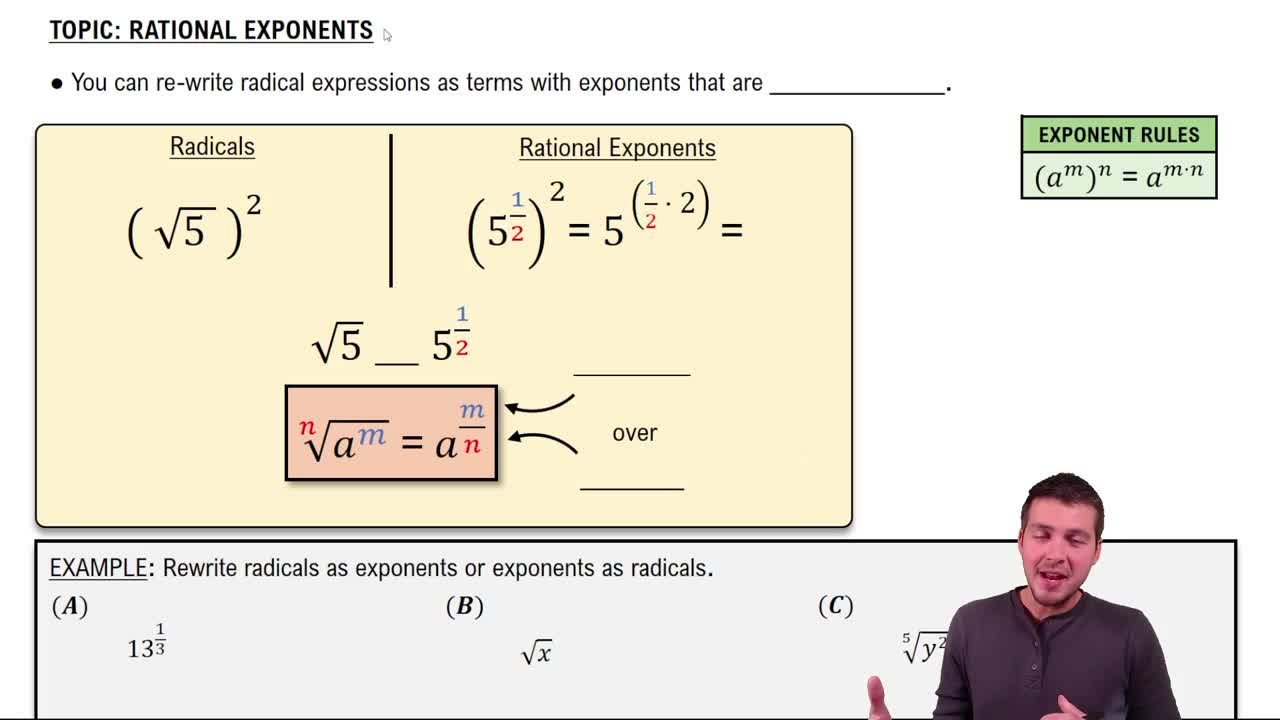
Recognize that the fractional exponent 4/3 can be broken into two parts: the denominator (3) represents a cube root, and the numerator (4) represents raising to the fourth power. So, 27^(4/3) = (27^(1/3))^4.
Find the cube root of 27. Since 27 = 3^3, the cube root of 27 is 3. Therefore, 27^(1/3) = 3.
Raise the result from the previous step to the fourth power. This means (27^(1/3))^4 = 3^4.
Substitute the result back into the original expression: 1/(27^(4/3)) = 1/(3^4). Simplify further if needed.
Verified video answer for a similar problem:
This video solution was recommended by our tutors as helpful for the problem above
Video duration:
57s
Play a video:
0 Comments
Key Concepts
Here are the essential concepts you must grasp in order to answer the question correctly.
Exponents and Rational Exponents
Exponents represent repeated multiplication of a base number. Rational exponents, such as -4/3, indicate both a root and a power. The numerator indicates the power, while the denominator indicates the root. For example, 27^(-4/3) can be interpreted as 1/(27^(4/3)), which involves taking the cube root of 27 and then raising it to the fourth power.
Negative exponents indicate the reciprocal of the base raised to the corresponding positive exponent. For instance, a^(-n) is equivalent to 1/(a^n). In the expression 27^(-4/3), the negative exponent means we will first evaluate 27^(4/3) and then take the reciprocal of that result, which is essential for simplifying the expression correctly.
Evaluating roots involves finding a number that, when raised to a specific power, yields the original number. In the case of 27^(1/3), we are looking for a number that, when cubed, equals 27. This number is 3, as 3^3 = 27. Understanding how to evaluate roots is crucial for simplifying expressions with rational exponents.