Ch. 1 - Equations and Inequalities
Lial - College Algebra 13th Edition
Lial13th EditionCollege AlgebraISBN: 9780136881063Not the one you use?Change textbook
Chapter 2, Problem 45

Solve each equation. x - √(2x+3) = 0

Verified step by step guidance
1
Start with the given equation: \(x - \sqrt{2x + 3} = 0\).
Isolate the square root term by adding \(\sqrt{2x + 3}\) to both sides: \(x = \sqrt{2x + 3}\).
To eliminate the square root, square both sides of the equation: \(x^2 = (\sqrt{2x + 3})^2\) which simplifies to \(x^2 = 2x + 3\).
Rewrite the equation in standard quadratic form by subtracting \$2x + 3\( from both sides: \)x^2 - 2x - 3 = 0$.
Solve the quadratic equation \(x^2 - 2x - 3 = 0\) using factoring, completing the square, or the quadratic formula to find the possible values of \(x\).

Verified video answer for a similar problem:

This video solution was recommended by our tutors as helpful for the problem above.
Video duration:
7m
Was this helpful?

Key Concepts

Here are the essential concepts you must grasp in order to answer the question correctly.

Isolating the Variable

Isolating the variable means rearranging the equation to have the variable on one side alone. This step simplifies solving by making it easier to apply operations like squaring or factoring. For example, rewriting x - √(2x+3) = 0 as x = √(2x+3) helps in the next steps.
Recommended video:
Guided course
05:28
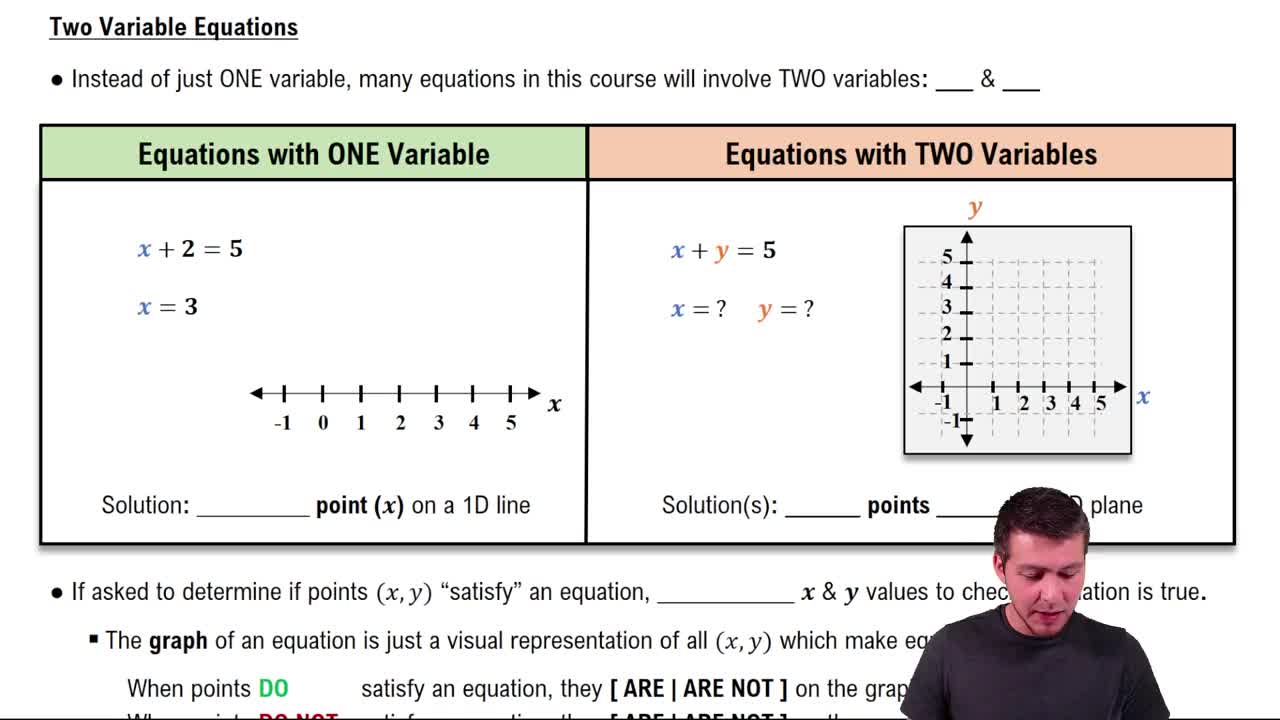
Equations with Two Variables

Solving Equations Involving Square Roots

Equations with square roots often require squaring both sides to eliminate the radical. This process can introduce extraneous solutions, so it's important to check all solutions in the original equation. For instance, squaring x = √(2x+3) leads to x² = 2x + 3.
Recommended video:
06:12
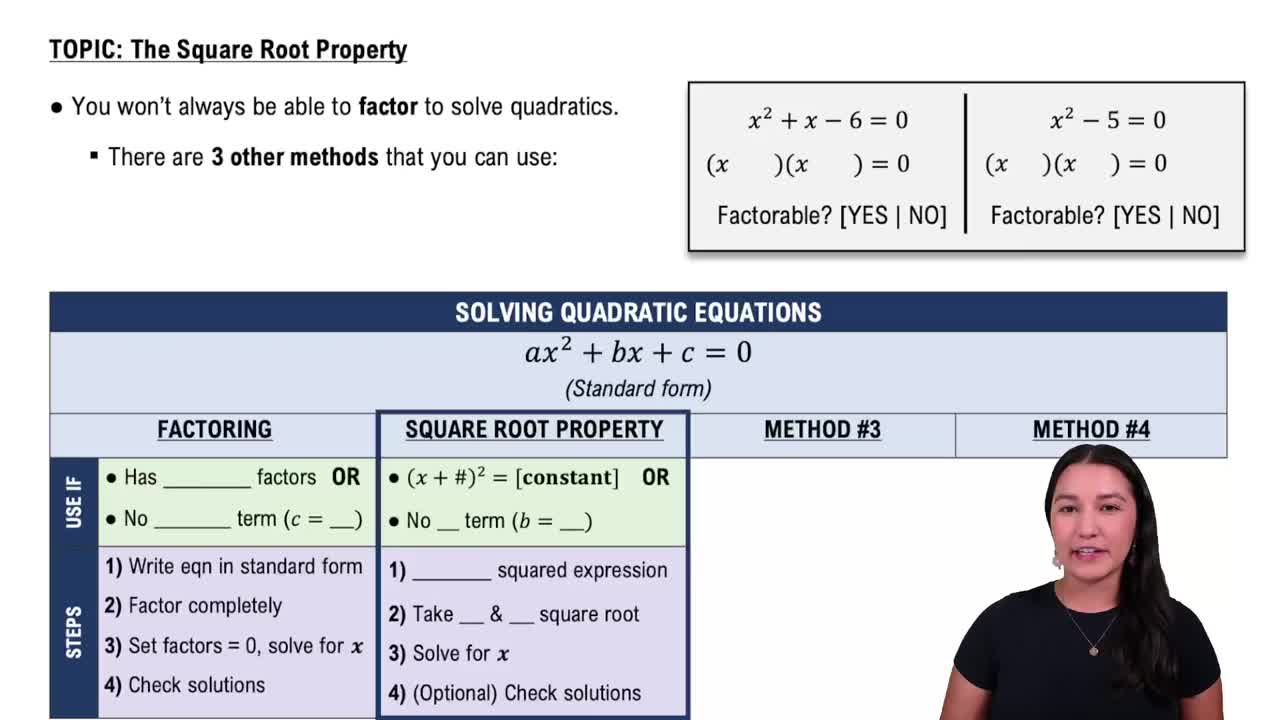
Solving Quadratic Equations by the Square Root Property

Checking for Extraneous Solutions

After solving, substitute solutions back into the original equation to verify their validity. Squaring both sides can create solutions that don't satisfy the original equation, called extraneous solutions. This step ensures only true solutions are accepted.
Recommended video:
05:21
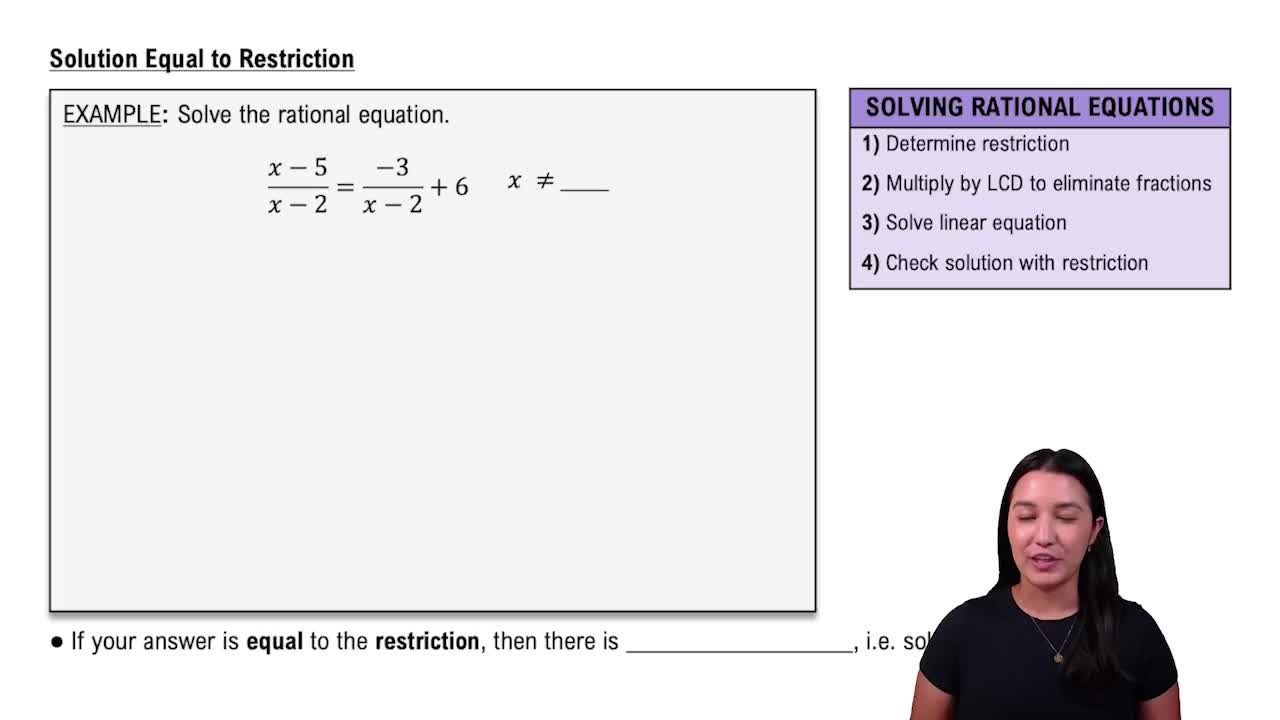
Restrictions on Rational Equations