Ch. 3 - Polynomial and Rational Functions
Lial - College Algebra 13th Edition
Lial13th EditionCollege AlgebraISBN: 9780136881063Not the one you use?Change textbook
Chapter 4, Problem 45

Graph each polynomial function. Factor first if the polynomial is not in factored form. ƒ(x)=3x4-7x3-6x2+12x+8

Verified step by step guidance
1
Start by writing down the polynomial function: \(f(x) = 3x^4 - 7x^3 - 6x^2 + 12x + 8\).
Attempt to factor the polynomial. Since it is a quartic (degree 4), try factoring by grouping or use the Rational Root Theorem to find possible roots.
Use the Rational Root Theorem to list possible rational roots: factors of the constant term (8) over factors of the leading coefficient (3), which gives possible roots \(\pm1, \pm2, \pm4, \pm8, \pm\frac{1}{3}, \pm\frac{2}{3}, \pm\frac{4}{3}, \pm\frac{8}{3}\).
Test these possible roots by substituting them into \(f(x)\) or by using synthetic division to find which values make the polynomial equal to zero, thus identifying factors.
Once a root is found, factor out the corresponding binomial (e.g., \((x - r)\)) and continue factoring the resulting polynomial until it is fully factored or cannot be factored further; then use the factored form to analyze and graph the function.

Verified video answer for a similar problem:

This video solution was recommended by our tutors as helpful for the problem above.
Video duration:
11m
Was this helpful?

Key Concepts

Here are the essential concepts you must grasp in order to answer the question correctly.

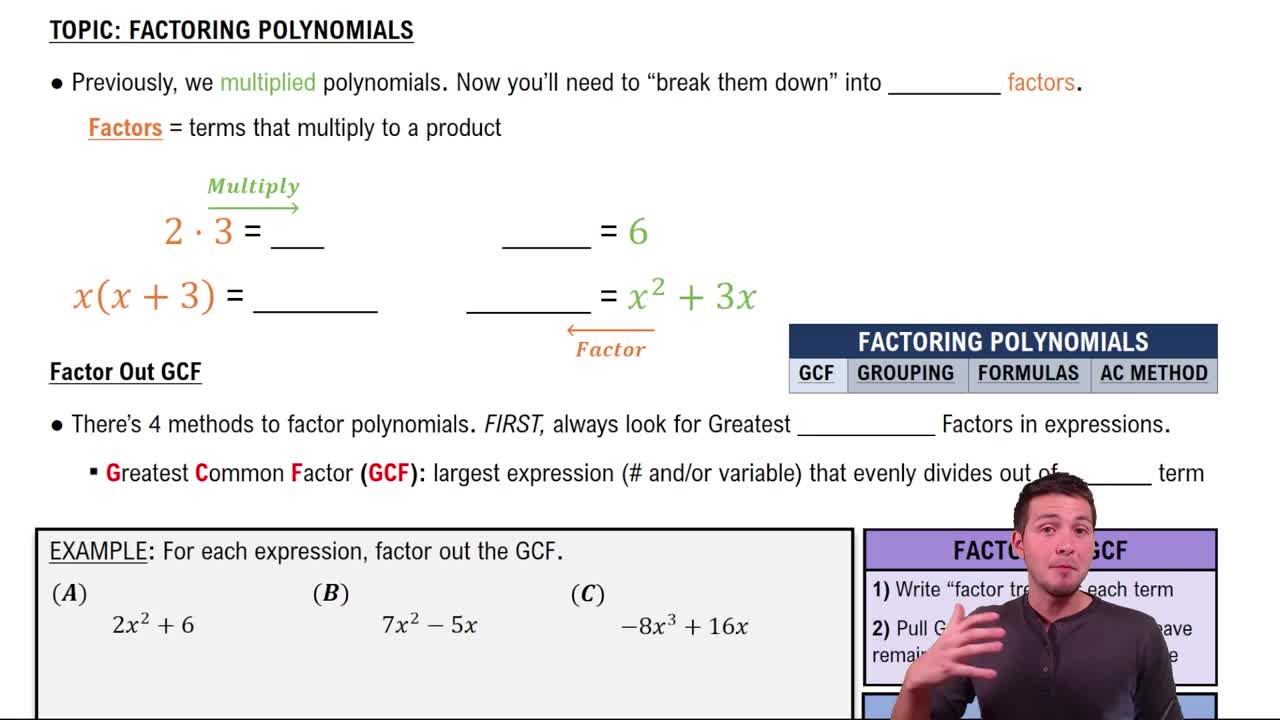
Polynomial Factoring

Factoring a polynomial involves rewriting it as a product of simpler polynomials, which helps identify its roots and simplifies graphing. Techniques include factoring out the greatest common factor, grouping, or using special formulas like difference of squares or sum/difference of cubes.
Recommended video:
Guided course
07:30
Introduction to Factoring Polynomials

Finding Roots of a Polynomial

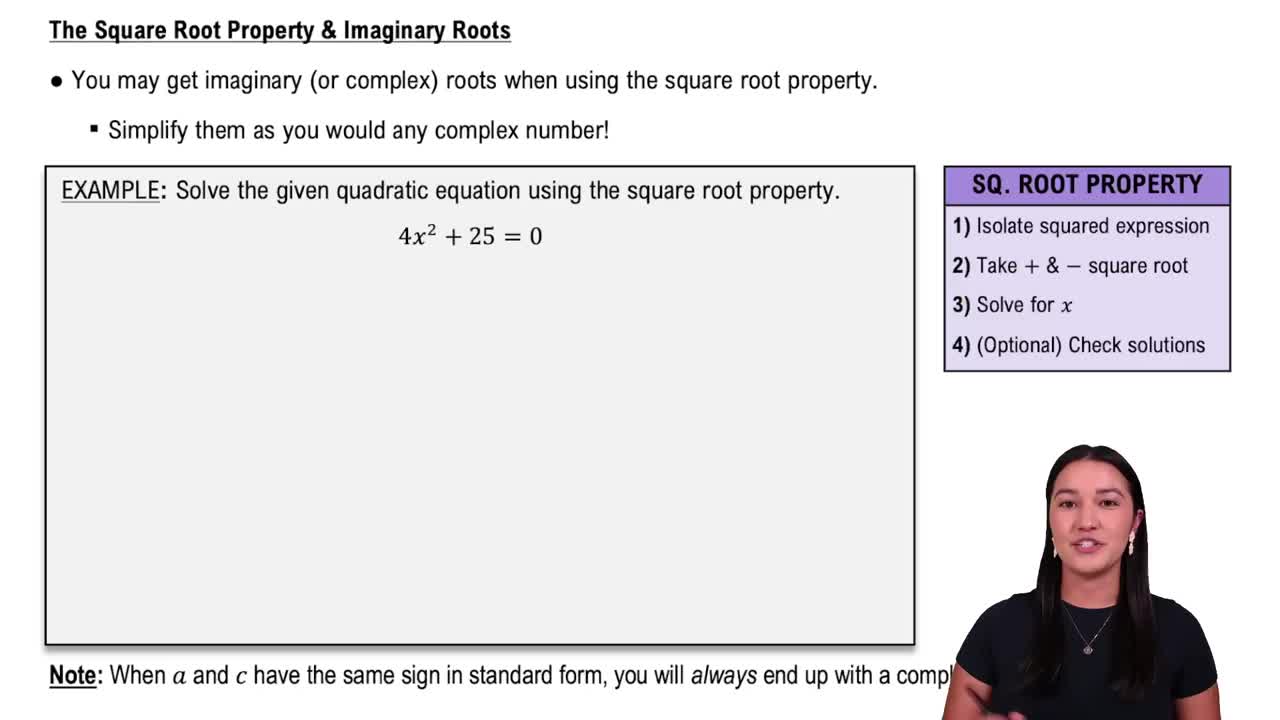
Roots (or zeros) are the values of x where the polynomial equals zero. After factoring, setting each factor equal to zero gives the roots, which correspond to x-intercepts on the graph. Knowing roots helps in sketching the polynomial's graph accurately.
Recommended video:
02:20
Imaginary Roots with the Square Root Property

Graphing Polynomial Functions

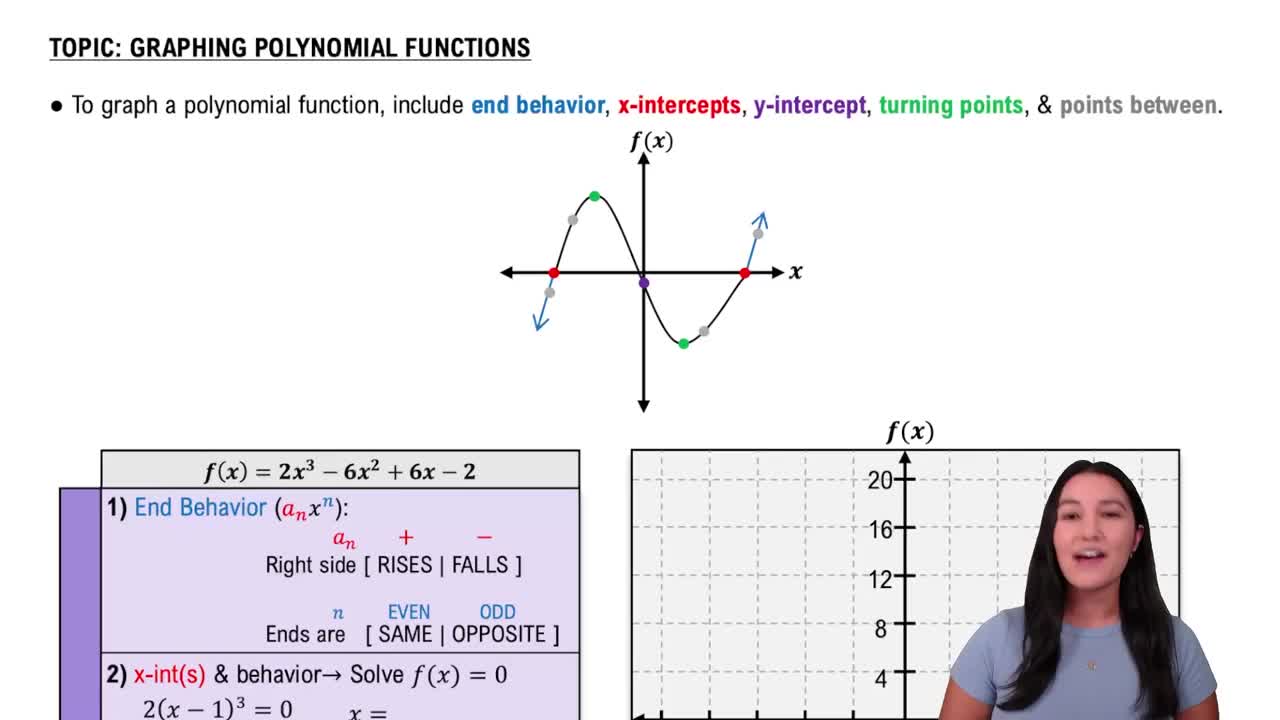
Graphing involves plotting key points such as roots, y-intercept, and analyzing end behavior based on the leading term. The degree and leading coefficient determine the shape and direction of the graph, while multiplicity of roots affects how the graph touches or crosses the x-axis.
Recommended video:
05:25
Graphing Polynomial Functions