Ch. R - Review of Basic Concepts
Lial - College Algebra 13th Edition
Lial13th EditionCollege AlgebraISBN: 9780136881063Not the one you use?Change textbook
Chapter 1, Problem 45

Determine whether each statement is true or false. {2, 5, 8, 9} = {2, 5, 9, 8}

Verified step by step guidance
1
Understand that the problem is asking whether the two sets \(\{2, 5, 8, 9\}\) and \(\{2, 5, 9, 8\}\) are equal.
Recall the definition of set equality: Two sets are equal if and only if they contain exactly the same elements, regardless of the order.
List the elements of the first set: \$2, 5, 8, 9$.
List the elements of the second set: \$2, 5, 9, 8$.
Compare the elements of both sets to confirm that they contain the same elements, just in a different order, which means the sets are equal.

Verified video answer for a similar problem:

This video solution was recommended by our tutors as helpful for the problem above.
Video duration:
1m
Was this helpful?

Key Concepts

Here are the essential concepts you must grasp in order to answer the question correctly.

Set Equality

Two sets are equal if and only if they contain exactly the same elements, regardless of the order or repetition. This means that every element of the first set must be in the second set, and vice versa.
Recommended video:
05:18
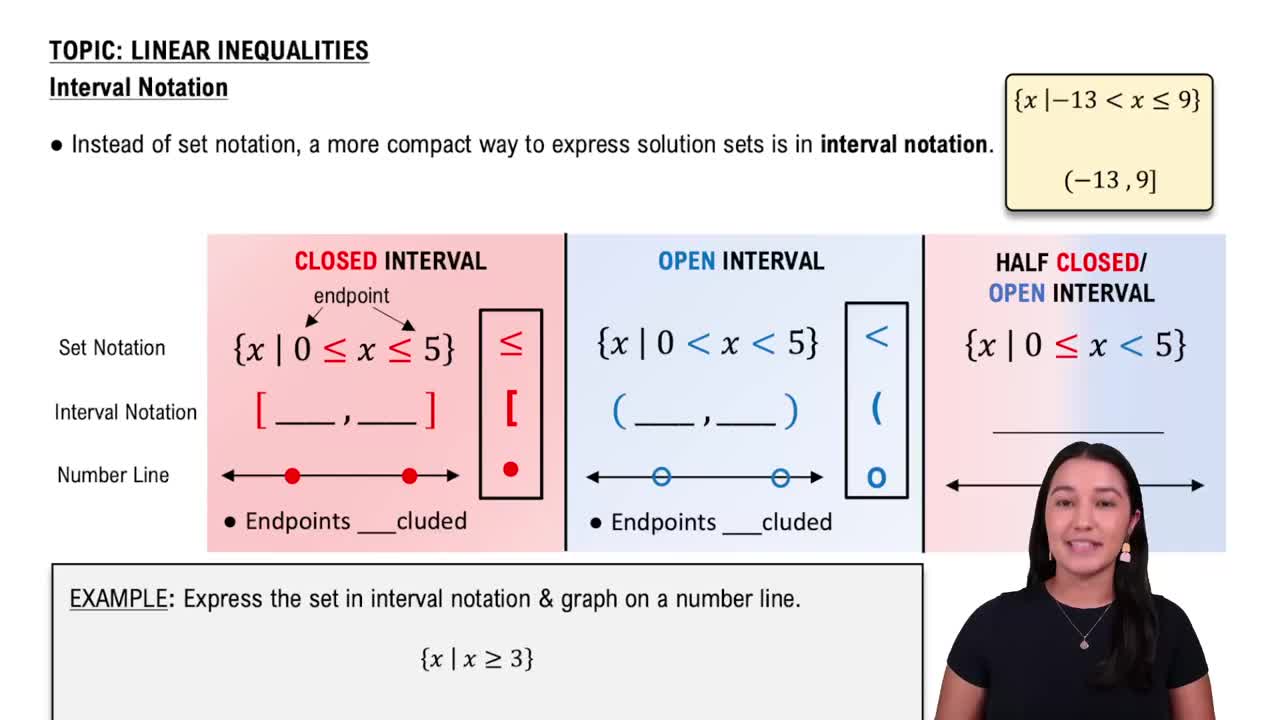
Interval Notation

Order Irrelevance in Sets

In set theory, the order of elements does not matter. For example, {2, 5, 8} is the same set as {5, 8, 2} because they contain the same elements, just arranged differently.
Recommended video:
5:02
Solving Logarithmic Equations

Element Membership

Element membership refers to whether a particular item is contained within a set. To verify set equality, you check that each element of one set is a member of the other set.
Recommended video:
02:44
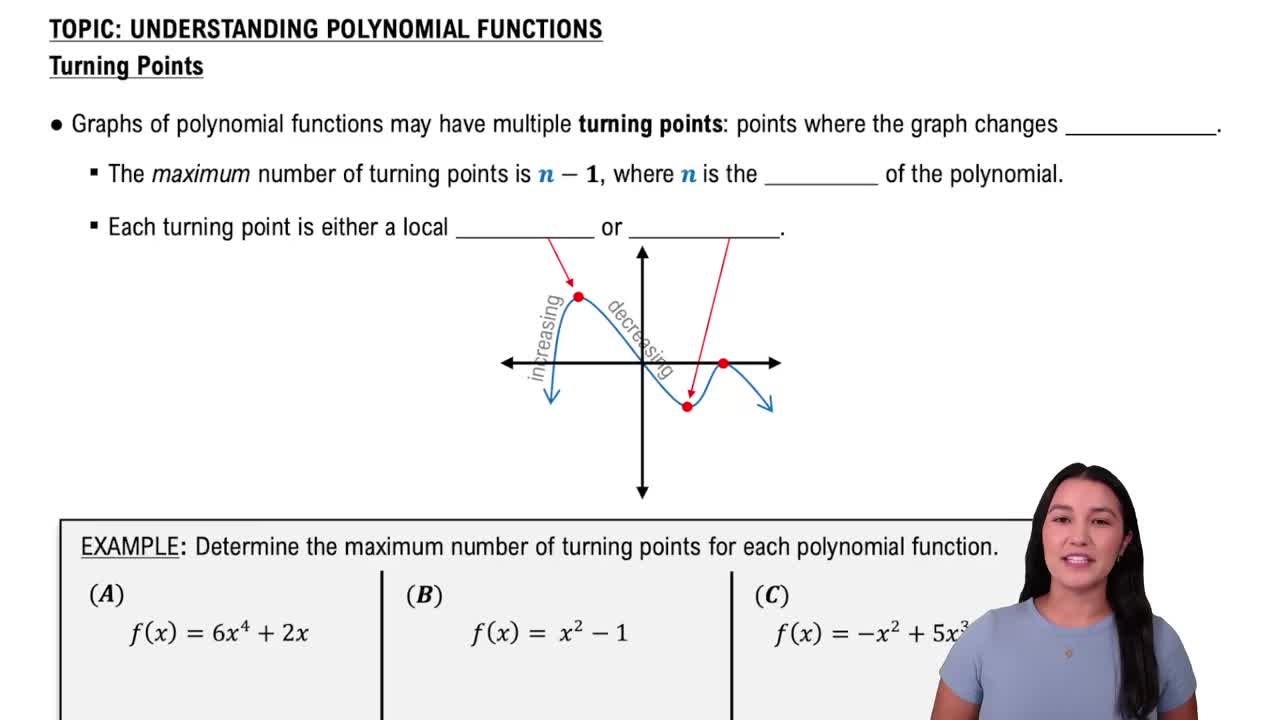
Maximum Turning Points of a Polynomial Function