
Textbook Question
Show that the real zeros of each polynomial function satisfy the given conditions. ƒ(x)=x5-3x3+x+2; no real zero greater than 2
513
views

 Verified step by step guidance
 6:04
6:04
 3:12
3:12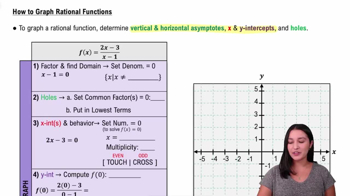 8:19
8:19Show that the real zeros of each polynomial function satisfy the given conditions. ƒ(x)=x5-3x3+x+2; no real zero greater than 2
Show that the real zeros of each polynomial function satisfy the given conditions. See Example 6.
; no real zero less than -2
Use synthetic division to determine whether the given number k is a zero of the polynomial function. If it is not, give the value of ƒ(k). ƒ(x) = 4x4 + x2 + 17x + 3; k= -3/2
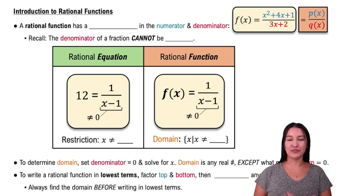
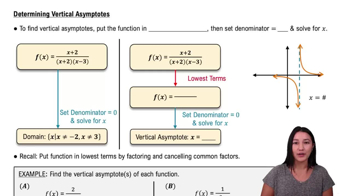
Graph each rational function. ƒ(x)=(x+1)/(x-4)
Use synthetic division to determine whether the given number k is a zero of the polynomial function. If it is not, give the value of ƒ(k). ƒ(x) = x3 + 3x2 -x + 1; k = 1+i
Solve each rational inequality. Give the solution set in interval notation. 1 /(x+ 2) > 1 /(x -3)