Ch. 4 - Inverse, Exponential, and Logarithmic Functions
Lial - College Algebra 13th Edition
Lial13th EditionCollege AlgebraISBN: 9780136881063Not the one you use?Change textbook
Chapter 5, Problem 101

Use properties of logarithms to rewrite each function, then graph. ƒ(x) = log2 [4 (x-3) ]

Verified step by step guidance
1
Identify the logarithmic function given: \(f(x) = \log_{2} \left[ 4 (x-3) \right]\).
Use the product property of logarithms, which states \(\log_{a}(MN) = \log_{a} M + \log_{a} N\), to rewrite the function as \(f(x) = \log_{2} 4 + \log_{2} (x-3)\).
Recognize that \(\log_{2} 4\) is a constant since 4 is a power of 2. You can express it as \(\log_{2} 2^{2}\), which simplifies to \(2\) using the power property of logarithms: \(\log_{a} a^{k} = k\).
Rewrite the function as \(f(x) = 2 + \log_{2} (x-3)\), which is a vertical shift of the basic logarithmic function \(\log_{2} (x)\) by 3 units to the right and 2 units up.
To graph, start with the parent function \(y = \log_{2} x\), shift it right by 3 units to account for \((x-3)\), then shift the entire graph up by 2 units. Also, note the domain restriction \(x > 3\) because the argument of the logarithm must be positive.

Verified video answer for a similar problem:

This video solution was recommended by our tutors as helpful for the problem above.
Video duration:
4m
Was this helpful?

Key Concepts

Here are the essential concepts you must grasp in order to answer the question correctly.

Properties of Logarithms

Properties of logarithms include rules such as the product, quotient, and power rules, which allow the simplification and rewriting of logarithmic expressions. For example, the product rule states that log_b(MN) = log_b(M) + log_b(N), which helps break down complex arguments into simpler parts for easier manipulation and graphing.
Recommended video:
5:36
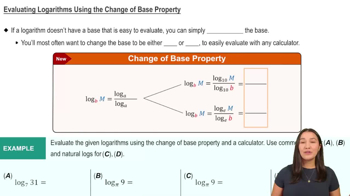
Change of Base Property

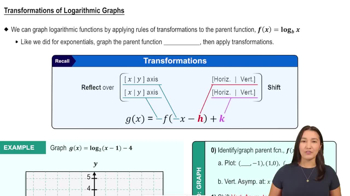
Logarithmic Function Transformation

Understanding how changes inside the logarithm's argument affect the graph is crucial. Horizontal shifts occur when the input variable is adjusted (e.g., x - 3 shifts the graph right by 3 units), and vertical shifts or stretches happen when the logarithm is multiplied or added to constants. Recognizing these transformations helps in sketching the graph accurately.
Recommended video:
4:37
Transformations of Logarithmic Graphs

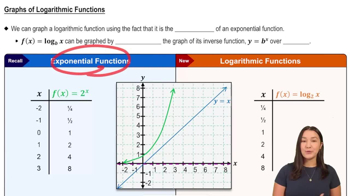
Graphing Logarithmic Functions

Graphing logarithmic functions involves identifying key features such as the domain, vertical asymptote, intercepts, and general shape. The domain is restricted to values making the argument positive, and the vertical asymptote occurs where the argument equals zero. Plotting points after rewriting the function using logarithm properties aids in creating an accurate graph.
Recommended video:
5:26
Graphs of Logarithmic Functions