Ch. 2 - Graphs and Functions
Lial - College Algebra 13th Edition
Lial13th EditionCollege AlgebraISBN: 9780136881063Not the one you use?Change textbook
Chapter 3, Problem 45

Without graphing, determine whether each equation has a graph that is symmetric with respect to the x-axis, the y-axis, the origin, or none of these. See Examples 3 and 4. y=x2+5

Verified step by step guidance
1
Recall the tests for symmetry of a graph: - Symmetry about the y-axis: Replace \(x\) with \(-x\) and check if the equation remains unchanged. - Symmetry about the x-axis: Replace \(y\) with \(-y\) and check if the equation remains unchanged. - Symmetry about the origin: Replace \(x\) with \(-x\) and \(y\) with \(-y\) and check if the equation remains unchanged.
Start with the given equation: \(y = x^2 + 5\).
Test for y-axis symmetry by replacing \(x\) with \(-x\): \(y = (-x)^2 + 5 = x^2 + 5\). Since the equation remains the same, the graph is symmetric about the y-axis.
Test for x-axis symmetry by replacing \(y\) with \(-y\): \(-y = x^2 + 5\). This is not equivalent to the original equation, so the graph is not symmetric about the x-axis.
Test for origin symmetry by replacing \(x\) with \(-x\) and \(y\) with \(-y\): \(-y = (-x)^2 + 5 = x^2 + 5\). This is not equivalent to the original equation, so the graph is not symmetric about the origin.

Verified video answer for a similar problem:

This video solution was recommended by our tutors as helpful for the problem above.
Video duration:
1m
Was this helpful?

Key Concepts

Here are the essential concepts you must grasp in order to answer the question correctly.

Symmetry with Respect to the x-axis

A graph is symmetric about the x-axis if replacing y with -y in the equation yields an equivalent equation. This means for every point (x, y), the point (x, -y) is also on the graph. Testing this helps determine if the graph reflects over the x-axis.
Recommended video:
07:42
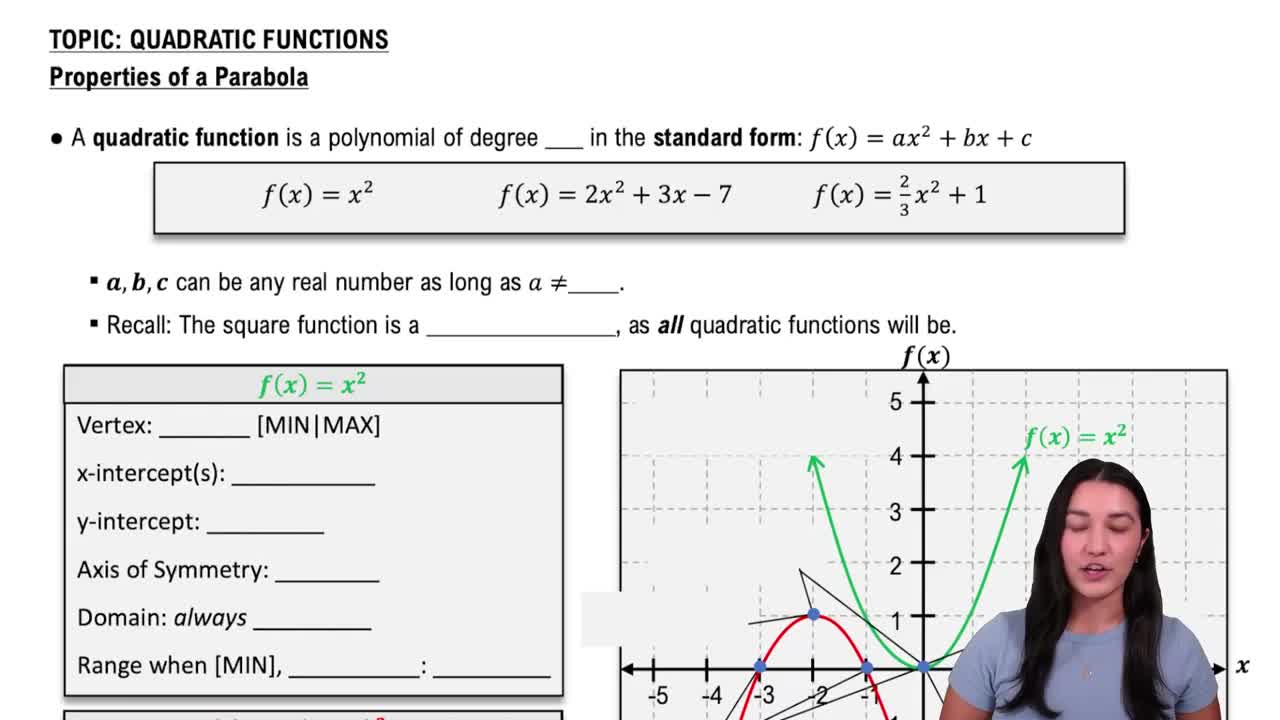
Properties of Parabolas

Symmetry with Respect to the y-axis

A graph is symmetric about the y-axis if replacing x with -x in the equation results in the same equation. This implies that for every point (x, y), the point (-x, y) is also on the graph. This test checks if the graph mirrors across the y-axis.
Recommended video:
07:42
Properties of Parabolas

Symmetry with Respect to the Origin

A graph is symmetric about the origin if replacing both x with -x and y with -y produces an equivalent equation. This means for every point (x, y), the point (-x, -y) is also on the graph. This test identifies rotational symmetry of 180 degrees around the origin.
Recommended video:
5:59
Graph Hyperbolas NOT at the Origin