Ch. 1 - Equations and Inequalities
Lial - College Algebra 13th Edition
Lial13th EditionCollege AlgebraISBN: 9780136881063Not the one you use?Change textbook
Chapter 2, Problem 35

Solve each inequality. Give the solution set in interval notation. -4≤(x+1)/2≤5

Verified step by step guidance
1
Start by understanding that the compound inequality \(-4 \leq \frac{x+1}{2} \leq 5\) means that \(\frac{x+1}{2}\) is between \(-4\) and \(5\), inclusive.
To isolate \(x\), first eliminate the denominator by multiplying all parts of the inequality by 2: \(2 \times (-4) \leq 2 \times \frac{x+1}{2} \leq 2 \times 5\), which simplifies to \(-8 \leq x+1 \leq 10\).
Next, subtract 1 from all parts of the inequality to isolate \(x\): \(-8 - 1 \leq x + 1 - 1 \leq 10 - 1\), which simplifies to \(-9 \leq x \leq 9\).
Interpret the solution: \(x\) is greater than or equal to \(-9\) and less than or equal to \(9\).
Express the solution set in interval notation as \([-9, 9]\).

Verified video answer for a similar problem:

This video solution was recommended by our tutors as helpful for the problem above.
Video duration:
2m
Was this helpful?

Key Concepts

Here are the essential concepts you must grasp in order to answer the question correctly.

Compound Inequalities

Compound inequalities involve two inequalities combined into one statement, often using 'and' or 'or'. In this problem, the inequality -4 ≤ (x+1)/2 ≤ 5 means both conditions must be true simultaneously, so the solution set includes values of x that satisfy both inequalities at once.
Recommended video:
06:07
Linear Inequalities

Solving Linear Inequalities

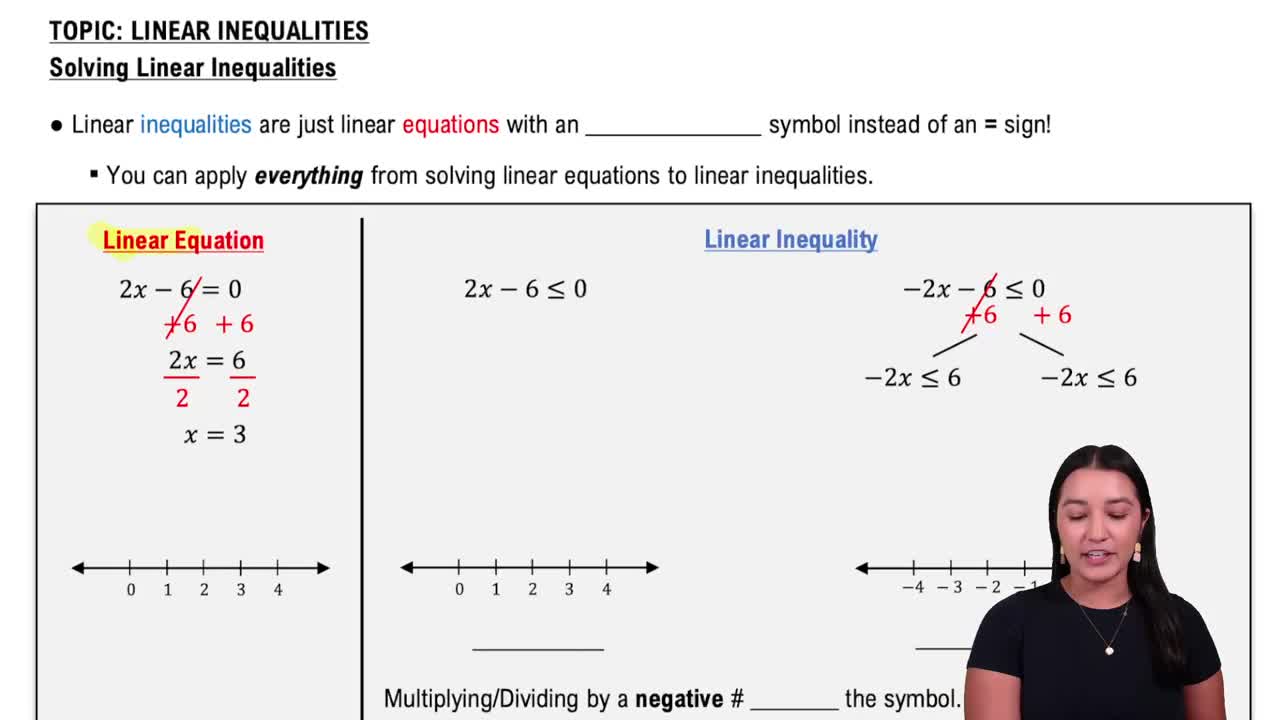
Solving linear inequalities requires isolating the variable by performing inverse operations, similar to solving equations, but with attention to inequality direction. Multiplying or dividing by a positive number keeps the inequality direction the same, while doing so by a negative number reverses it.
Recommended video:
06:07
Linear Inequalities

Interval Notation

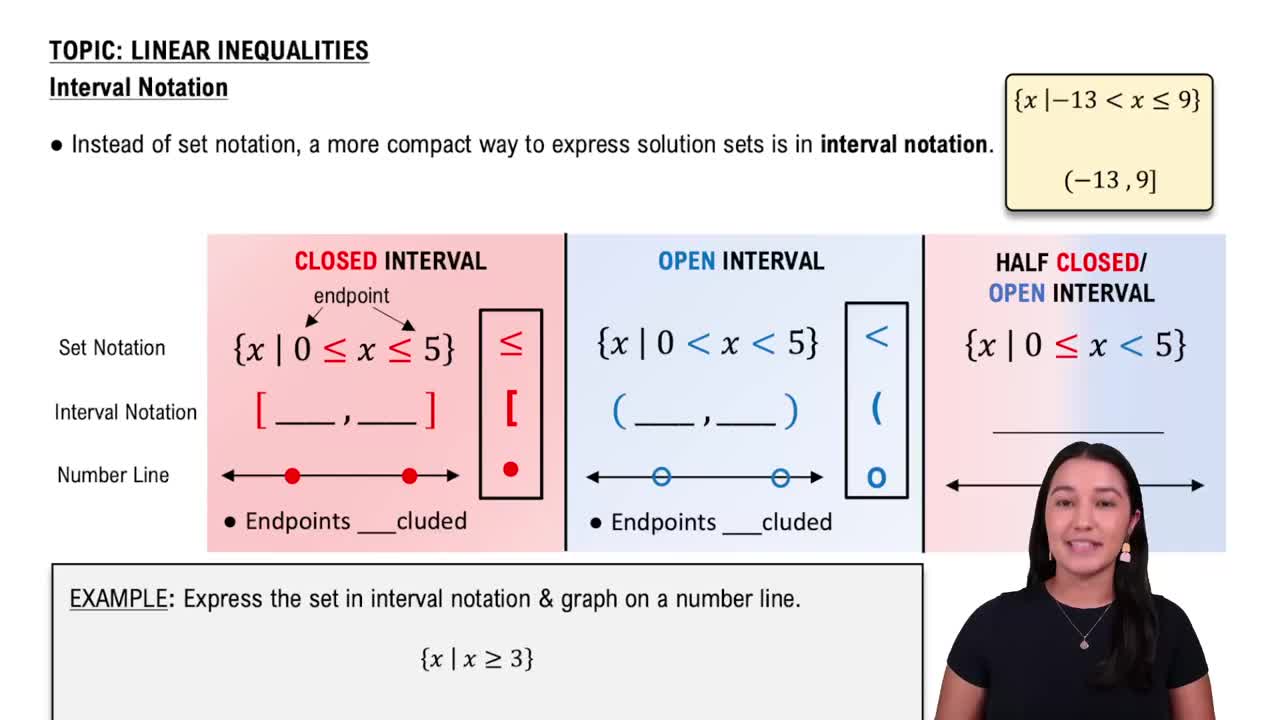
Interval notation is a concise way to represent solution sets of inequalities using parentheses and brackets. Brackets [ ] indicate inclusion of endpoints, while parentheses ( ) indicate exclusion. For example, [a, b] means all values from a to b, including a and b.
Recommended video:
05:18
Interval Notation