Identify the given equation: \(\frac{x}{x-4} = \frac{4}{x-4} + 4\).
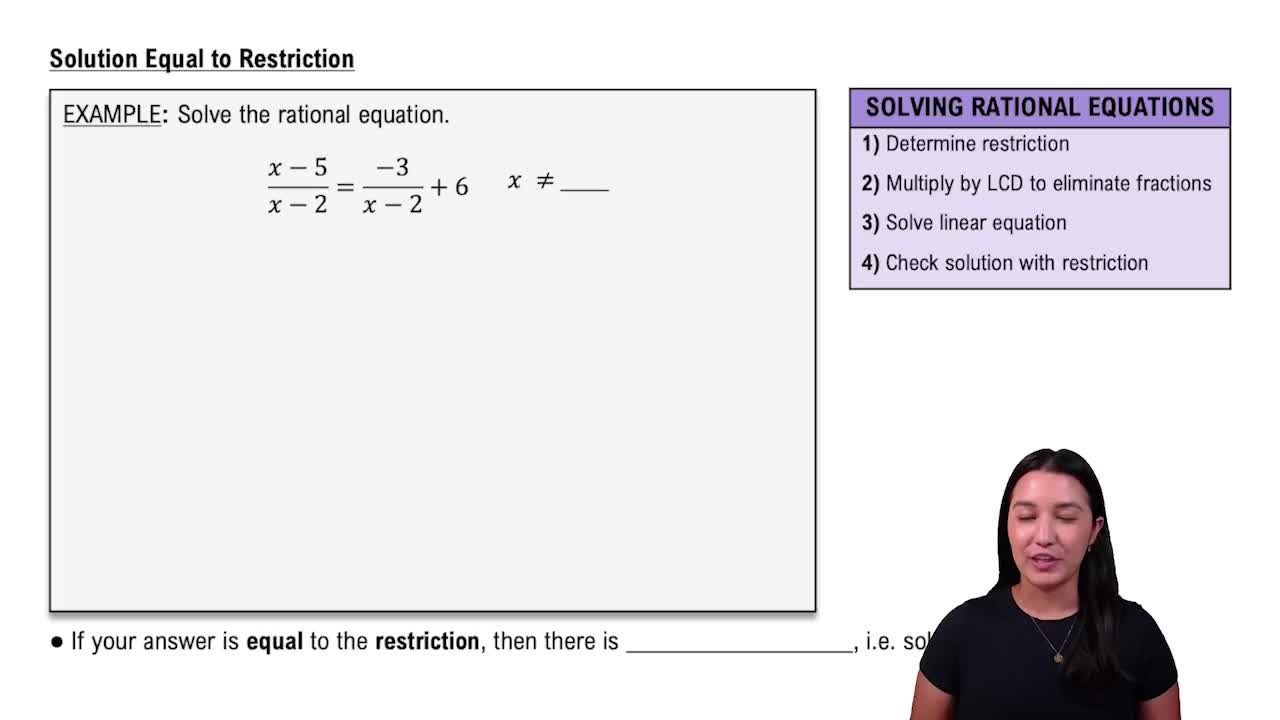
Notice that the denominators on the left and right side are the same, \(x-4\), so to eliminate the fractions, multiply both sides of the equation by \(x-4\) (noting that \(x \neq 4\) to avoid division by zero).
After multiplying both sides by \(x-4\), simplify the equation by canceling the denominators: this gives \(x = 4 + 4(x-4)\).
Distribute the 4 on the right side: \(x = 4 + 4x - 16\).
Combine like terms and isolate \(x\) on one side to solve for \(x\).
Verified video answer for a similar problem:
This video solution was recommended by our tutors as helpful for the problem above
Video duration:
4m
Play a video:
0 Comments
Key Concepts
Here are the essential concepts you must grasp in order to answer the question correctly.
Solving Rational Equations
Rational equations involve expressions with variables in the denominator. To solve them, identify values that make denominators zero (excluded values) and multiply both sides by the least common denominator to eliminate fractions, simplifying the equation.
Domain restrictions are values that make any denominator zero, which are not allowed in the solution set. Before solving, determine these values to avoid extraneous solutions that arise from invalid substitutions.
After solving the equation, substitute solutions back into the original equation to verify they do not produce undefined expressions. This step ensures that extraneous solutions introduced during the solving process are excluded.