Ch. R - Review of Basic Concepts
Lial - College Algebra 13th Edition
Lial13th EditionCollege AlgebraISBN: 9780136881063Not the one you use?Change textbook
Chapter 1, Problem 133

Perform the indicated operations and/or simplify each expression. Assume all variables represent positive real numbers. √(2/3x)

Verified step by step guidance
1
Identify the expression given: \(\frac{\sqrt{2}}{3x}\). The numerator is the square root of 2, and the denominator is the product of 3 and \(x\).
Since the expression is a fraction with a square root in the numerator and a product in the denominator, check if any simplification is possible by factoring or rationalizing.
Note that the denominator \$3x$ does not contain any radicals, so rationalization is not necessary here.
Because \(x\) is a positive real number, the expression cannot be simplified further by combining terms under the square root or canceling factors.
Therefore, the simplified form of the expression remains \(\frac{\sqrt{2}}{3x}\).

Verified video answer for a similar problem:

This video solution was recommended by our tutors as helpful for the problem above.
Video duration:
2m
Was this helpful?

Key Concepts

Here are the essential concepts you must grasp in order to answer the question correctly.

Simplifying Radicals

Simplifying radicals involves rewriting a square root expression in its simplest form by factoring out perfect squares. For example, √18 can be simplified to 3√2 because 18 = 9 × 2 and √9 = 3. This process makes expressions easier to work with and understand.
Recommended video:
Guided course
5:48
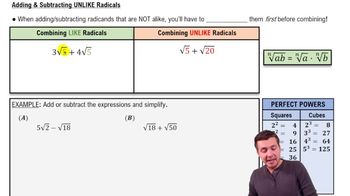
Adding & Subtracting Unlike Radicals by Simplifying

Properties of Square Roots

The square root of a product equals the product of the square roots: √(a × b) = √a × √b. This property allows us to separate or combine radicals, which is essential when simplifying expressions involving roots and variables.
Recommended video:
02:20
Imaginary Roots with the Square Root Property

Operations with Variables under Radicals

When variables are under a square root, their exponents affect simplification. For positive variables, √(x^2) = x because squaring and square rooting are inverse operations. Understanding this helps simplify expressions like √(3x) by treating coefficients and variables separately.
Recommended video:
Guided course
06:44
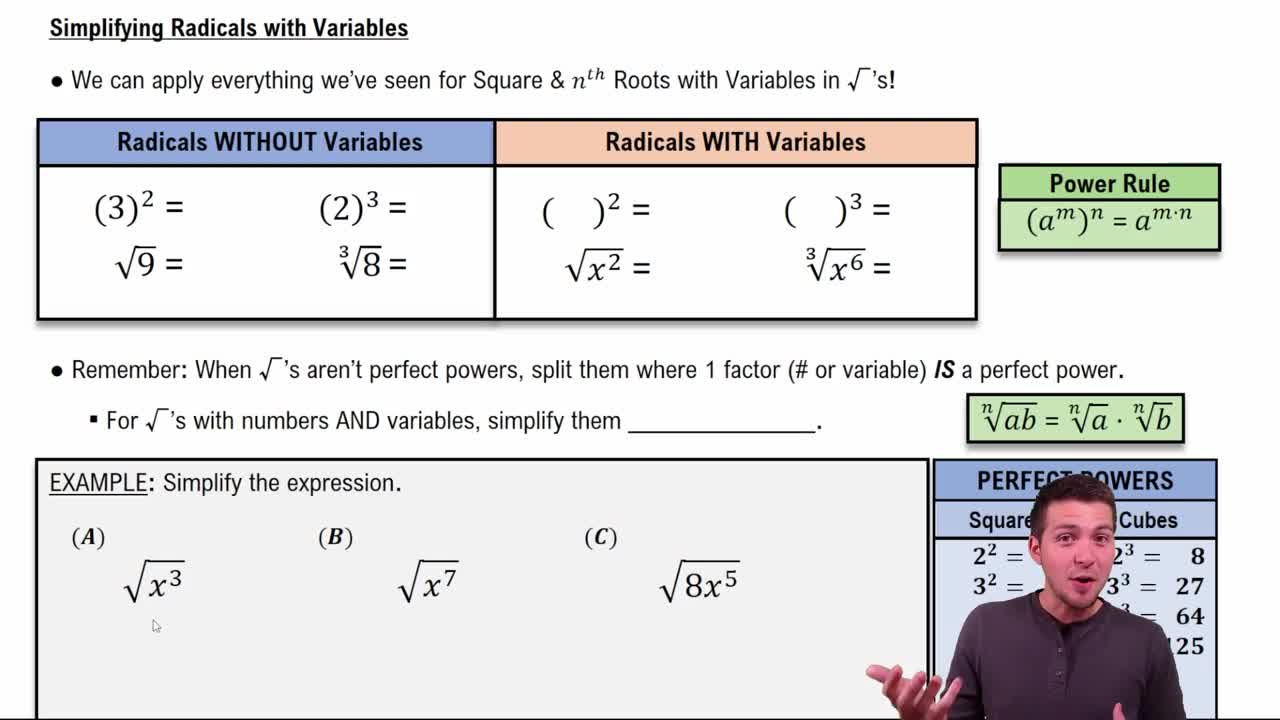
Radical Expressions with Variables