For each polynomial function, one zero is given. Find all other zeros.
Ch. 3 - Polynomial and Rational Functions

Chapter 4, Problem 33
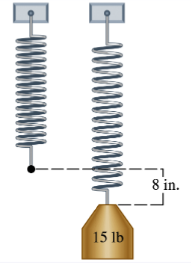
Hooke's Law for a Spring Hooke's law for an elastic spring states that the distance a spring stretches varies directly as the force applied. If a force of 15 lb stretches a certain spring 8 in., how much will a force of 30 lb stretch the spring?

Verified step by step guidance1
Identify the relationship given by Hooke's Law: the distance stretched \(d\) varies directly as the force applied \(F\). This can be written as \(d = kF\), where \(k\) is the constant of proportionality.
Use the given information to find the constant \(k\). Substitute \(F = 15\) lb and \(d = 8\) in. into the equation \(d = kF\) to get \(8 = k \times 15\).
Solve for \(k\) by dividing both sides of the equation by 15: \(k = \frac{8}{15}\).
Use the constant \(k\) to find the new distance stretched when the force is 30 lb. Substitute \(F = 30\) and \(k = \frac{8}{15}\) into \(d = kF\) to get \(d = \frac{8}{15} \times 30\).
Simplify the expression to find the distance \(d\) the spring stretches under a 30 lb force.

Verified video answer for a similar problem:
This video solution was recommended by our tutors as helpful for the problem above.
Video duration:
2mWas this helpful?
Key Concepts
Here are the essential concepts you must grasp in order to answer the question correctly.
Direct Variation
Direct variation means one quantity changes proportionally with another. In this problem, the distance the spring stretches varies directly with the applied force, so if the force doubles, the stretch doubles. This relationship can be expressed as y = kx, where k is a constant.
Recommended video:
Maximum Turning Points of a Polynomial Function
Hooke's Law
Hooke's Law states that the force needed to stretch or compress a spring is proportional to the displacement from its rest position. Mathematically, F = kx, where F is force, x is displacement, and k is the spring constant. This law applies within the elastic limit of the spring.
Solving Proportions
Solving proportions involves setting two ratios equal to each other to find an unknown value. Here, the ratio of force to stretch length is constant, so you can set up the proportion 15/8 = 30/x and solve for x to find the new stretch length.
Recommended video:
Solving Logarithmic Equations
Related Practice
Textbook Question
683
views
Textbook Question
Show that each polynomial function has a real zero as described in parts (a) and (b). In Exercises 31 and 32, also work part (c). ƒ(x)=4x3-37x2+50x+60 between 7 and 8
506
views
Textbook Question
Match the rational function in Column I with the appropriate description in Column II. Choices in Column II can be used only once. ƒ(x)=(x2-16)/(x+4)
864
views
Textbook Question
For each polynomial function, use the remainder theorem to find ƒ(k). ƒ(x) = x2 + 5x+6; k = -2
442
views
Textbook Question
Solve each polynomial inequality. Give the solution set in interval notation. (x + 3)3(2x - 1)(x + 4) ≥ 0
452
views
Textbook Question
Show that each polynomial function has a real zero as described in parts (a) and (b). In Exercises 31 and 32, also work part (c). ƒ(x)=4x^3-37x^2+50x+60 Find the zero in part (b) to three decimal places.
383
views