Ch. 3 - Polynomial and Rational Functions
Lial - College Algebra 13th Edition
Lial13th EditionCollege AlgebraISBN: 9780136881063Not the one you use?Change textbook
Chapter 4, Problem 53

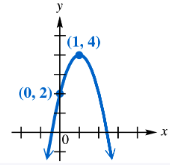
Connecting Graphs with Equations Find a quadratic function f having the graph shown. (Hint: See the Note following Example 3.)
Graph of a downward-opening parabola passing through points (0,2) and (1,4) on an xy-coordinate plane.

Verified step by step guidance
1
Step 1: Identify the general form of the quadratic function, which is \(f(x) = ax^2 + bx + c\), where \(a\), \(b\), and \(c\) are constants to be determined.
Step 2: Use the point \((0, 9)\) to find \(c\). Substitute \(x = 0\) and \(f(0) = 9\) into the equation: \$9 = a(0)^2 + b(0) + c\(, which simplifies to \)c = 9$.
Step 3: Use the point \((2, 13)\) to create an equation involving \(a\) and \(b\). Substitute \(x = 2\) and \(f(2) = 13\) into the equation: \$13 = a(2)^2 + b(2) + 9$.
Step 4: Simplify the equation from Step 3 to get \$13 = 4a + 2b + 9\(. Subtract 9 from both sides to isolate terms with \)a\( and \)b\(: \)4 = 4a + 2b$.
Step 5: To find \(a\) and \(b\), you need one more condition. Since the graph is a parabola with a vertex at the maximum point, use the vertex form or the fact that the vertex's \(x\)-coordinate is at \(x = -\frac{b}{2a}\). Use the graph to estimate the vertex's \(x\)-coordinate and set up an equation to solve for \(a\) and \(b\).

Verified video answer for a similar problem:

This video solution was recommended by our tutors as helpful for the problem above.
Video duration:
4m
Was this helpful?

Key Concepts

Here are the essential concepts you must grasp in order to answer the question correctly.

Quadratic Function and Standard Form

A quadratic function is a polynomial of degree two, typically written as f(x) = ax^2 + bx + c, where a, b, and c are constants and a ≠ 0. The graph of a quadratic function is a parabola, which can open upwards or downwards depending on the sign of a.
Recommended video:
04:34
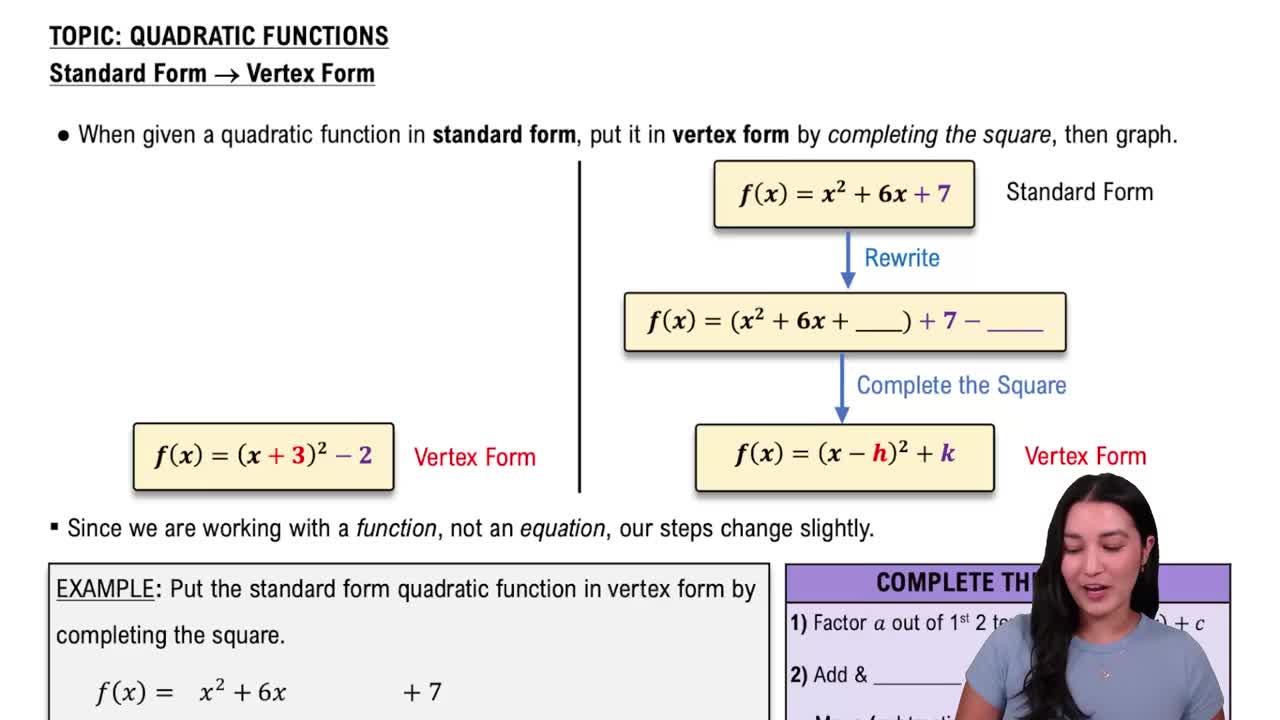
Converting Standard Form to Vertex Form

Using Points to Find Coefficients

Given points on the graph of a quadratic function, you can substitute their coordinates into the quadratic equation to create a system of equations. Solving this system helps determine the values of a, b, and c, thus defining the specific quadratic function.
Recommended video:
Guided course
04:27
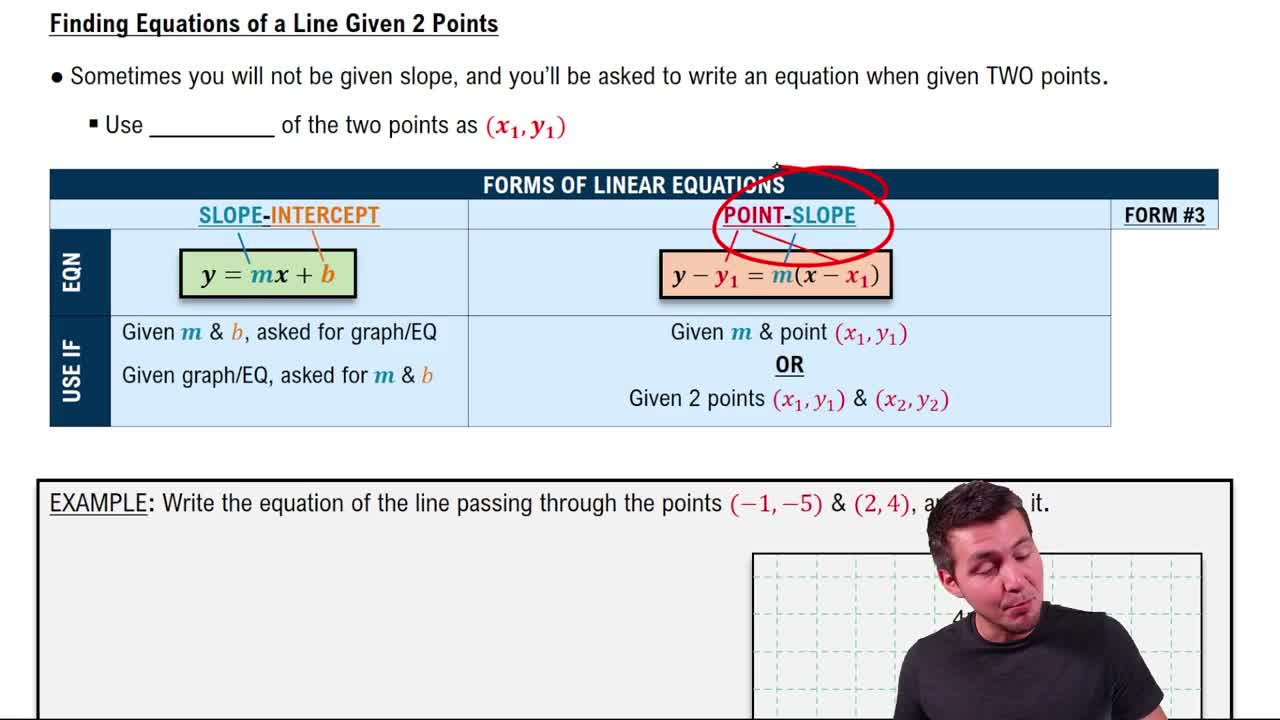
Finding Equations of Lines Given Two Points

Interpreting the Graph and Coordinates

The graph shows specific points (0, 9) and (2, 13) on the parabola. The point (0, 9) gives the y-intercept, which directly provides the value of c in the quadratic equation. The other point helps form equations to solve for a and b.
Recommended video:
Guided course
02:16
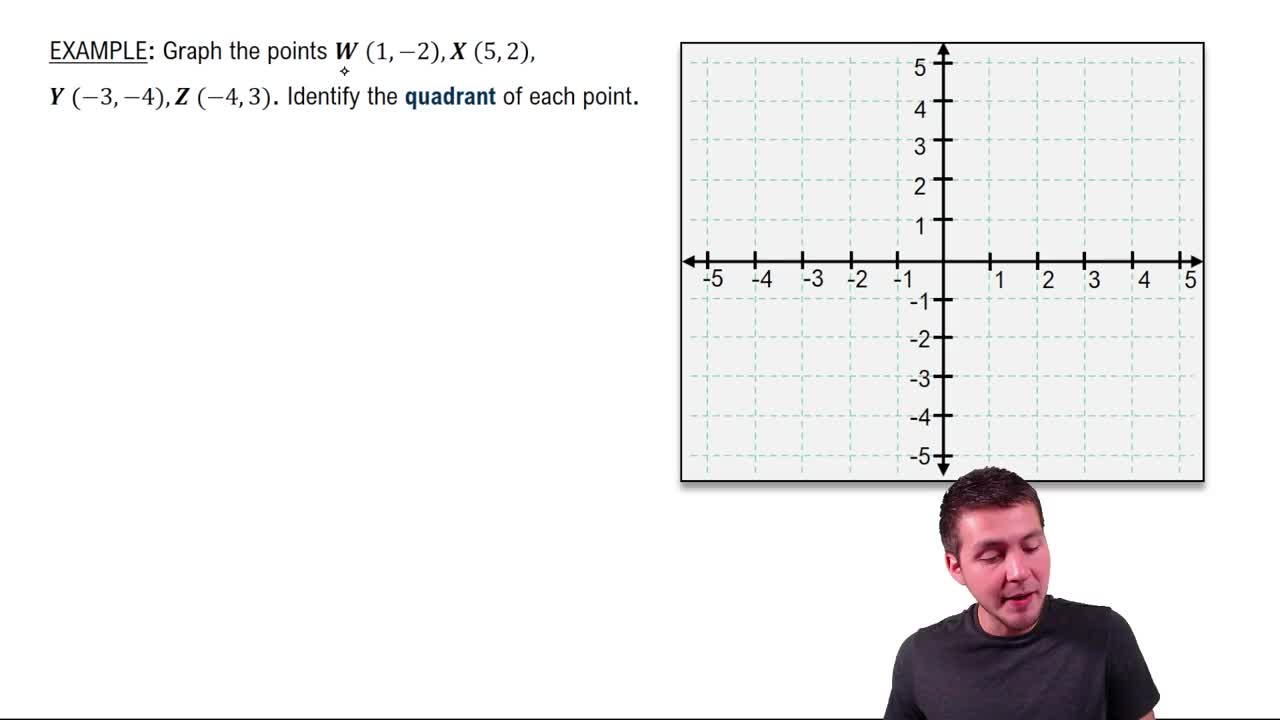
Graphs and Coordinates - Example