Ch. 4 - Inverse, Exponential, and Logarithmic Functions
Lial - College Algebra 13th Edition
Lial13th EditionCollege AlgebraISBN: 9780136881063Not the one you use?Change textbook
Chapter 5, Problem 49

Graph each function. Give the domain and range. ƒ(x) = 2x+2 - 4

Verified step by step guidance
1
Identify the base function and its transformations. The base function here is the exponential function \(f(x) = 2^x\). The given function is \(f(x) = 2^{x+2} - 4\), which involves a horizontal shift and a vertical shift.
Determine the horizontal shift by analyzing the exponent \(x + 2\). Since it is \(x + 2\), this represents a shift to the left by 2 units compared to the base function \$2^x$.
Determine the vertical shift by looking at the \(-4\) outside the exponential. This means the entire graph of \$2^{x+2}$ is shifted downward by 4 units.
Find the domain and range of the function. The domain of any exponential function \$2^x\( is all real numbers, so the domain of \)f(x) = 2^{x+2} - 4\( is also all real numbers. The range of the base function \)2^x$ is \((0, \, \infty)\), so after shifting down by 4, the range becomes \((-4, \, \infty)\).
To graph the function, start by plotting key points of the base function \$2^x\(, shift them left by 2 units, then shift down by 4 units. Draw a smooth curve through these points, remembering the horizontal asymptote is now at \)y = -4$.

Verified video answer for a similar problem:

This video solution was recommended by our tutors as helpful for the problem above.
Video duration:
8m
Was this helpful?

Key Concepts

Here are the essential concepts you must grasp in order to answer the question correctly.

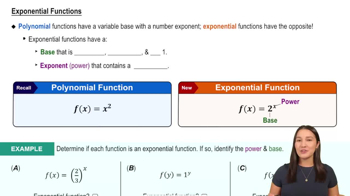
Exponential Functions

An exponential function has the form f(x) = a^x, where the variable is in the exponent. In this question, the function is f(x) = 2^(x+2) - 4, which involves a base of 2 raised to the power (x+2). Understanding how exponential functions grow and shift is essential for graphing.
Recommended video:
6:13
Exponential Functions

Domain and Range of Functions

The domain is the set of all possible input values (x-values), and the range is the set of all possible output values (f(x)-values). For exponential functions like this one, the domain is usually all real numbers, while the range depends on vertical shifts and transformations.
Recommended video:
4:22
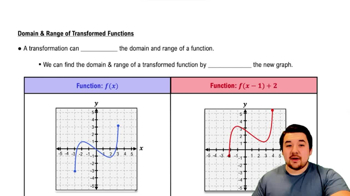
Domain & Range of Transformed Functions

Transformations of Functions

Transformations include shifts, stretches, and reflections applied to the base function. Here, (x+2) shifts the graph horizontally left by 2 units, and subtracting 4 shifts it vertically down by 4 units. Recognizing these helps in accurately sketching the graph and determining domain and range.
Recommended video:
4:22
Domain & Range of Transformed Functions