Ch. R - Review of Basic Concepts
Lial - College Algebra 13th Edition
Lial13th EditionCollege AlgebraISBN: 9780136881063Not the one you use?Change textbook
Chapter 1, Problem 23

Add or subtract, as indicated. (5x24x+7)+(4x2+3x5)(5x^2-4x+7) + (-4x^2+3x-5)

Verified step by step guidance
1
Identify the polynomials to be added: \((5x^2 - 4x + 7)\) and \((-4x^2 + 3x - 5)\).
Remove the parentheses and write the expression as a sum of all terms: \$5x^2 - 4x + 7 - 4x^2 + 3x - 5$.
Group like terms together. Like terms have the same variable raised to the same power: \((5x^2 - 4x^2) + (-4x + 3x) + (7 - 5)\).
Combine the coefficients of each group: For \(x^2\) terms, add \(5\) and \(-4\); for \(x\) terms, add \(-4\) and \(3\); for constants, add \(7\) and \(-5\).
Write the simplified polynomial by combining the results from the previous step, keeping the variable parts intact.

Verified video answer for a similar problem:

This video solution was recommended by our tutors as helpful for the problem above.
Video duration:
1m
Was this helpful?

Key Concepts

Here are the essential concepts you must grasp in order to answer the question correctly.

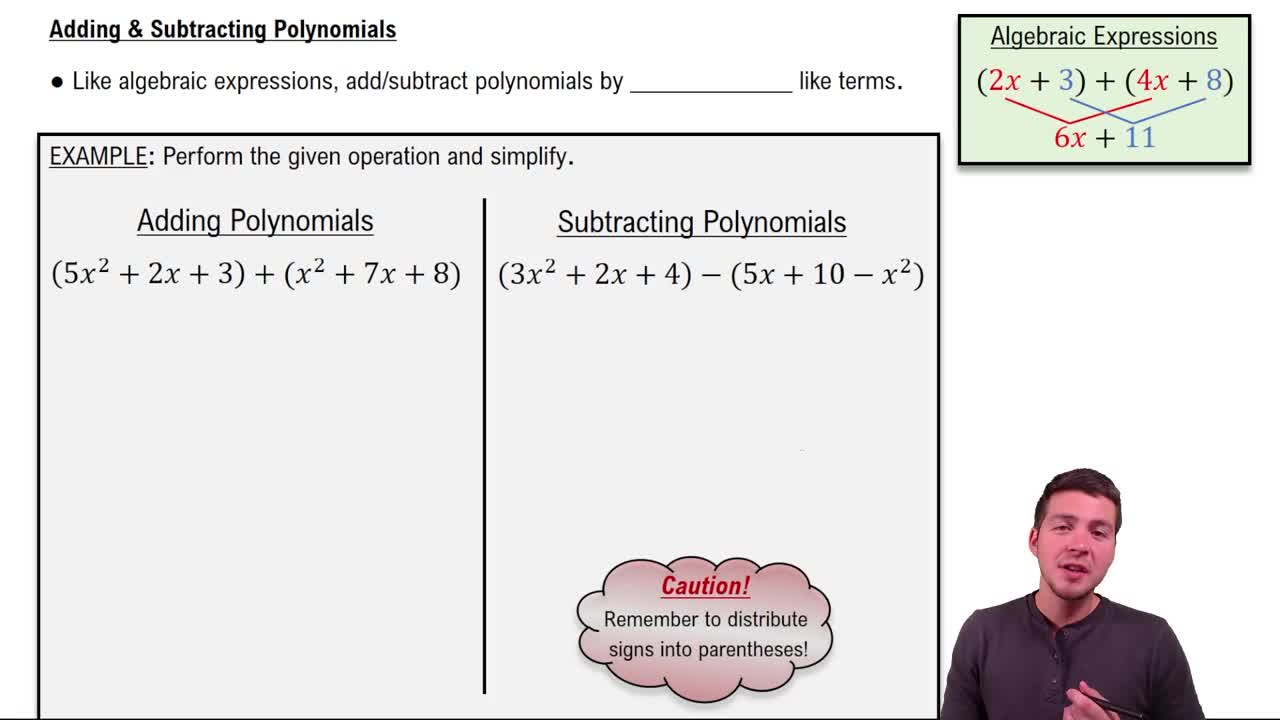
Polynomial Addition and Subtraction

Adding or subtracting polynomials involves combining like terms, which are terms with the same variable raised to the same power. You add or subtract their coefficients while keeping the variable part unchanged. This process simplifies the expression into a single polynomial.
Recommended video:
Guided course
03:34
Adding and Subtracting Polynomials

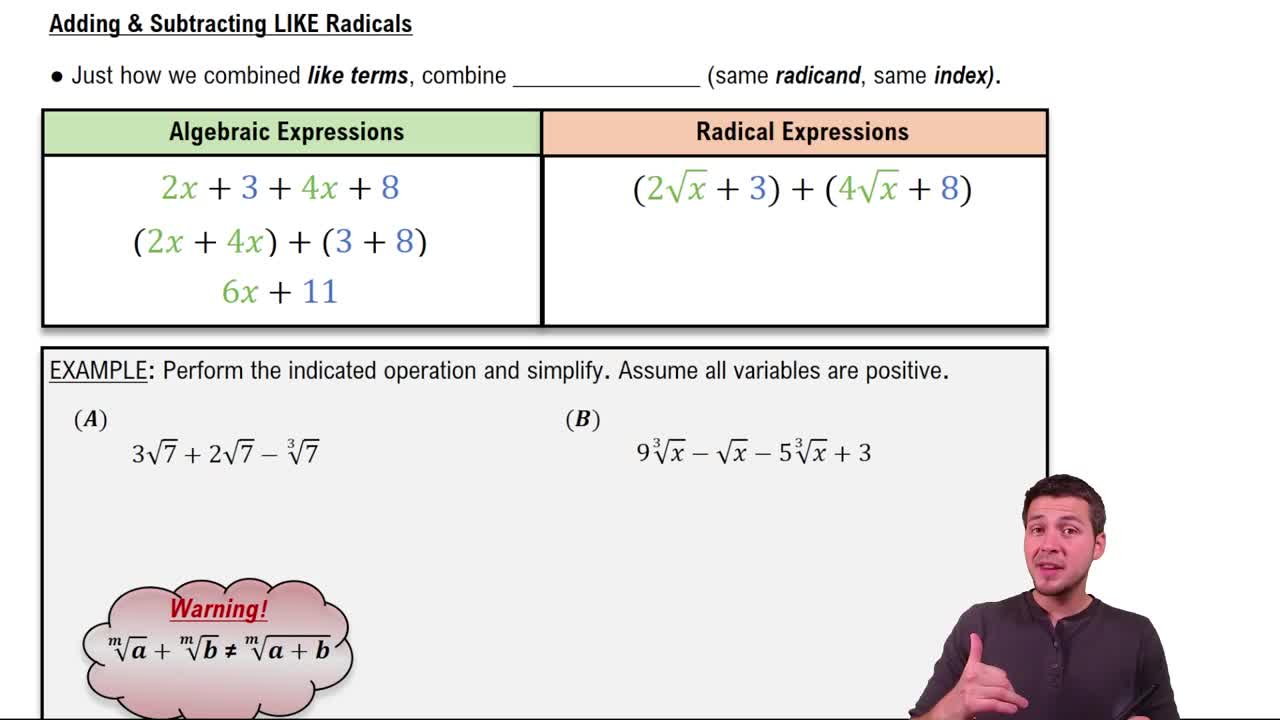
Like Terms

Like terms are terms in a polynomial that have identical variable parts, including the same exponents. For example, 5x² and -4x² are like terms because both have x raised to the second power. Recognizing like terms is essential for correctly combining polynomials.
Recommended video:
Guided course
03:50
Adding & Subtracting Like Radicals

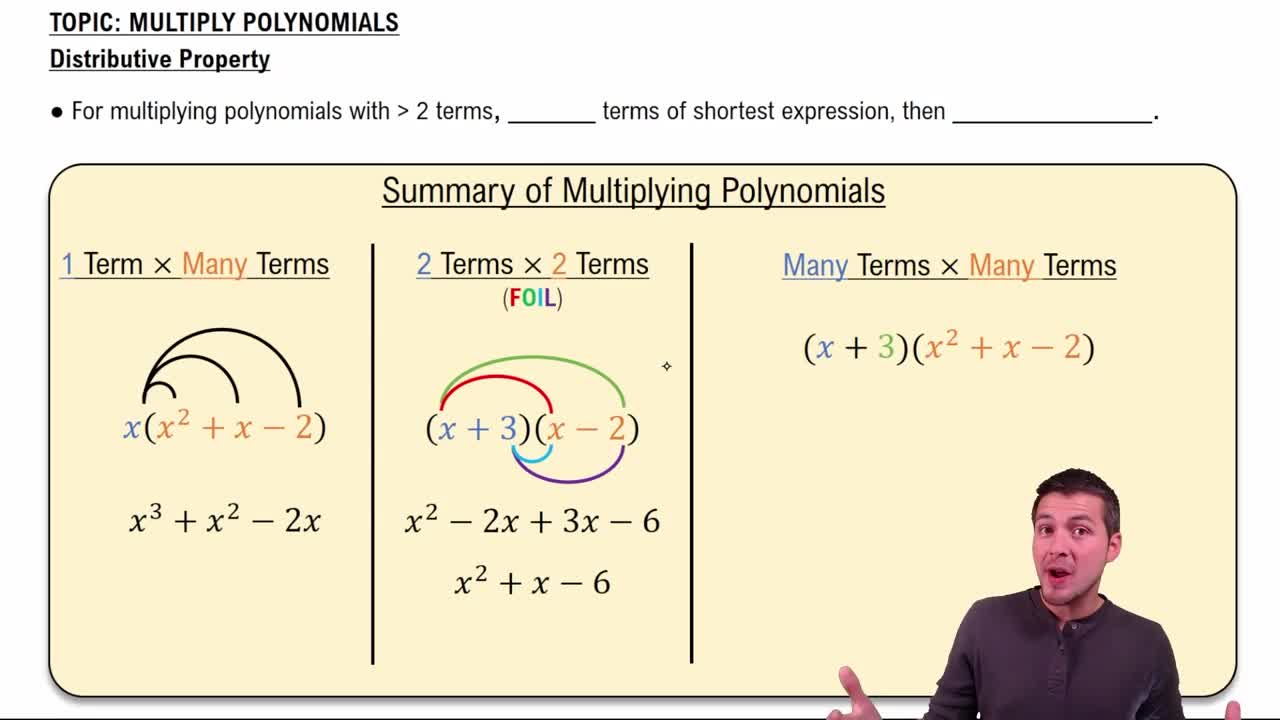
Distributive Property

The distributive property allows you to multiply a term outside parentheses by each term inside. When subtracting polynomials, you distribute the negative sign across all terms in the second polynomial before combining like terms. This ensures correct addition or subtraction of coefficients.
Recommended video:
Guided course
04:15
Multiply Polynomials Using the Distributive Property