Ch. 3 - Polynomial and Rational Functions
Lial - College Algebra 13th Edition
Lial13th EditionCollege AlgebraISBN: 9780136881063Not the one you use?Change textbook
Chapter 4, Problem 58

Show that the real zeros of each polynomial function satisfy the given conditions. ƒ(x)=2x5-x4+2x3-2x2+4x-4; no real zero greater than 1

Verified step by step guidance
1
First, understand the problem: we need to show that the polynomial function \(f(x) = 2x^5 - x^4 + 2x^3 - 2x^2 + 4x - 4\) has no real zeros greater than 1. This means if \(f(c) = 0\) for some real number \(c\), then \(c \leq 1\).
Evaluate the polynomial at \(x = 1\) to check the sign of \(f(1)\). Substitute \(x=1\) into the polynomial: \(f(1) = 2(1)^5 - (1)^4 + 2(1)^3 - 2(1)^2 + 4(1) - 4\).
Analyze the behavior of \(f(x)\) for values greater than 1. One way is to check the sign of \(f(x)\) at a value greater than 1, for example at \(x=2\), to see if the polynomial changes sign, which would indicate a zero in that interval.
Use the Intermediate Value Theorem: if \(f(1)\) and \(f(2)\) have the same sign, then there is no zero between 1 and 2. Repeat this for other values greater than 1 if necessary to confirm no zeros exist beyond 1.
Alternatively, consider the polynomial's end behavior and use techniques such as synthetic division or the Rational Root Theorem to test possible roots greater than 1, or analyze the derivative to understand the function's increasing/decreasing behavior beyond \(x=1\).

Verified video answer for a similar problem:

This video solution was recommended by our tutors as helpful for the problem above.
Video duration:
6m
Was this helpful?

Key Concepts

Here are the essential concepts you must grasp in order to answer the question correctly.

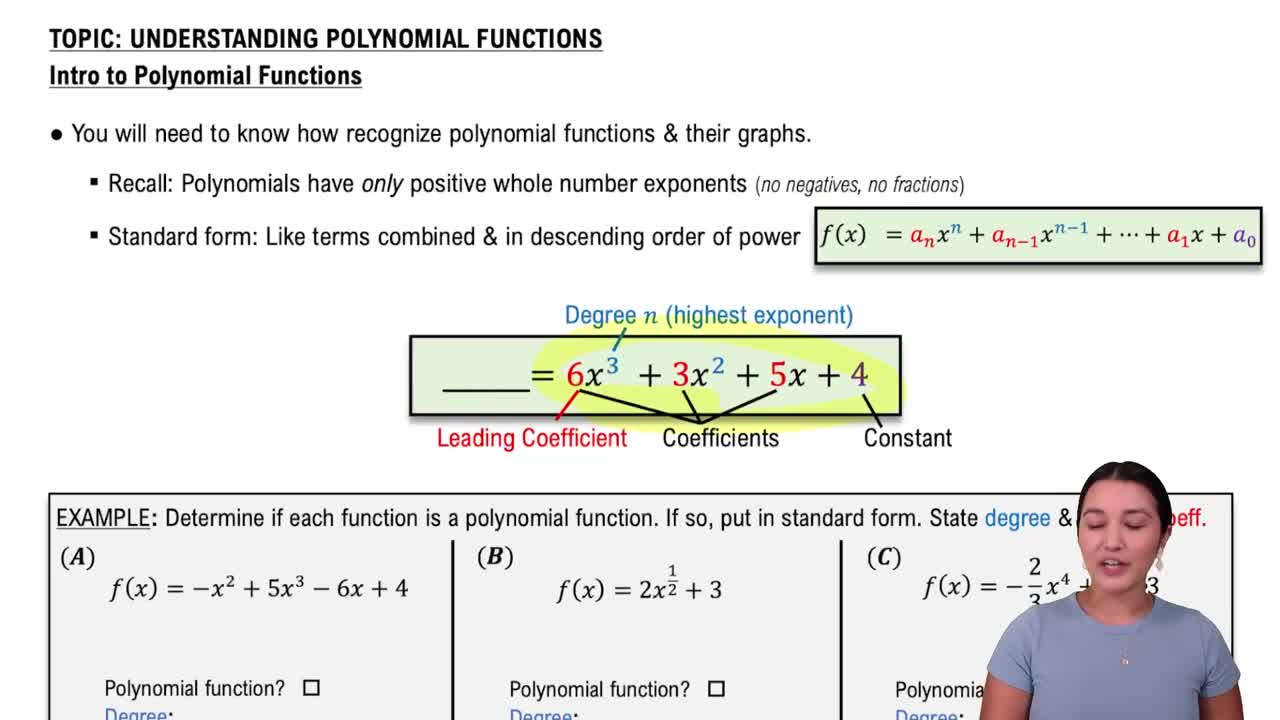
Real Zeros of Polynomial Functions

Real zeros of a polynomial are the values of x for which the polynomial equals zero. These zeros correspond to the x-intercepts of the graph. Understanding how to find and interpret real zeros is essential for analyzing the behavior of polynomial functions.
Recommended video:
06:04
Introduction to Polynomial Functions

Polynomial Inequalities and Root Bounds

Polynomial inequalities involve determining where a polynomial is greater or less than zero. Root bounds are techniques used to estimate intervals where real zeros can or cannot exist, such as using the Rational Root Theorem or testing values to show no zeros lie beyond a certain point.
Recommended video:
Guided course
3:21
Nonlinear Inequalities

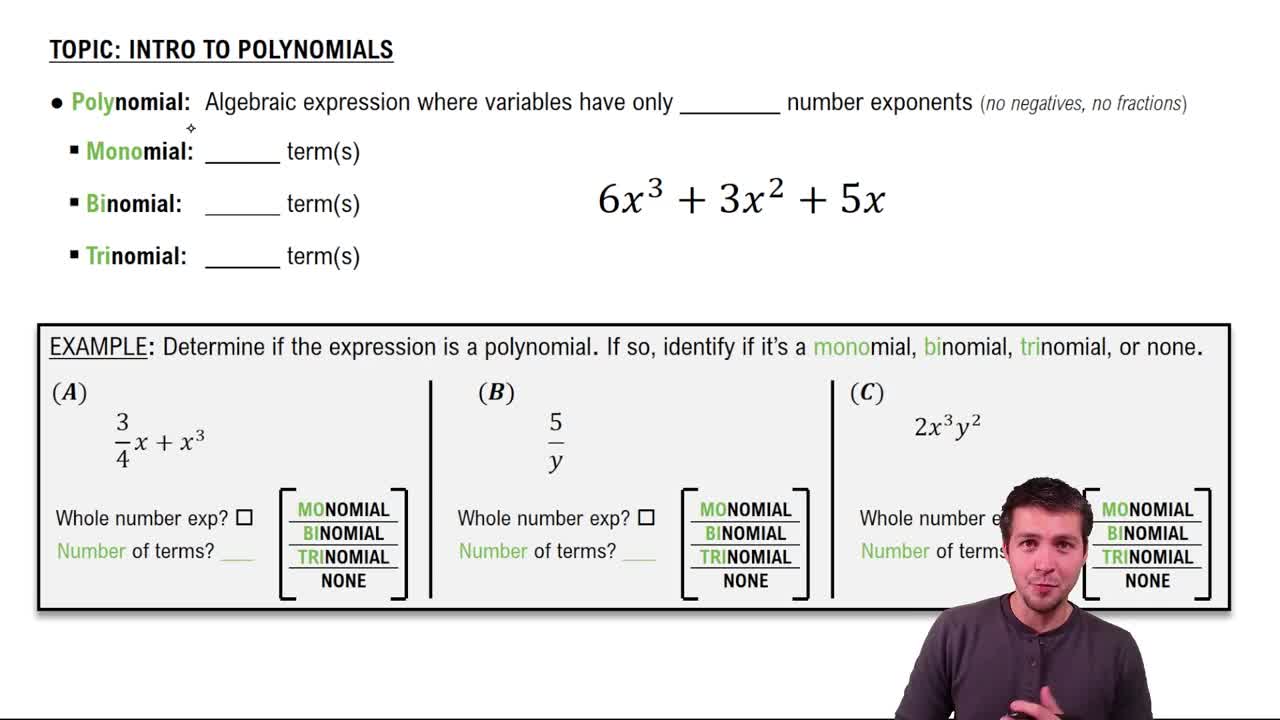
Evaluating Polynomials and Sign Testing

Evaluating a polynomial at specific points helps determine the sign of the function, which is useful for locating zeros and verifying conditions like 'no real zero greater than 1.' Sign testing between points can confirm intervals where zeros do or do not exist.
Recommended video:
Guided course
05:13
Introduction to Polynomials