Find a polynomial function ƒ(x) of least degree having only real coefficients and zeros as given. Assume multiplicity 1 unless otherwise stated. 2-i, 3, and -1
Ch. 3 - Polynomial and Rational Functions

Chapter 4, Problem 68
Solve each rational inequality. Give the solution set in interval notation.
Verified step by step guidance1
Start with the given inequality: \(\frac{5}{2 - x} > \frac{3}{3 - x}\).
Identify the domain restrictions by setting the denominators not equal to zero: \(2 - x \neq 0\) and \(3 - x \neq 0\), which means \(x \neq 2\) and \(x \neq 3\).
Bring all terms to one side to form a single rational expression: \(\frac{5}{2 - x} - \frac{3}{3 - x} > 0\).
Find a common denominator, which is \((2 - x)(3 - x)\), and combine the fractions: \(\frac{5(3 - x) - 3(2 - x)}{(2 - x)(3 - x)} > 0\).
Simplify the numerator and analyze the sign of the rational expression by considering the critical points from the numerator and denominator to determine the solution intervals.

Verified video answer for a similar problem:
This video solution was recommended by our tutors as helpful for the problem above.
Video duration:
4mWas this helpful?
Key Concepts
Here are the essential concepts you must grasp in order to answer the question correctly.
Rational Inequalities
Rational inequalities involve expressions where variables appear in the denominator. Solving them requires finding values of the variable that make the inequality true, while ensuring the denominator is never zero to avoid undefined expressions.
Recommended video:
Guided course
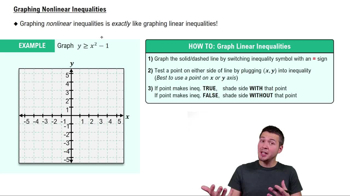
Nonlinear Inequalities
Finding a Common Denominator and Cross-Multiplication
To compare two rational expressions, you can cross-multiply when denominators are positive or find a common denominator to combine terms. Care must be taken to consider the sign of denominators, as multiplying or dividing by negative values reverses inequality signs.
Recommended video:
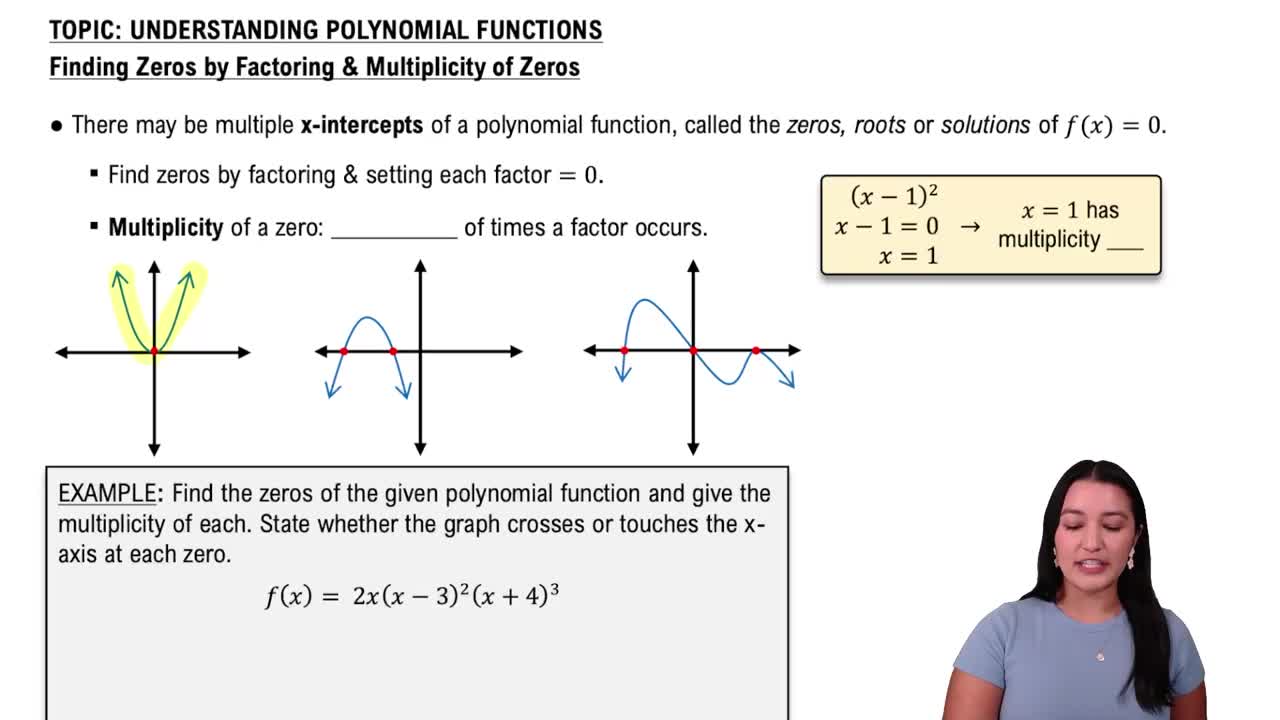
Finding Zeros & Their Multiplicity
Domain Restrictions and Interval Notation
The domain excludes values that make any denominator zero. After solving the inequality, solutions must be expressed in interval notation, clearly indicating which values satisfy the inequality and respecting domain restrictions.
Recommended video:
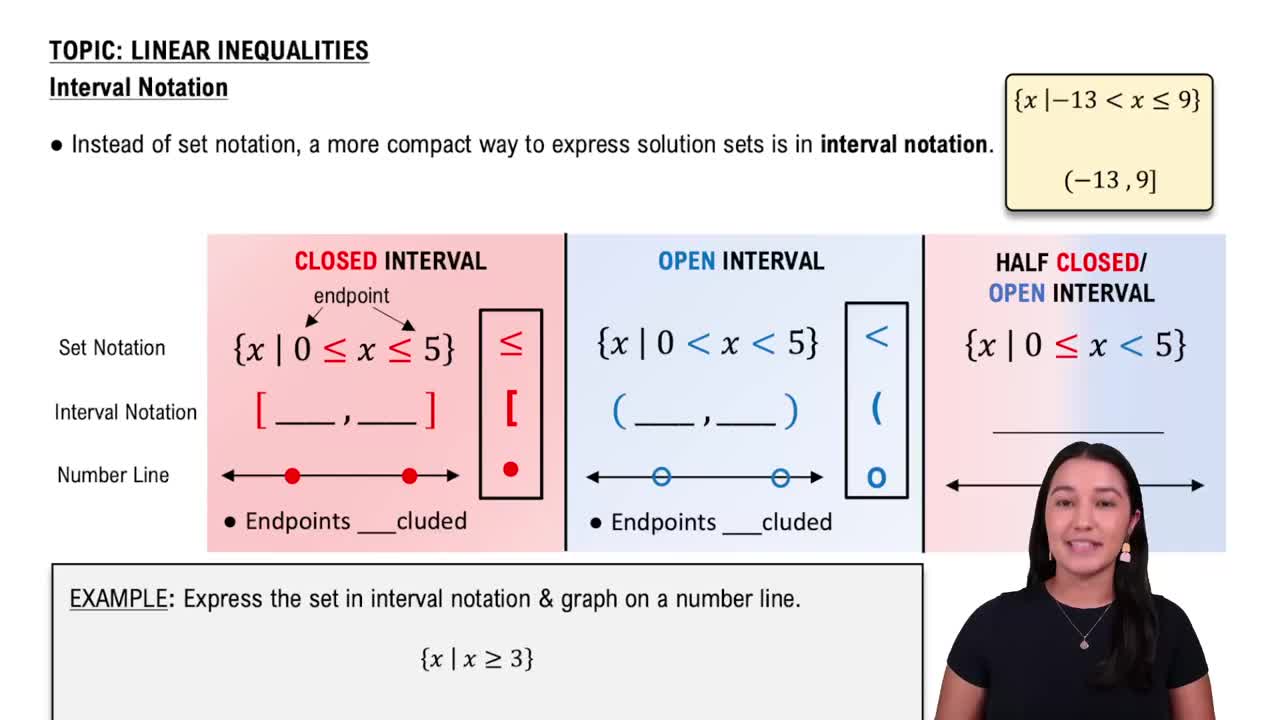
Interval Notation
Related Practice
Textbook Question
398
views
Textbook Question
Solve each rational inequality. Give the solution set in interval notation. 3 /{4 - x} > 6 /{ 1 - x}
413
views
Textbook Question
Find a polynomial function f of least degree having the graph shown. (Hint: See the NOTE following Example 4.)
1480
views
Textbook Question
The remainder theorem indicates that when a polynomial ƒ(x) is divided by x-k, the remainder is equal to ƒ(k). Consider the polynomial function ƒ(x) = x3 - 2x2 - x+2. Use the remainder theorem to find each of the following. Then determine the coordinates of the corresponding point on the graph of ƒ(x). ƒ (1)
683
views
Textbook Question
Graph each rational function. ƒ(x)=(2x+1)/(x2+6x+8)
82
views
Textbook Question
Graph each rational function. ƒ(x)=5x/(x2-1)
615
views