Ch. R - Review of Basic Concepts
Lial - College Algebra 13th Edition
Lial13th EditionCollege AlgebraISBN: 9780136881063Not the one you use?Change textbook
Chapter 1, Problem 109

Perform the indicated operations. Assume all variables represent positive real numbers. 64xy23+27x4y53\(\sqrt\)[3]{64xy^2} + \(\sqrt\)[3]{27x^4y^5}

Verified step by step guidance
1
Identify the cube roots in the expression: \(\sqrt[3]{64xy^{2}} + \sqrt[3]{27x^{4}y^{5}}\).
Rewrite each radicand (the expression inside the cube root) as a product of perfect cubes and remaining factors. For example, express 64 as \$4^{3}$, and separate powers of variables into multiples of 3 plus remainders.
Apply the cube root to each perfect cube factor separately, using the property \(\sqrt[3]{a^{3}} = a\), and keep the remaining factors inside the cube root.
Simplify each term by extracting the cube roots of the perfect cubes and rewriting the expression as a sum of simplified terms.
Combine like terms if possible, considering the variables and remaining cube roots, to write the expression in its simplest form.

Verified video answer for a similar problem:

This video solution was recommended by our tutors as helpful for the problem above.
Video duration:
5m
Was this helpful?

Key Concepts

Here are the essential concepts you must grasp in order to answer the question correctly.

Cube Roots and Radicals

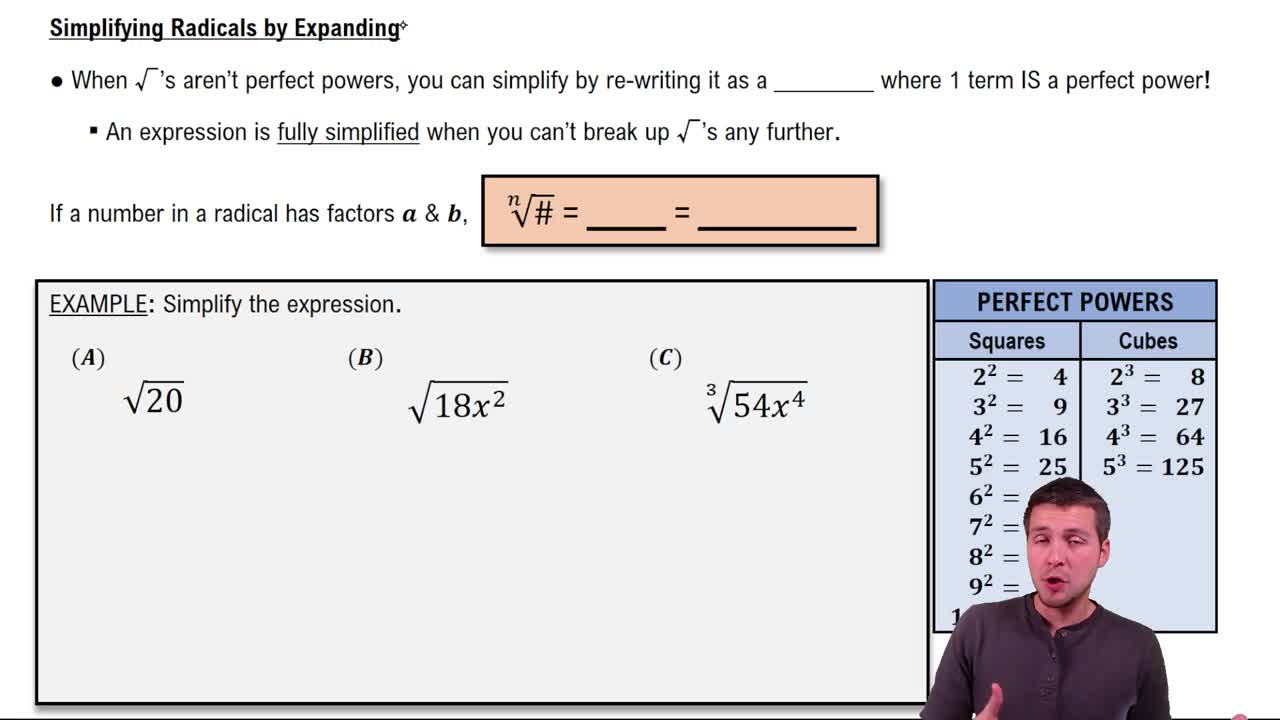
A cube root of a number is a value that, when multiplied by itself three times, gives the original number. For example, ∛64 = 4 because 4³ = 64. Understanding how to simplify cube roots, especially with variables and exponents, is essential for combining radical expressions.
Recommended video:
Guided course
05:20
Expanding Radicals

Properties of Exponents

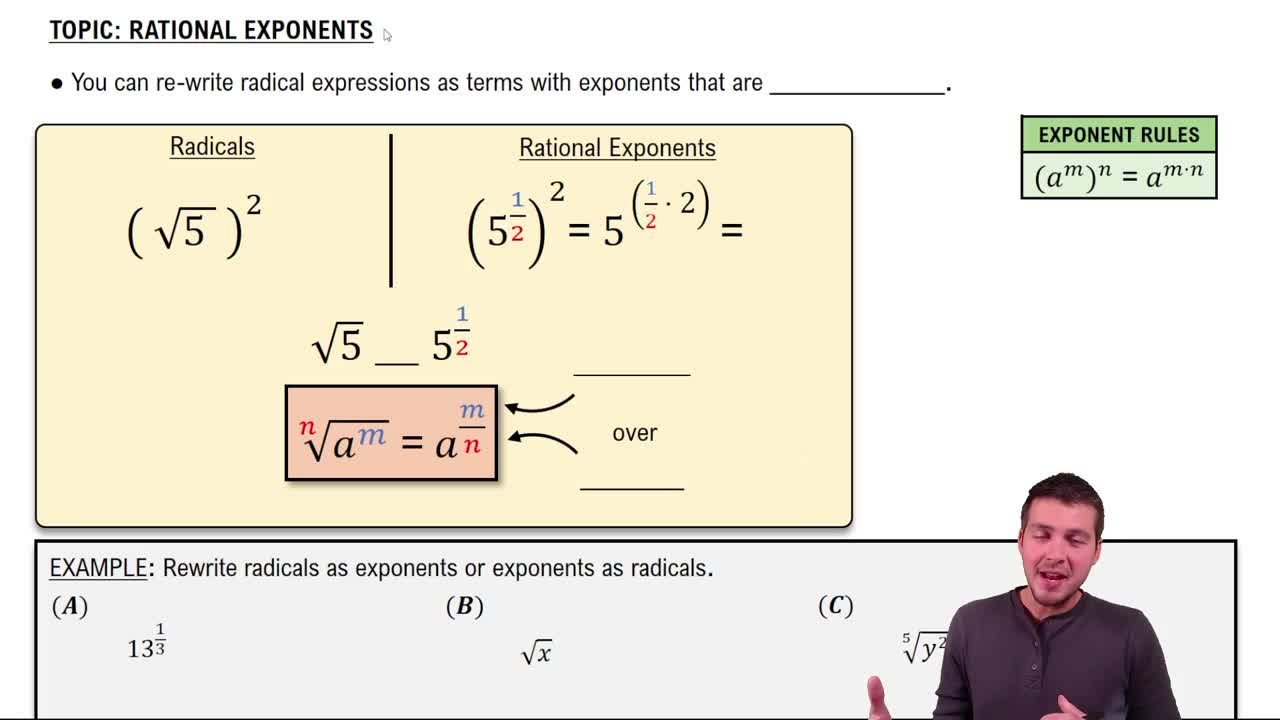
Exponents indicate how many times a base is multiplied by itself. When dealing with radicals, exponents can be manipulated using fractional powers, such as x^(m/n) representing the nth root of x raised to the mth power. This helps in simplifying and combining terms under radicals.
Recommended video:
Guided course
04:06
Rational Exponents

Adding Like Radicals

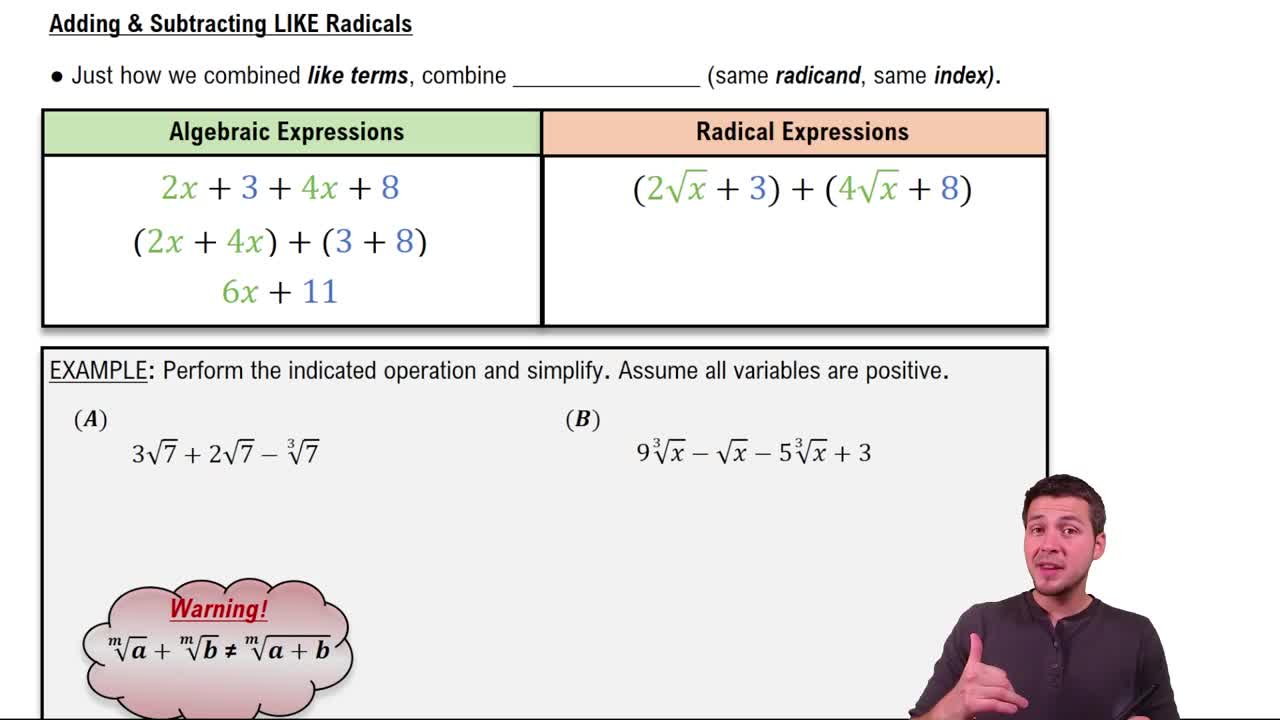
Radical expressions can only be added or subtracted if they have the same radicand and index. After simplifying each radical, check if the terms are like radicals. If they are, combine their coefficients; if not, the expression remains a sum of separate radicals.
Recommended video:
Guided course
03:50
Adding & Subtracting Like Radicals