Solve each rational inequality. Give the solution set in interval notation. 1 /(x - 1) < 1 /(x + 1)
Ch. 3 - Polynomial and Rational Functions

Chapter 4, Problem 64
Show that the real zeros of each polynomial function satisfy the given conditions. See Example 6.
; no real zero less than -3
Verified step by step guidance1
First, understand the problem: we need to show that the polynomial function \(f(x) = x^5 - 3x^3 + x + 2\) has no real zeros less than \(-3\). This means that for all \(x < -3\), \(f(x) \neq 0\).
Step 1: Evaluate the function at \(x = -3\) to get a reference value. Calculate \(f(-3) = (-3)^5 - 3(-3)^3 + (-3) + 2\).
Step 2: Analyze the behavior of \(f(x)\) for values less than \(-3\). Since \(f(x)\) is a polynomial, it is continuous everywhere. If there were a zero less than \(-3\), the function would have to cross the x-axis somewhere in that region.
Step 3: Check the sign of \(f(x)\) at a point less than \(-3\), for example at \(x = -4\). Calculate \(f(-4) = (-4)^5 - 3(-4)^3 + (-4) + 2\) and note its sign.
Step 4: Use the Intermediate Value Theorem: if \(f(-4)\) and \(f(-3)\) have the same sign, then there is no zero between \(-4\) and \(-3\). Since the polynomial is continuous, and if this pattern holds for all \(x < -3\), it shows no zeros exist less than \(-3\).

Verified video answer for a similar problem:
This video solution was recommended by our tutors as helpful for the problem above.
Video duration:
7mWas this helpful?
Key Concepts
Here are the essential concepts you must grasp in order to answer the question correctly.
Polynomial Functions and Their Zeros
A polynomial function is an expression involving variables raised to whole-number exponents with coefficients. The zeros of a polynomial are the values of x for which the function equals zero. Understanding how to find and interpret these zeros is essential for analyzing the behavior of the function.
Recommended video:
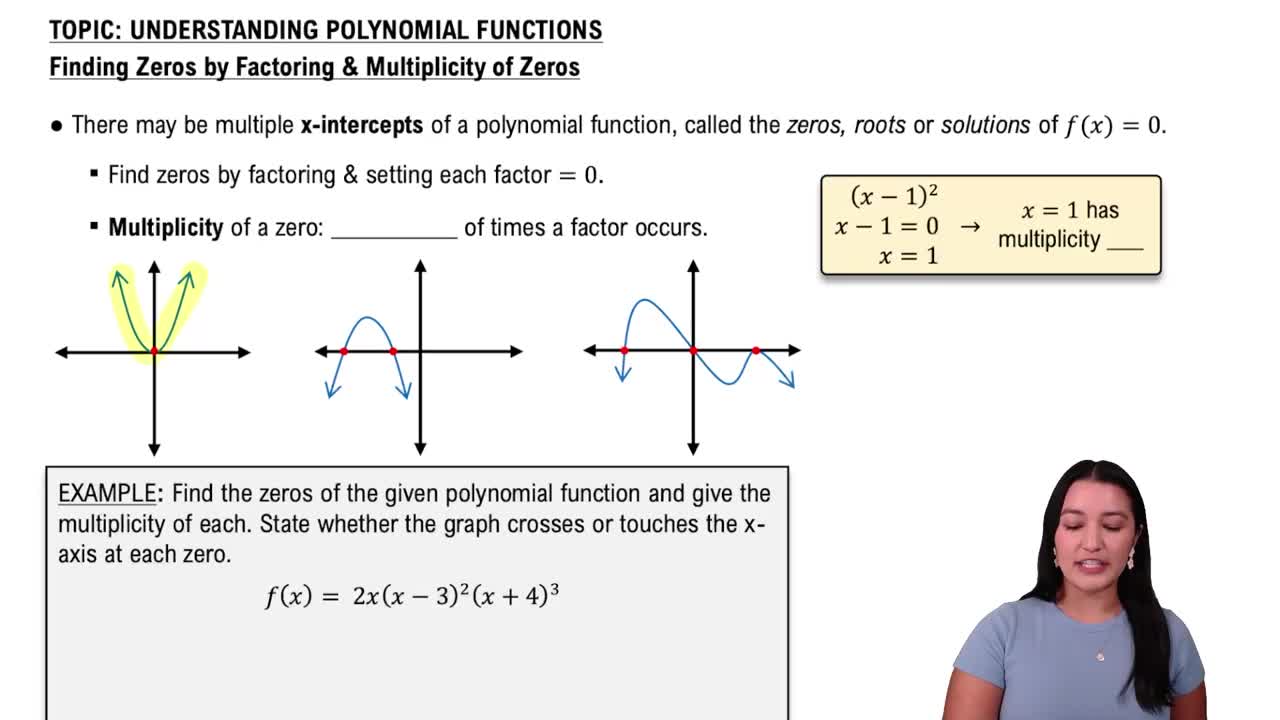
Finding Zeros & Their Multiplicity
Evaluating Polynomial Values to Determine Zero Locations
To show that no real zero lies below a certain value, evaluate the polynomial at that value and nearby points. If the polynomial does not change sign below that point, it indicates no zeros exist there. This method uses the Intermediate Value Theorem and sign analysis to locate zeros.
Recommended video:
Guided course
Determinants of 2×2 Matrices
Intermediate Value Theorem
The Intermediate Value Theorem states that if a continuous function changes sign over an interval, it must have at least one zero in that interval. This theorem helps confirm the existence or absence of zeros within specific ranges by checking function values at interval endpoints.
Recommended video:
Introduction to Hyperbolas
Related Practice
Textbook Question
493
views
Textbook Question
Show that the real zeros of each polynomial function satisfy the given conditions. ƒ(x)=x5-3x3+x+2; no real zero greater than 2
513
views
Textbook Question
The remainder theorem indicates that when a polynomial ƒ(x) is divided by x-k, the remainder is equal to ƒ(k). Consider the polynomial function ƒ(x) = x3 - 2x2 - x+2. Use the remainder theorem to find each of the following. Then determine the coordinates of the corresponding point on the graph of ƒ(x). ƒ (-2)
506
views
Textbook Question
Solve each rational inequality. Give the solution set in interval notation. 1 /(x+ 2) > 1 /(x -3)
523
views
Textbook Question
Find a polynomial function f of least degree having the graph shown. (Hint: See the NOTE following Example 4.)
1159
views
Textbook Question
Solve each rational inequality. Give the solution set in interval notation. 2 /(x - 2) ≥ 1 / x
515
views