Use the following facts. If x represents an integer, then x+1 represents the next consecutive integer. If x represents an even integer, then x+2 represents the next consecutive even integer. If x represents an odd integer, then x+2 represents the next consecutive odd integer. The difference of the squares of two positive consecutive odd integers is 32. Find the integers.
Ch. 1 - Equations and Inequalities

Chapter 2, Problem 18
Solve each equation using the zero-factor property. -6x2 + 7x = -10
Verified step by step guidance1
First, rewrite the equation so that one side equals zero. Start with the given equation: \(-6x^2 + 7x = -10\). Add 10 to both sides to get: \(-6x^2 + 7x + 10 = 0\).
Next, try to factor the quadratic expression \(-6x^2 + 7x + 10\). To make factoring easier, you can factor out a negative sign first: \(-(6x^2 - 7x - 10) = 0\).
Now, focus on factoring the quadratic inside the parentheses: \$6x^2 - 7x - 10\(. Look for two numbers that multiply to \(6 \times (-10) = -60\) and add to \)-7$.
Once you find those two numbers, use them to split the middle term and factor by grouping. This will give you a product of two binomials.
After factoring, apply the zero-factor property which states that if \(AB = 0\), then either \(A = 0\) or \(B = 0\). Set each factor equal to zero and solve for \(x\).

Verified video answer for a similar problem:
This video solution was recommended by our tutors as helpful for the problem above.
Video duration:
2mWas this helpful?
Key Concepts
Here are the essential concepts you must grasp in order to answer the question correctly.
Zero-Factor Property
The zero-factor property states that if the product of two factors equals zero, then at least one of the factors must be zero. This property is essential for solving polynomial equations by factoring, as it allows us to set each factor equal to zero and solve for the variable.
Recommended video:
Guided course
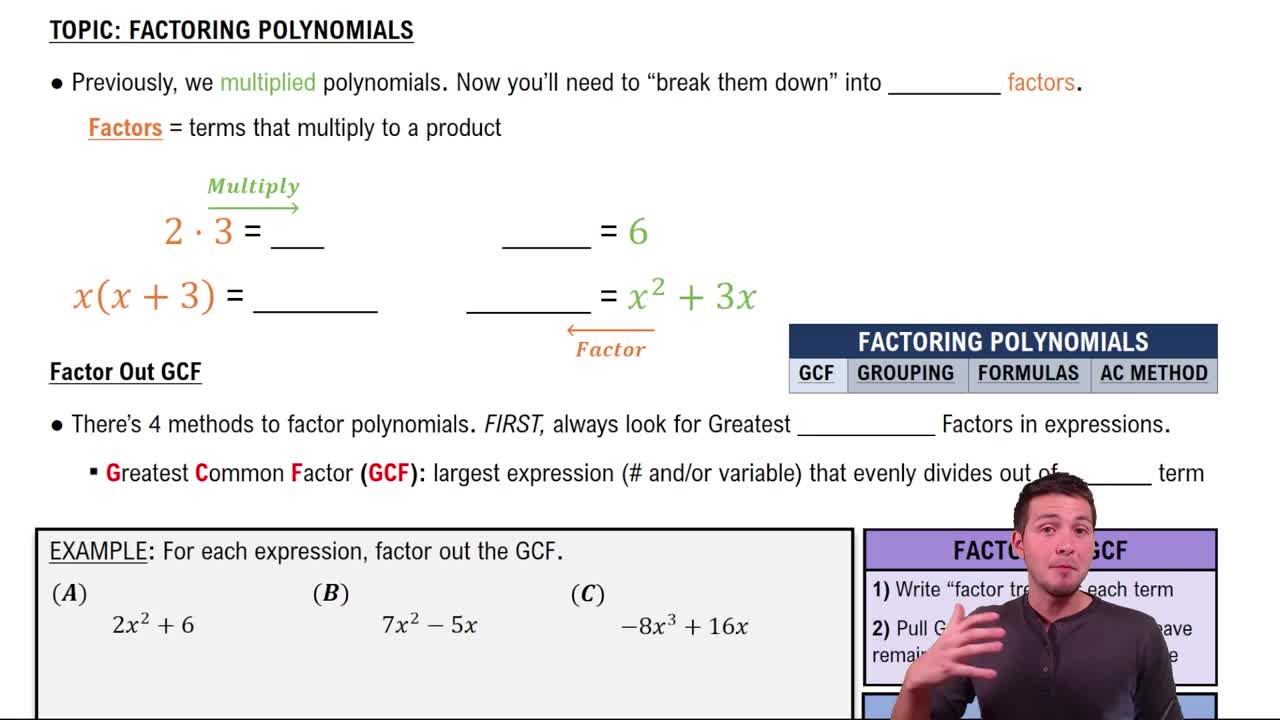
Introduction to Factoring Polynomials
Rearranging Equations to Standard Form
Before applying the zero-factor property, the equation must be rewritten in standard form, meaning all terms are on one side and the equation equals zero. This step is crucial because factoring and applying the zero-factor property require the equation to be set to zero.
Recommended video:
Guided course
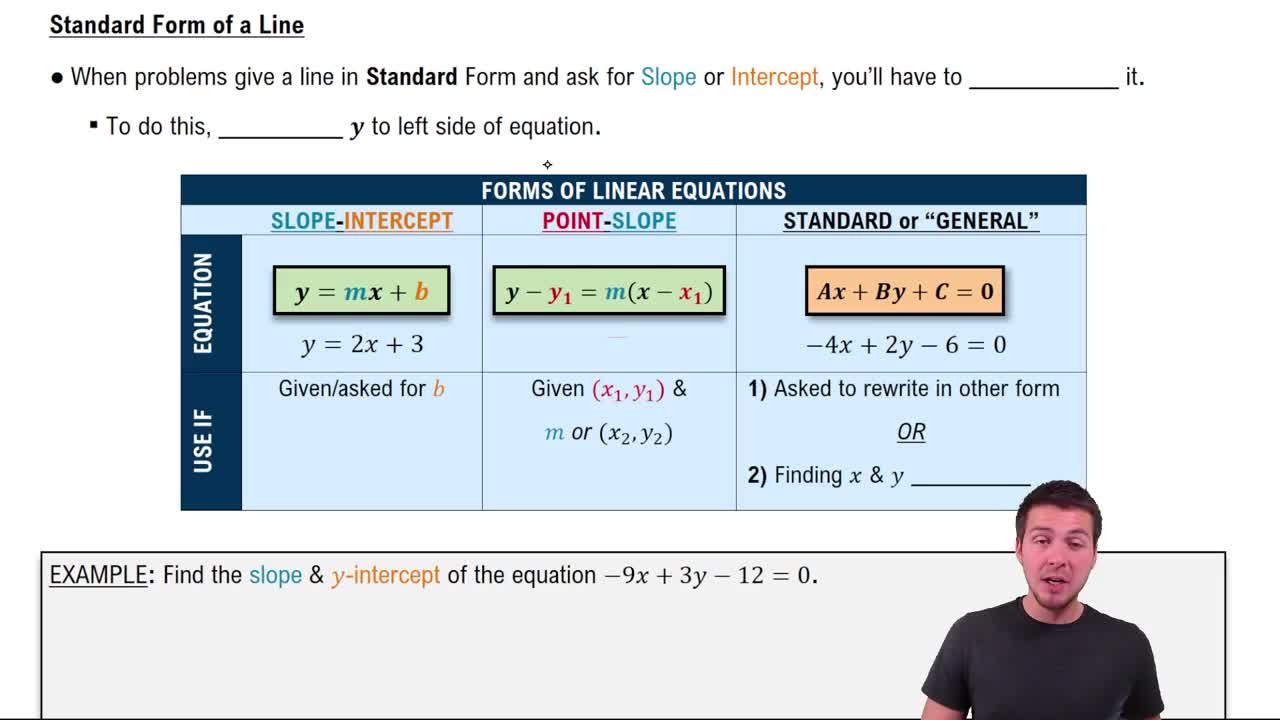
Standard Form of Line Equations
Factoring Quadratic Expressions
Factoring involves expressing a quadratic expression as a product of two binomials or other factors. Recognizing common factoring techniques, such as factoring out the greatest common factor or using methods like grouping or the quadratic formula, is key to breaking down the equation for applying the zero-factor property.
Recommended video:
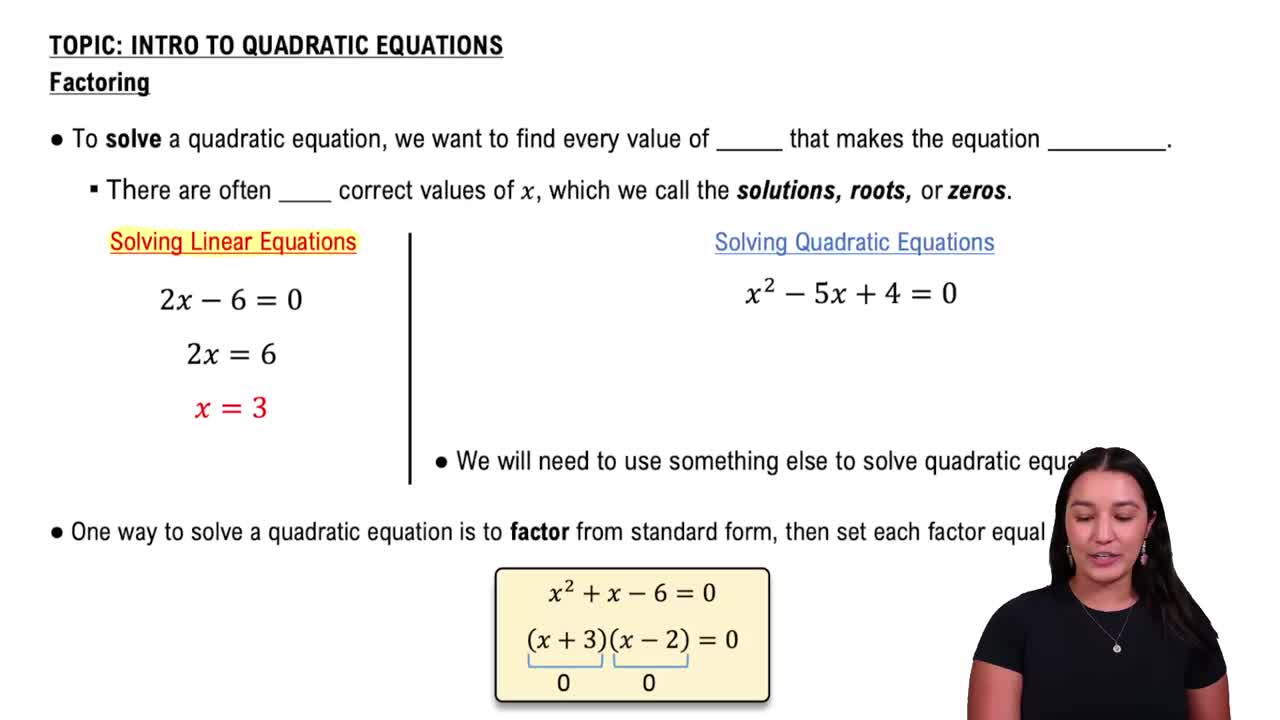
Solving Quadratic Equations by Factoring
Related Practice
Textbook Question
841
views
Textbook Question
Solve each equation.
546
views
Textbook Question
Solve each inequality. Give the solution set in interval notation. 6x-(2x+3)≥4x-5
61
views
Textbook Question
Solve each equation. See Example 1. (2x+5)/2 - 3x/(x-2) = x
567
views
Textbook Question
Solve each equation. (4x+3)/4 - 2x/(x+1) = x
572
views
Textbook Question
Use the following facts. If x represents an integer, then x+1 represents the next consecutive integer. If x represents an even integer, then x+2 represents the next consecutive even integer. If x represents an odd integer, then x+2 represents the next consecutive odd integer. The difference of the squares of two positive consecutive even integers is 84. Find the integers.
853
views
