Factor each polynomial. See Example 7. 9(a-4)2+30(a-4)+25
Verified step by step guidance
1
Recognize that the polynomial is in terms of the binomial expression \((a-4)\). To simplify, let \(x = (a-4)\), so the polynomial becomes \$9x^2 + 30x + 25$.
Identify the quadratic trinomial \$9x^2 + 30x + 25\( and look for a way to factor it. Since the leading coefficient is not 1, consider factoring by grouping or using the method of finding two numbers that multiply to \(9 \times 25 = 225\) and add to \)30$.
Find two numbers that multiply to 225 and add to 30. These numbers are 15 and 15, which suggests the trinomial might be a perfect square.
Rewrite the trinomial as \$9x^2 + 15x + 15x + 25\( and then group terms: \)(9x^2 + 15x) + (15x + 25)$.
Factor each group: \$3x(3x + 5) + 5(3x + 5)\(, then factor out the common binomial \)(3x + 5)\( to get \)(3x + 5)^2\(. Finally, substitute back \)x = (a-4)\( to write the factorization as \)(3(a-4) + 5)^2$.
Verified video answer for a similar problem:
This video solution was recommended by our tutors as helpful for the problem above
Video duration:
3m
Play a video:
0 Comments
Key Concepts
Here are the essential concepts you must grasp in order to answer the question correctly.
Polynomial Factoring
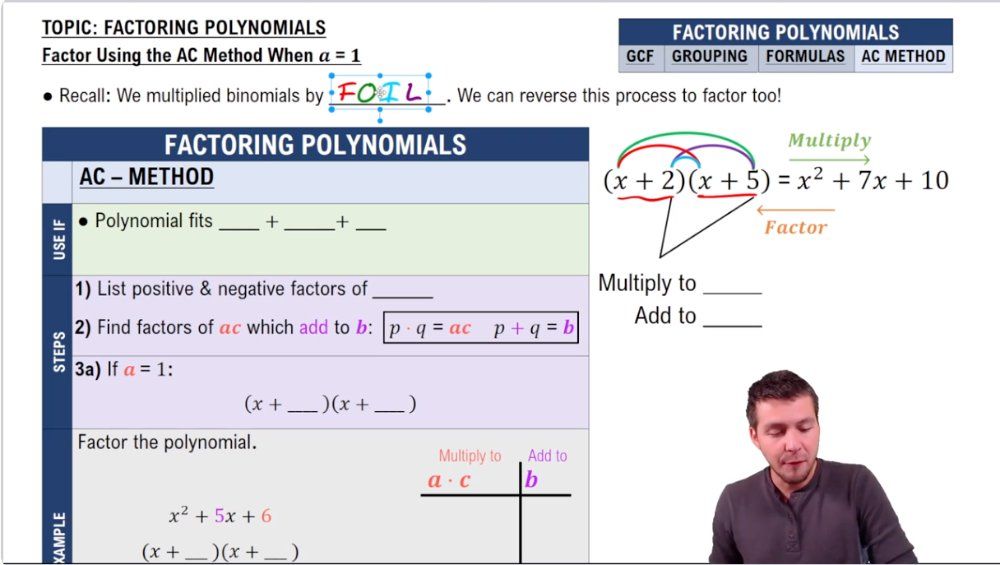
Factoring polynomials involves rewriting a polynomial as a product of simpler polynomials or expressions. This process helps simplify expressions and solve equations. Common methods include factoring out the greatest common factor, grouping, and recognizing special products like perfect square trinomials.
A perfect square trinomial is a quadratic expression that can be written as the square of a binomial, typically in the form a² ± 2ab + b² = (a ± b)². Recognizing this pattern allows quick factoring without trial and error, such as factoring 9(a-4)² + 30(a-4) + 25 into a binomial square.
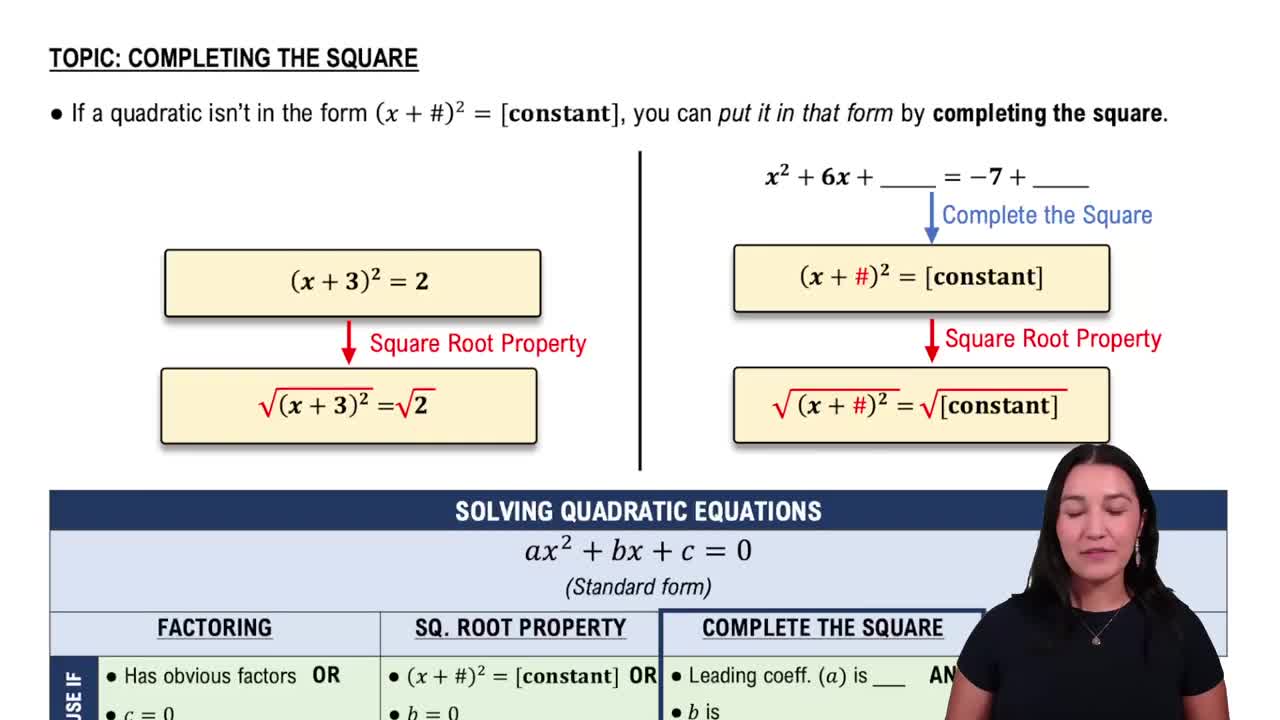
Solving Quadratic Equations by Completing the Square
Substitution Method in Factoring
Substitution involves temporarily replacing a complex expression with a single variable to simplify factoring. For example, letting x = (a-4) transforms the polynomial into a quadratic in x, making it easier to factor before substituting back the original expression.

 3:06 minutes
 Verified step by step guidance
 07:30
07:30