Recognize that the expression is in terms of the binomial \(4z - 3\). To simplify factoring, let \(x = 4z - 3\). This transforms the polynomial into \(6x^2 + 7x - 3\).
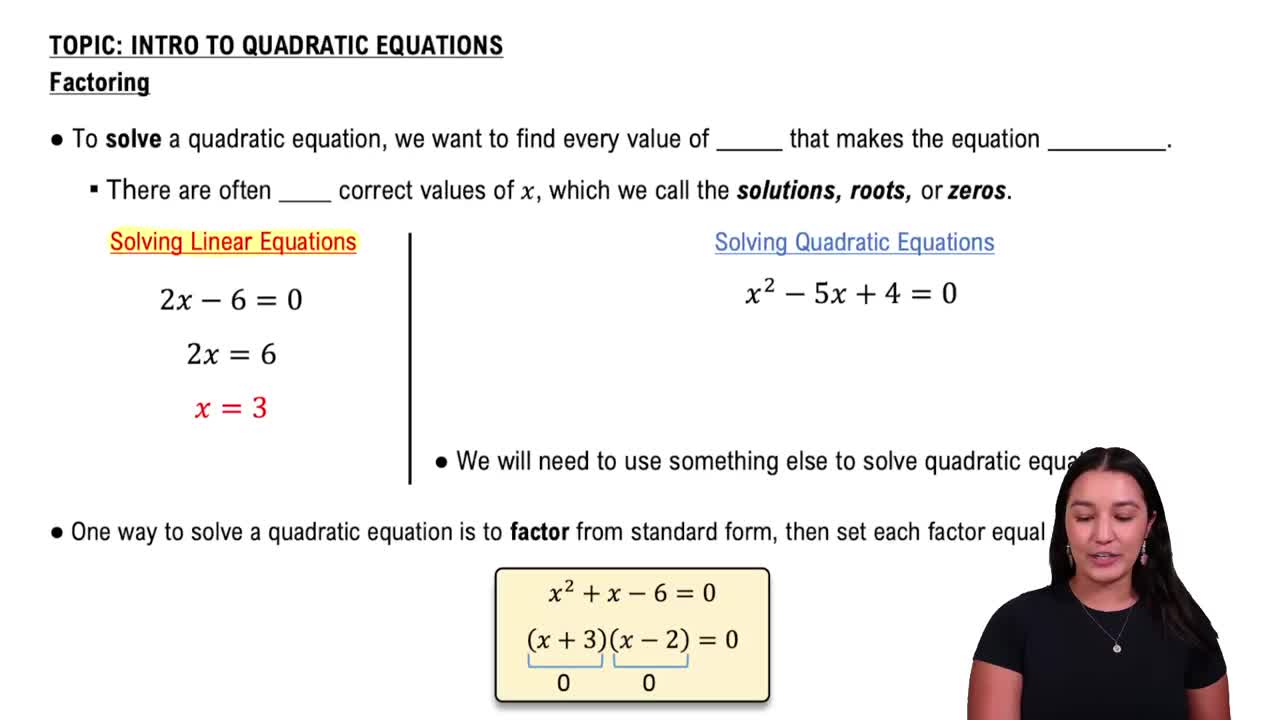
Focus on factoring the quadratic expression \(6x^2 + 7x - 3\). To do this, look for two numbers that multiply to \(6 \times (-3) = -18\) and add up to \(7\).
Once you find the two numbers, use them to split the middle term \(7x\) into two terms. This will rewrite the quadratic as \(6x^2 + (\text{first number})x + (\text{second number})x - 3\).
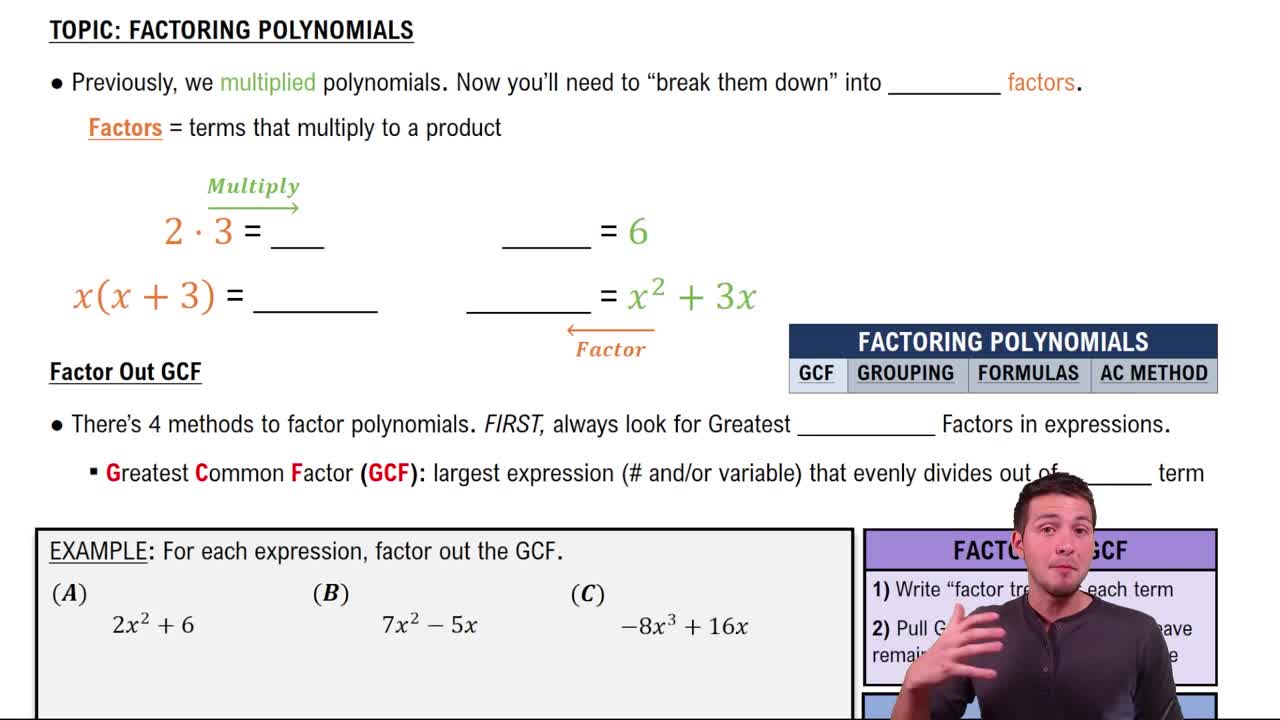
Group the terms in pairs and factor out the greatest common factor (GCF) from each group. This should allow you to factor by grouping and write the expression as a product of two binomials.
Finally, substitute back \(x = 4z - 3\) into the factored form to express the factorization in terms of \(z\).
Verified video answer for a similar problem:
This video solution was recommended by our tutors as helpful for the problem above
Video duration:
4m
Play a video:
0 Comments
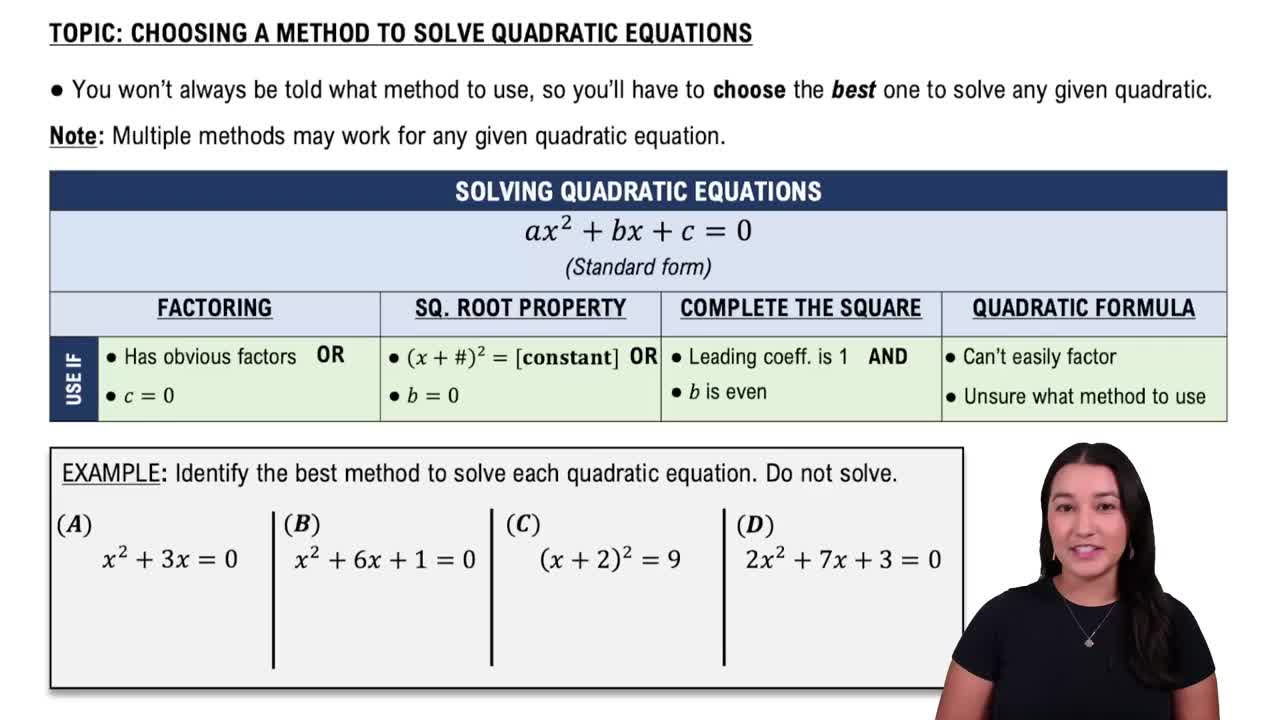
Key Concepts
Here are the essential concepts you must grasp in order to answer the question correctly.
Polynomial Factoring
Factoring polynomials involves rewriting a polynomial as a product of simpler polynomials or expressions. This process helps simplify expressions and solve equations. Recognizing common patterns like quadratics or special products is essential for effective factoring.
The substitution method involves replacing a complex expression with a single variable to simplify the polynomial. For example, letting u = (4z - 3) transforms the given polynomial into a quadratic in terms of u, making it easier to factor.
Quadratic factoring is the process of expressing a quadratic polynomial ax^2 + bx + c as a product of two binomials. Techniques include factoring by grouping, using the AC method, or applying the quadratic formula to find roots that help factor the expression.

 4:31 minutes
 Verified step by step guidance
 07:30
07:30