Ch. R - Review of Basic Concepts
Lial - College Algebra 13th Edition
Lial13th EditionCollege AlgebraISBN: 9780136881063Not the one you use?Change textbook
Chapter 1, Problem 100

Perform each division. See Examples 9 and 10.
(3x32x+5)(x3)\(\frac{(3x^3-2x+5)}{(x-3)}\)

Verified step by step guidance
1
Identify the given expression to divide: \(\frac{3x^3 - 2x + 5}{x - 3}\). This is a polynomial division problem where the numerator is a cubic polynomial and the denominator is a linear polynomial.
Set up the polynomial long division by writing \$3x^3 - 2x + 5\( (the dividend) under the division bar and \)x - 3$ (the divisor) outside the division bar.
Divide the leading term of the dividend, \$3x^3\(, by the leading term of the divisor, \)x\(, to find the first term of the quotient. This gives \)3x^2$.
Multiply the entire divisor \(x - 3\) by this term \$3x^2$ and subtract the result from the dividend. Then bring down the next terms to form a new polynomial.
Repeat the process: divide the leading term of the new polynomial by \(x\), multiply the divisor by this result, subtract, and continue until the degree of the remainder is less than the degree of the divisor.

Verified video answer for a similar problem:

This video solution was recommended by our tutors as helpful for the problem above.
Video duration:
5m
Was this helpful?

Key Concepts

Here are the essential concepts you must grasp in order to answer the question correctly.

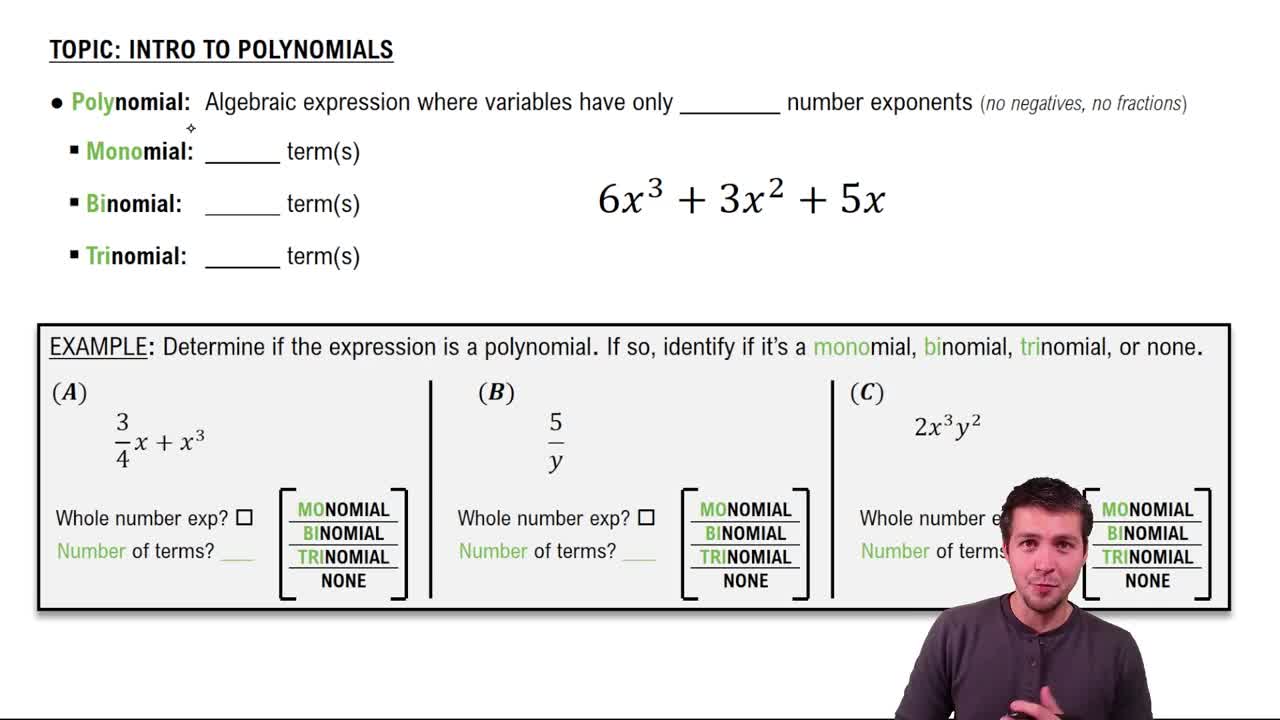
Polynomial Long Division

Polynomial long division is a method used to divide a polynomial by another polynomial of lower degree, similar to numerical long division. It involves dividing the leading term of the dividend by the leading term of the divisor, multiplying, subtracting, and repeating until the remainder has a lower degree than the divisor.
Recommended video:
Guided course
05:13
Introduction to Polynomials

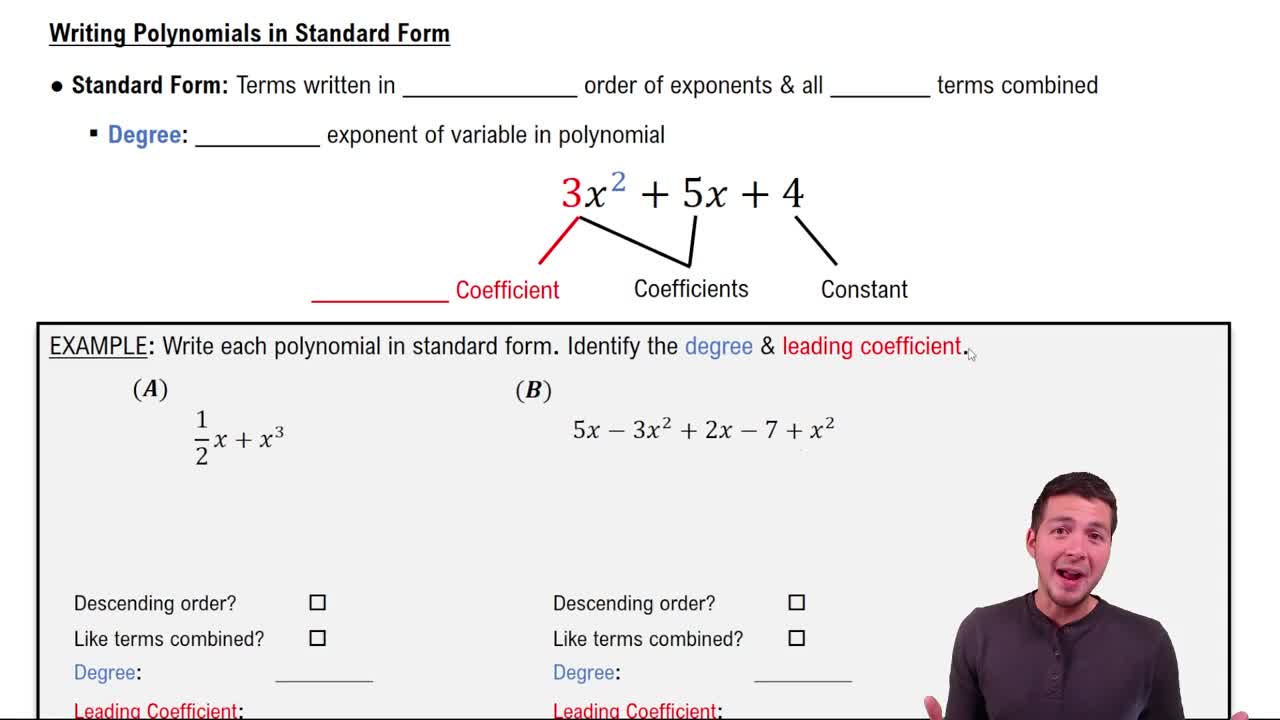
Degree of a Polynomial

The degree of a polynomial is the highest power of the variable in the expression. Understanding the degree helps determine the steps in division and when to stop, as the division process continues until the remainder's degree is less than the divisor's degree.
Recommended video:
Guided course
05:16
Standard Form of Polynomials

Remainder and Quotient in Polynomial Division

When dividing polynomials, the result consists of a quotient and possibly a remainder. The quotient is the polynomial obtained from the division, and the remainder is what is left over, having a degree less than the divisor. The original expression can be written as divisor × quotient + remainder.
Recommended video:
Guided course
05:13
Introduction to Polynomials