Ch. 2 - Graphs and Functions
Lial - College Algebra 13th Edition
Lial13th EditionCollege AlgebraISBN: 9780136881063Not the one you use?Change textbook
Chapter 3, Problem 85

Graph each function. See Examples 6–8 and the Summary of Graphing Techniques box following Example 9. ƒ(x)=2√x+1

Verified step by step guidance
1
Identify the base function and the transformations applied. The given function is \(f(x) = 2\sqrt{x} + 1\), which is a transformation of the basic square root function \(y = \sqrt{x}\).
Recall the graph of the parent function \(y = \sqrt{x}\), which starts at the origin \((0,0)\) and increases slowly to the right.
Apply the vertical stretch by a factor of 2. This means every \(y\)-value of \(\sqrt{x}\) is multiplied by 2, so the graph becomes steeper. The function now looks like \(y = 2\sqrt{x}\).
Apply the vertical shift upward by 1 unit. This means you add 1 to every \(y\)-value of \(2\sqrt{x}\), resulting in the function \(f(x) = 2\sqrt{x} + 1\).
Plot key points to sketch the graph: start with \(x=0\) giving \(f(0) = 2\sqrt{0} + 1 = 1\), then choose other \(x\) values (like 1, 4, 9) to find corresponding \(y\) values, and plot these points to see the shape of the graph.

Verified video answer for a similar problem:

This video solution was recommended by our tutors as helpful for the problem above.
Video duration:
1m
Was this helpful?

Key Concepts

Here are the essential concepts you must grasp in order to answer the question correctly.

Square Root Function

A square root function is of the form f(x) = √x, which produces outputs that are the non-negative square roots of x. Its graph starts at the origin (0,0) and increases slowly, only defined for x ≥ 0. Understanding this basic shape helps in graphing transformations.
Recommended video:
02:20
Imaginary Roots with the Square Root Property

Function Transformations

Function transformations include shifts, stretches, and reflections applied to the parent function. For f(x) = 2√(x) + 1, the coefficient 2 vertically stretches the graph, and the +1 shifts it upward by 1 unit. Recognizing these changes helps in accurately sketching the graph.
Recommended video:
4:22
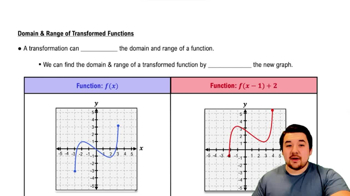
Domain & Range of Transformed Functions

Domain and Range

The domain is the set of all input values for which the function is defined, and the range is the set of possible outputs. For f(x) = 2√x + 1, the domain is x ≥ 0 because of the square root, and the range is y ≥ 1 due to the vertical shift upward.
Recommended video:
4:22
Domain & Range of Transformed Functions