Ch. 4 - Inverse, Exponential, and Logarithmic Functions
Lial - College Algebra 13th Edition
Lial13th EditionCollege AlgebraISBN: 9780136881063Not the one you use?Change textbook
Chapter 5, Problem 65

Solve each equation. Give solutions in exact form. See Examples 5–9. log8 (x + 2) + log8 (x + 4) = log8 8

Verified step by step guidance
1
Recall the logarithm property that allows you to combine the sum of two logs with the same base: \(\log_b A + \log_b B = \log_b (A \times B)\). Apply this to the left side: \(\log_8 (x + 2) + \log_8 (x + 4) = \log_8 ((x + 2)(x + 4))\).
Rewrite the equation using the combined logarithm: \(\log_8 ((x + 2)(x + 4)) = \log_8 8\).
Since the logarithms on both sides have the same base and are equal, set their arguments equal: \((x + 2)(x + 4) = 8\).
Expand the left side: \(x^2 + 4x + 2x + 8 = 8\), which simplifies to \(x^2 + 6x + 8 = 8\).
Subtract 8 from both sides to set the quadratic equation to zero: \(x^2 + 6x + 8 - 8 = 0\), simplifying to \(x^2 + 6x = 0\). Then solve this quadratic equation for \(x\).

Verified video answer for a similar problem:

This video solution was recommended by our tutors as helpful for the problem above.
Video duration:
5m
Was this helpful?

Key Concepts

Here are the essential concepts you must grasp in order to answer the question correctly.

Properties of Logarithms

Logarithmic properties, such as the product rule, allow combining or separating logarithms with the same base. For example, log_b(A) + log_b(B) = log_b(AB). This property is essential for simplifying the given equation by combining terms on one side.
Recommended video:
5:36
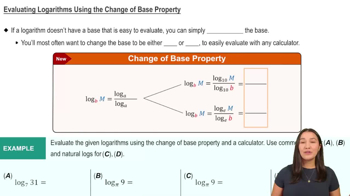
Change of Base Property

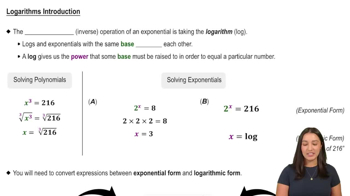
Definition of Logarithms and Their Inverses

A logarithm log_b(A) answers the question: to what power must b be raised to get A? Understanding this helps convert logarithmic equations into exponential form, making it easier to solve for the variable.
Recommended video:
7:30
Logarithms Introduction

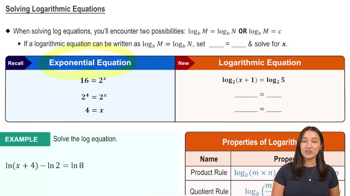
Solving Equations and Checking for Extraneous Solutions

After manipulating the equation, solving for the variable involves algebraic techniques. Since logarithms are only defined for positive arguments, solutions must be checked to ensure they do not make any log argument non-positive, avoiding extraneous solutions.
Recommended video:
5:02
Solving Logarithmic Equations