
Solve each problem. See Examples 5 and 6. Formaldehyde is an indoor air pollutant formerly found in plywood, foam insulation, and carpeting. When concentrations in the air reach 33 micrograms per cubic foot (μg/ft3), eye irritation can occur. One square foot of new plywood could emit 140 μg per hr. (Data from A. Hines, Indoor Air Quality & Control.) A room has 100 ft2 of new plywood flooring. Find a linear equation F that computes the amount of formaldehyde, in micrograms, emitted in x hours.

Solve each formula for the specified variable. Assume that the denominator is not 0 if variables appear in the denominator. F = GMm/r², for m (force of gravity)
Verified step by step guidance
Verified video answer for a similar problem:
Key Concepts
Algebraic Manipulation
Solving for a Variable in a Formula
Handling Variables in Denominators
Solve each problem. See Examples 5 and 6. Formaldehyde is an indoor air pollutant formerly found in plywood, foam insulation, and carpeting. When concentrations in the air reach 33 micrograms per cubic foot (μg/ft^3), eye irritation can occur. One square foot of new plywood could emit 140 μg per hr. (Data from A. Hines, Indoor Air Quality & Control.) The room contains 800 ft^3 of air and has no ventilation. Determine how long it would take for concentrations to reach 33 μg/ft^3. (Round to the nearest tenth.)
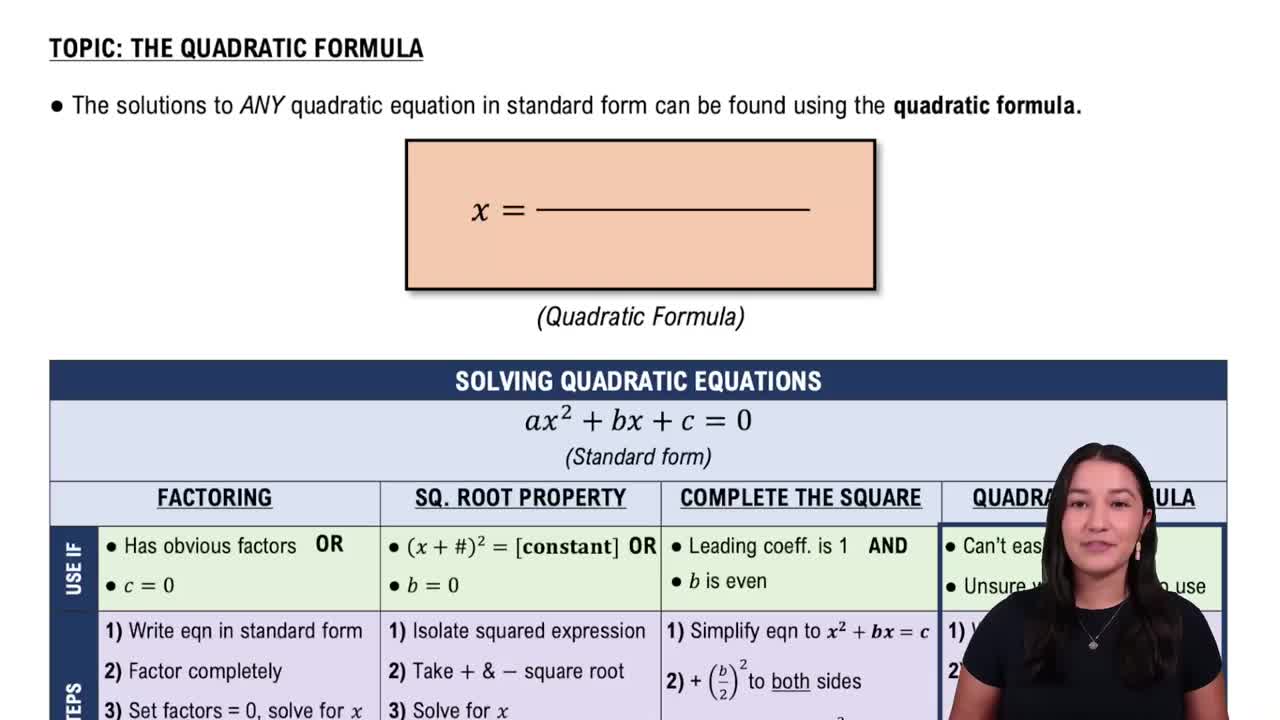
Solve each equation using completing the square. 3x2 + 2x = 5
Write each number in standard form a+bi. 10+ √-200 / 5
Solve each quadratic inequality. Give the solution set in interval notation. 3x2+x≤4
Solve each equation or inequality. |8 - 3x| - 3 = -2
