Ch. 3 - Polynomial and Rational Functions
Lial - College Algebra 13th Edition
Lial13th EditionCollege AlgebraISBN: 9780136881063Not the one you use?Change textbook
Chapter 4, Problem 62

Show that the real zeros of each polynomial function satisfy the given conditions. See Example 6.
ƒ(x)=3x4+2x34x2+x1ƒ(x)=3x^4+2x^3-4x^2+x-1; no real zero less than -2

Verified step by step guidance
1
First, understand the problem: we need to show that the real zeros of the polynomial function \(f(x) = 3x^4 + 2x^3 - 4x^2 + x - 1\) are all greater than or equal to \(-2\), meaning there are no real zeros less than \(-2\).
Evaluate the polynomial at \(x = -2\) to check the sign of \(f(-2)\). Substitute \(x = -2\) into the polynomial: \(f(-2) = 3(-2)^4 + 2(-2)^3 - 4(-2)^2 + (-2) - 1\).
Next, analyze the behavior of \(f(x)\) for values less than \(-2\). One way is to check the sign of \(f(x)\) at a value less than \(-2\), for example at \(x = -3\), by substituting \(x = -3\) into the polynomial.
If \(f(-2)\) and \(f(-3)\) have the same sign (both positive or both negative), then by the Intermediate Value Theorem, there is no zero between \(-3\) and \(-2\). Repeat this for other values less than \(-2\) if necessary to confirm no sign changes occur.
Finally, conclude that since the polynomial does not change sign for \(x < -2\), there are no real zeros less than \(-2\). This shows all real zeros satisfy the condition of being greater than or equal to \(-2\).

Verified video answer for a similar problem:

This video solution was recommended by our tutors as helpful for the problem above.
Video duration:
6m
Was this helpful?

Key Concepts

Here are the essential concepts you must grasp in order to answer the question correctly.

Real Zeros of Polynomial Functions

Real zeros of a polynomial are the values of x for which the polynomial equals zero. These zeros correspond to the x-intercepts of the graph. Finding real zeros often involves factoring, using the Rational Root Theorem, or applying numerical methods.
Recommended video:
06:04
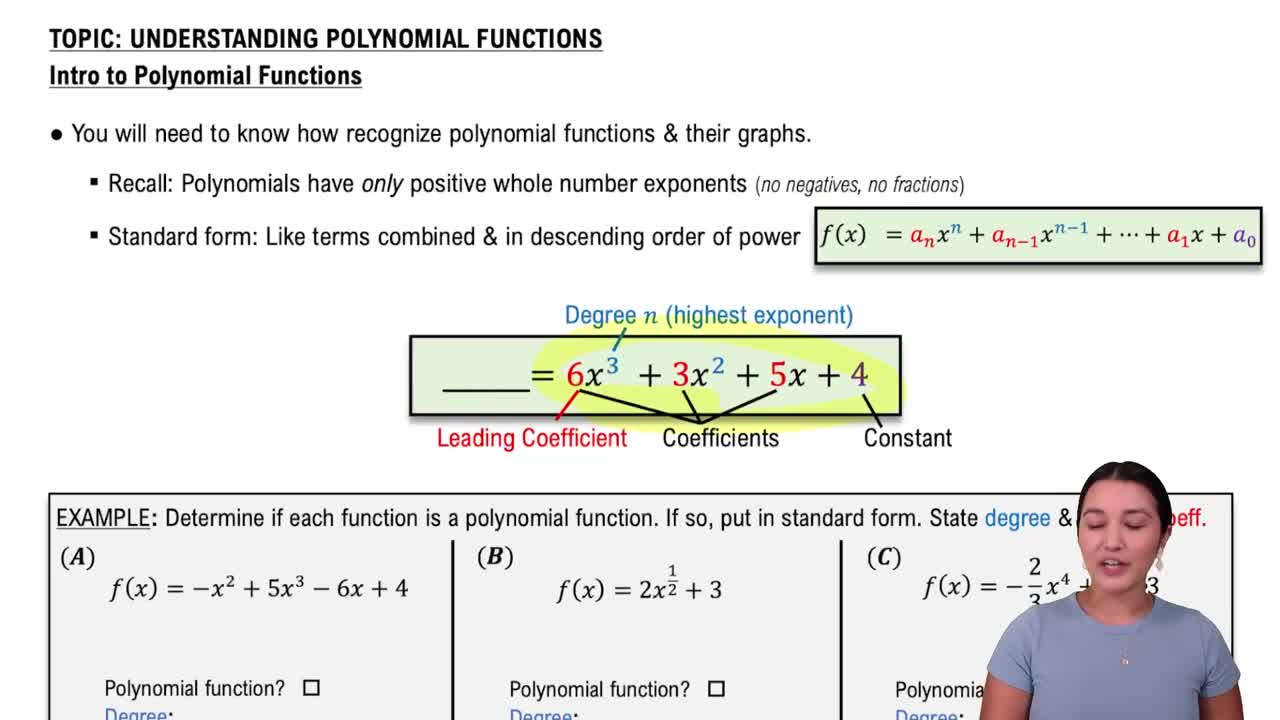
Introduction to Polynomial Functions

Evaluating Polynomial Values to Test Inequalities

To verify conditions on zeros, such as no real zero less than a certain value, evaluate the polynomial at strategic points and analyze sign changes. This helps determine intervals where zeros may lie, using the Intermediate Value Theorem.
Recommended video:

Intermediate Value Theorem

The Intermediate Value Theorem states that if a continuous function changes sign over an interval, it must have a zero within that interval. This theorem is essential for locating zeros and confirming their position relative to given bounds.
Recommended video:
6:15
Introduction to Hyperbolas