Factor out the greatest common factor from each polynomial. See Example 1. 5h2j+hj
Verified step by step guidance
1
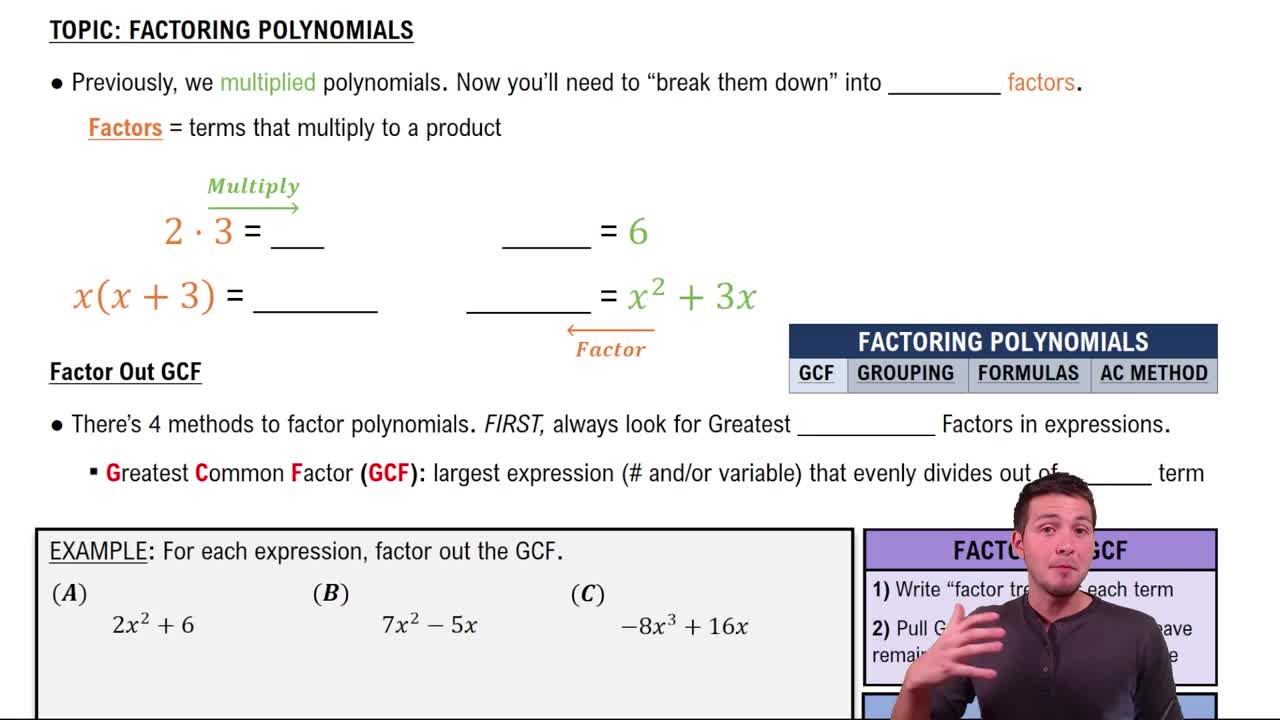
Identify the greatest common factor (GCF) of the terms in the polynomial \$5h^2j + hj$. Look at the coefficients and the variables separately.
For the coefficients, find the GCF of 5 and 1 (since the second term has an implied coefficient of 1). The GCF is 1.
For the variables, find the common variables with the smallest exponents in both terms. Both terms have \(h\) and \(j\), with the smallest powers being \(h^1\) and \(j^1\).
Combine the GCF of the coefficients and variables to get the overall GCF, which is \(hj\).
Factor out \(hj\) from each term: write \(hj\) outside the parentheses and divide each term by \(hj\) inside the parentheses, resulting in \(hj(5h + 1)\).
Verified video answer for a similar problem:
This video solution was recommended by our tutors as helpful for the problem above
Video duration:
3m
Play a video:
0 Comments
Key Concepts
Here are the essential concepts you must grasp in order to answer the question correctly.
Greatest Common Factor (GCF)
The Greatest Common Factor is the largest factor that divides two or more terms without leaving a remainder. In polynomials, it includes the highest power of variables and the largest numerical coefficient common to all terms. Factoring out the GCF simplifies expressions and is the first step in polynomial factorization.
Factoring polynomials involves rewriting the expression as a product of simpler polynomials or factors. Extracting the GCF is a fundamental factoring technique that reduces the polynomial to a product of the GCF and a simpler polynomial, making further operations easier.
Understanding how to handle variables with exponents and coefficients is essential when factoring. The GCF includes the lowest exponent of each variable common to all terms, and the numerical GCF is the largest number dividing all coefficients. Correctly identifying these ensures accurate factoring.