Use synthetic division to determine whether the given number k is a zero of the polynomial function. If it is not, give the value of ƒ(k). ƒ(x) = x2 +2x -8; k=2
Ch. 3 - Polynomial and Rational Functions

Chapter 4, Problem 47
Solve each polynomial inequality. Give the solution set in interval notation. x4 + 6x2 + 1 ≥ 4x3 + 4x
Verified step by step guidance1
Rewrite the inequality by bringing all terms to one side to set the inequality to zero: \(x^{4} + 6x^{2} + 1 - 4x^{3} - 4x \geq 0\).
Rearrange the terms in descending order of powers of \(x\): \(x^{4} - 4x^{3} + 6x^{2} - 4x + 1 \geq 0\).
Attempt to factor the polynomial on the left side. Notice the pattern resembles a binomial expansion, so try to factor it as \((x^{2} - 2x + 1)^{2}\) or \((x - 1)^{4}\).
Confirm the factorization by expanding \((x - 1)^{4}\) to verify it matches the polynomial \(x^{4} - 4x^{3} + 6x^{2} - 4x + 1\).
Since \((x - 1)^{4} \geq 0\) for all real \(x\), determine the solution set by considering where the expression is greater than or equal to zero, which will be all real numbers.

Verified video answer for a similar problem:
This video solution was recommended by our tutors as helpful for the problem above.
Video duration:
10mWas this helpful?
Key Concepts
Here are the essential concepts you must grasp in order to answer the question correctly.
Polynomial Inequalities
Polynomial inequalities involve expressions where a polynomial is compared to another using inequality symbols (>, <, ≥, ≤). Solving them requires finding all values of the variable that make the inequality true, often by rearranging terms and analyzing the sign of the resulting expression.
Recommended video:
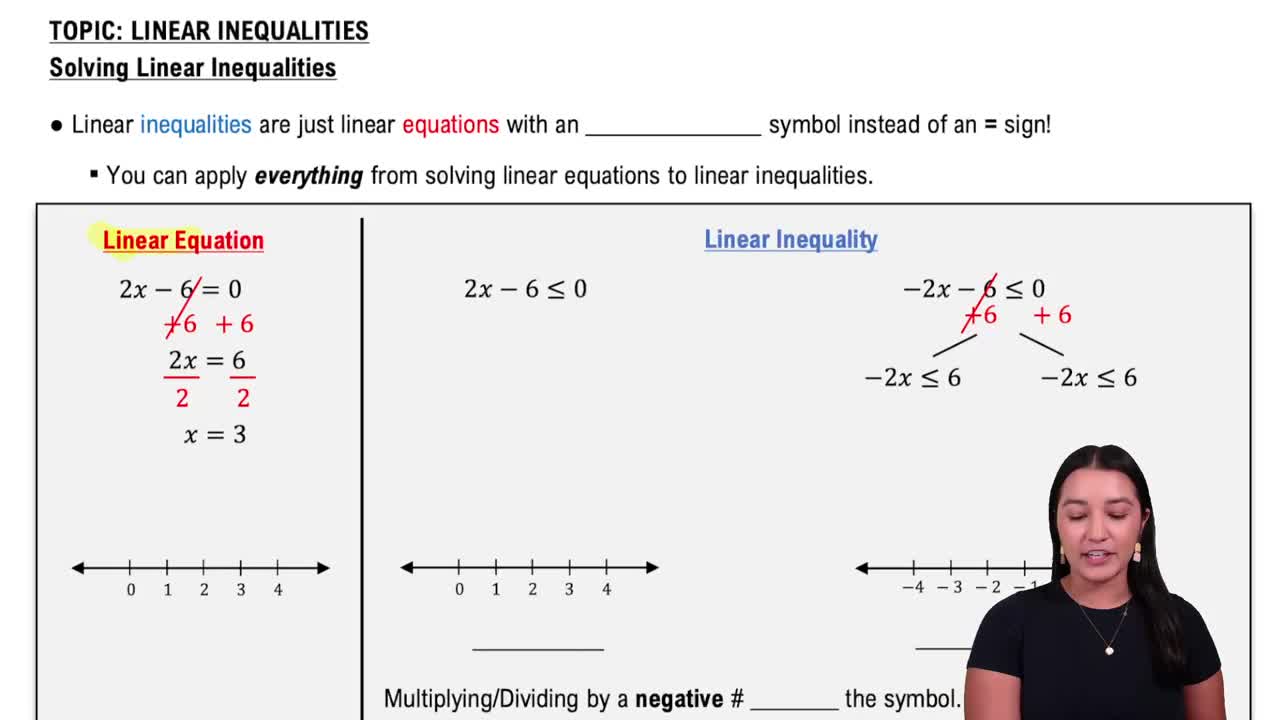
Linear Inequalities
Rearranging and Simplifying Expressions
To solve polynomial inequalities, first bring all terms to one side to set the inequality to zero. This simplification helps in factoring or applying other methods to determine where the polynomial is positive, negative, or zero, which is essential for identifying solution intervals.
Recommended video:
Guided course
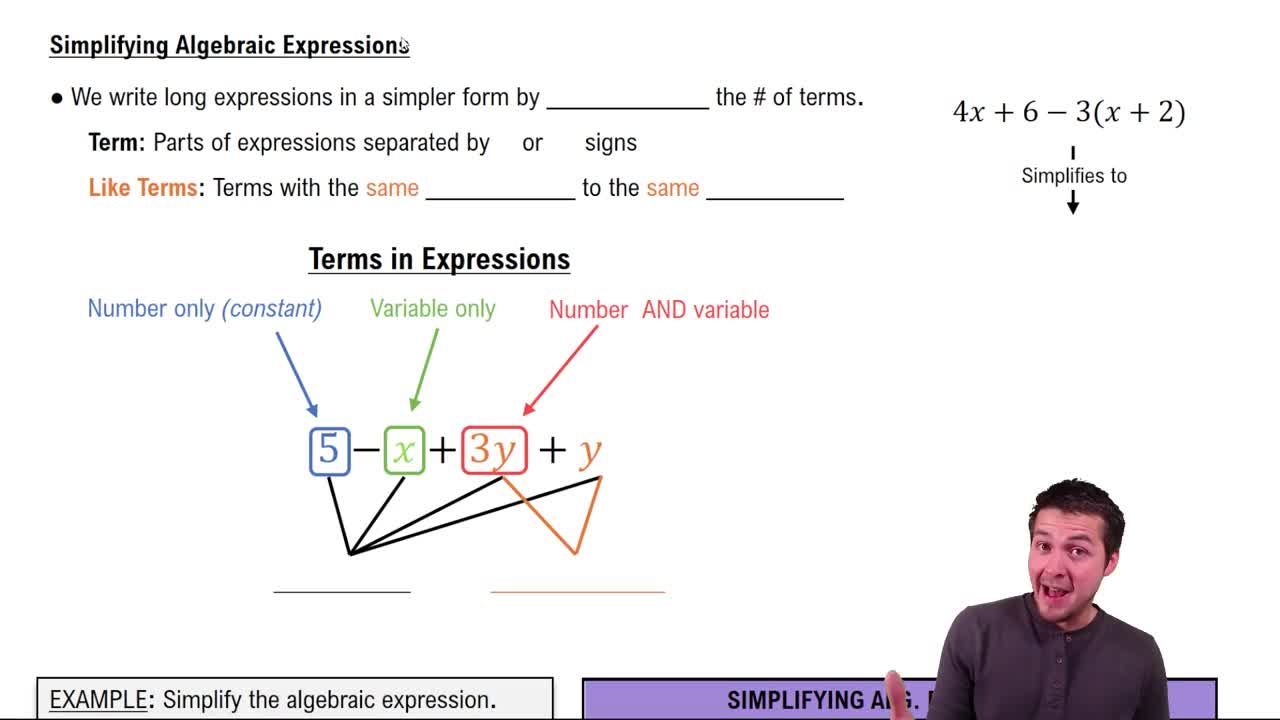
Simplifying Algebraic Expressions
Interval Notation and Sign Analysis
After finding critical points (roots), use sign analysis to test intervals between these points to see where the inequality holds. Expressing the solution set in interval notation concisely shows all values satisfying the inequality, using brackets for inclusive and parentheses for exclusive endpoints.
Recommended video:
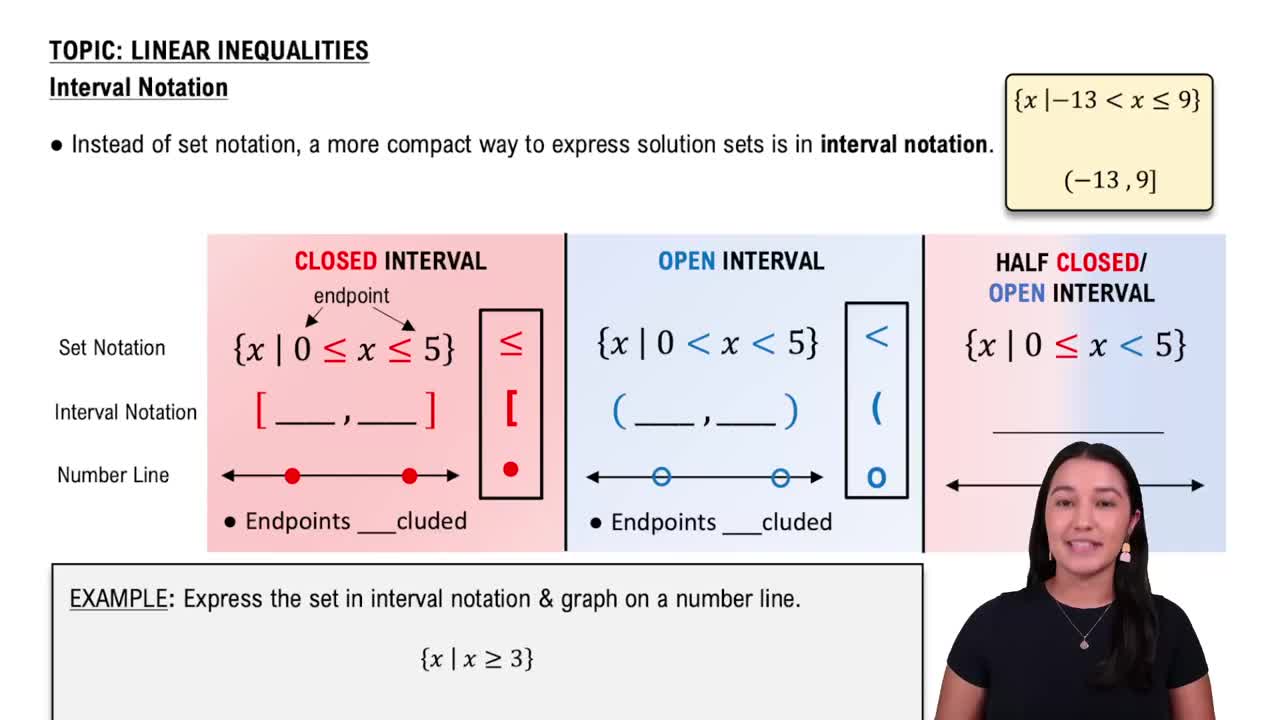
Interval Notation
Related Practice
Textbook Question
440
views
Textbook Question
Graph each polynomial function. ƒ(x)=(x-2)2(x+3)
921
views
Textbook Question
Give the equations of any vertical, horizontal, or oblique asymptotes for the graph of each rational function. ƒ(x)=(4x2+25)/(x2+9)
609
views
Textbook Question
Several graphs of the quadratic function ƒ(x) = ax2 + bx + c are shown below. For the given restrictions on a, b, and c, select the corresponding graph from choices A–F. (Hint: Use the discriminant.) a < 0; b2 - 4ac < 0
1237
views
Textbook Question
Graph each polynomial function. Factor first if the polynomial is not in factored form. ƒ(x)=x4+3x3-3x2-11x-6
724
views
Textbook Question
Use the intermediate value theorem to show that each polynomial function has a real zero between the numbers given. ƒ(x)=3x2-x-4; 1 and 2
1155
views