Ch. R - Review of Basic Concepts
Lial - College Algebra 13th Edition
Lial13th EditionCollege AlgebraISBN: 9780136881063Not the one you use?Change textbook
Chapter 1, Problem 34

If the expression is in exponential form, write it in radical form and evaluate if possible. If it is in radical form, write it in exponential form. Assume all variables represent positive real numbers. m2y5-m \(\sqrt{2y^5}\)

Verified step by step guidance
1
Identify the given expression and determine whether it is in exponential or radical form. The expression is \(-m \sqrt{2y^{5}}\), which is in radical form because it contains a square root symbol (\(\sqrt{\cdot}\)).
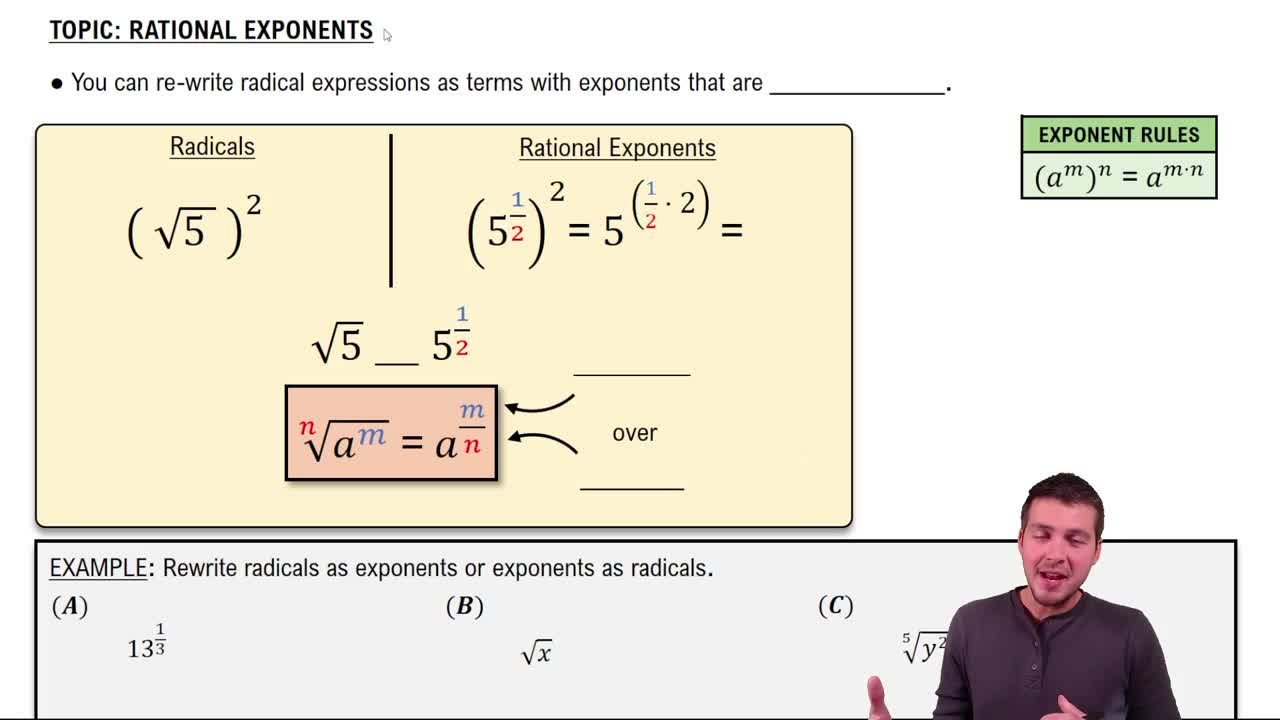
Recall the relationship between radicals and exponents: \(\sqrt[n]{a} = a^{\frac{1}{n}}\). For a square root, \(n = 2\), so \(\sqrt{a} = a^{\frac{1}{2}}\).
Rewrite the radical expression \(\sqrt{2y^{5}}\) using exponents: \(\sqrt{2y^{5}} = (2y^{5})^{\frac{1}{2}}\).
Apply the exponent to each factor inside the parentheses separately, using the property \((ab)^c = a^c b^c\). This gives \(2^{\frac{1}{2}} \cdot (y^{5})^{\frac{1}{2}}\).
Simplify the exponent on \(y\) by multiplying the exponents: \(y^{5 \cdot \frac{1}{2}} = y^{\frac{5}{2}}\). So the expression in exponential form is \(-m \cdot 2^{\frac{1}{2}} \cdot y^{\frac{5}{2}}\).

Verified video answer for a similar problem:

This video solution was recommended by our tutors as helpful for the problem above.
Video duration:
4m
Was this helpful?

Key Concepts

Here are the essential concepts you must grasp in order to answer the question correctly.

Exponential and Radical Forms

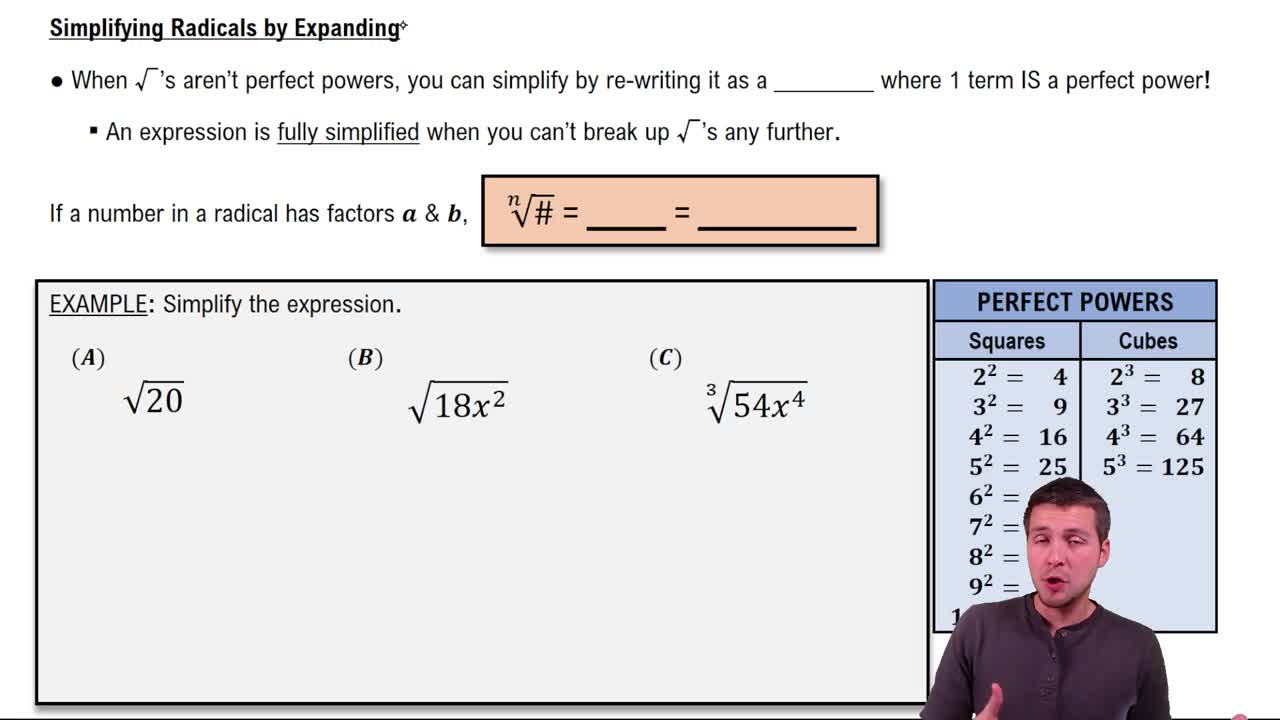
Exponential form expresses roots using fractional exponents, where the nth root of a number is written as that number raised to the power 1/n. Radical form uses the root symbol (√) to denote roots. Converting between these forms involves rewriting roots as fractional exponents and vice versa.
Recommended video:
Guided course
05:20
Expanding Radicals

Properties of Exponents

Understanding how to manipulate exponents is essential, including the rules for multiplying powers, raising powers to powers, and handling fractional exponents. For example, (a^m)^n = a^(m*n) and a^(1/n) represents the nth root of a. These properties help simplify expressions during conversion.
Recommended video:
Guided course
04:06
Rational Exponents

Evaluating Expressions with Positive Variables

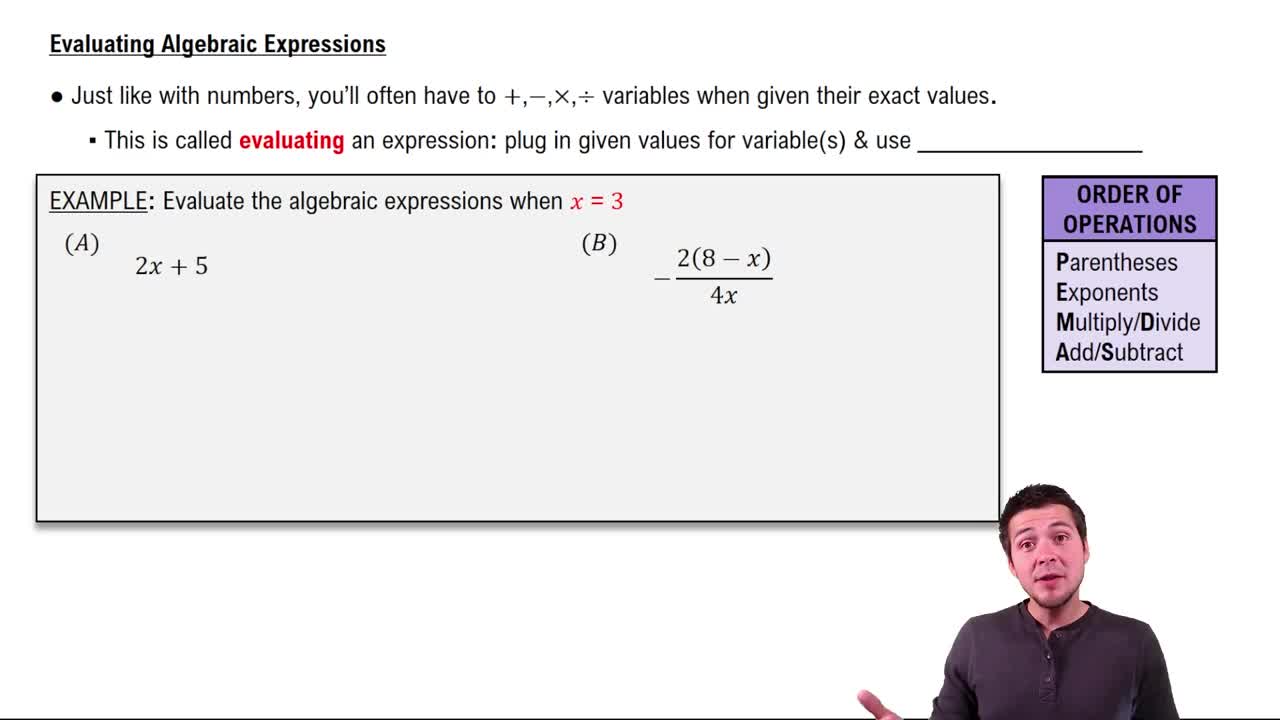
Since variables represent positive real numbers, it ensures that roots and fractional exponents are defined and real. This assumption allows simplification without considering complex numbers or absolute values, making evaluation straightforward when converting between forms.
Recommended video:
Guided course
03:11
Evaluating Algebraic Expressions