Ch. R - Review of Basic Concepts
Lial - College Algebra 13th Edition
Lial13th EditionCollege AlgebraISBN: 9780136881063Not the one you use?Change textbook
Chapter 1, Problem 35

Multiply or divide as indicated. Write answers in lowest terms as needed. 3141233\(\frac{1}{4}\) \(\cdot\) 1\(\frac{2}{3}\)

Verified step by step guidance
1
First, convert the mixed numbers to improper fractions. For 3\(\left\)(\(\frac{1}{4}\[\right\)), multiply the whole number 3 by the denominator 4 and add the numerator 1: \(\n\]\n\)\(3 \times 4 + 1 = 12 + 1 = 13\), so the improper fraction is \(\frac{13}{4}\).
Next, convert the second mixed number 1\(\left\)(\(\frac{2}{3}\[\right\)) to an improper fraction by multiplying the whole number 1 by the denominator 3 and adding the numerator 2: \(\n\]\n\)\(1 \times 3 + 2 = 3 + 2 = 5\), so the improper fraction is \(\frac{5}{3}\).
Now multiply the two improper fractions: \(\n\[\n\]\frac{13}{4} \times \frac{5}{3} = \frac{13 \times 5}{4 \times 3} = \frac{65}{12}\).
After multiplying, check if the fraction \(\frac{65}{12}\) can be simplified by finding the greatest common divisor (GCD) of 65 and 12. If the GCD is 1, the fraction is already in lowest terms.
Finally, if needed, convert the improper fraction back to a mixed number by dividing the numerator by the denominator: \(\n\[\n\]65 \div 12\) gives the whole number part and the remainder forms the numerator of the fractional part.

Verified video answer for a similar problem:

This video solution was recommended by our tutors as helpful for the problem above.
Video duration:
2m
Was this helpful?

Key Concepts

Here are the essential concepts you must grasp in order to answer the question correctly.

Multiplication of Mixed Numbers

To multiply mixed numbers, first convert them into improper fractions. This involves multiplying the whole number by the denominator and adding the numerator. Once converted, multiply the numerators together and the denominators together to find the product.
Recommended video:
4:47
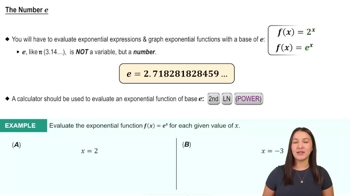
The Number e

Simplifying Fractions

After performing multiplication or division, simplify the resulting fraction by dividing the numerator and denominator by their greatest common divisor (GCD). This reduces the fraction to its lowest terms, making the answer clearer and more concise.
Recommended video:
Guided course
05:45
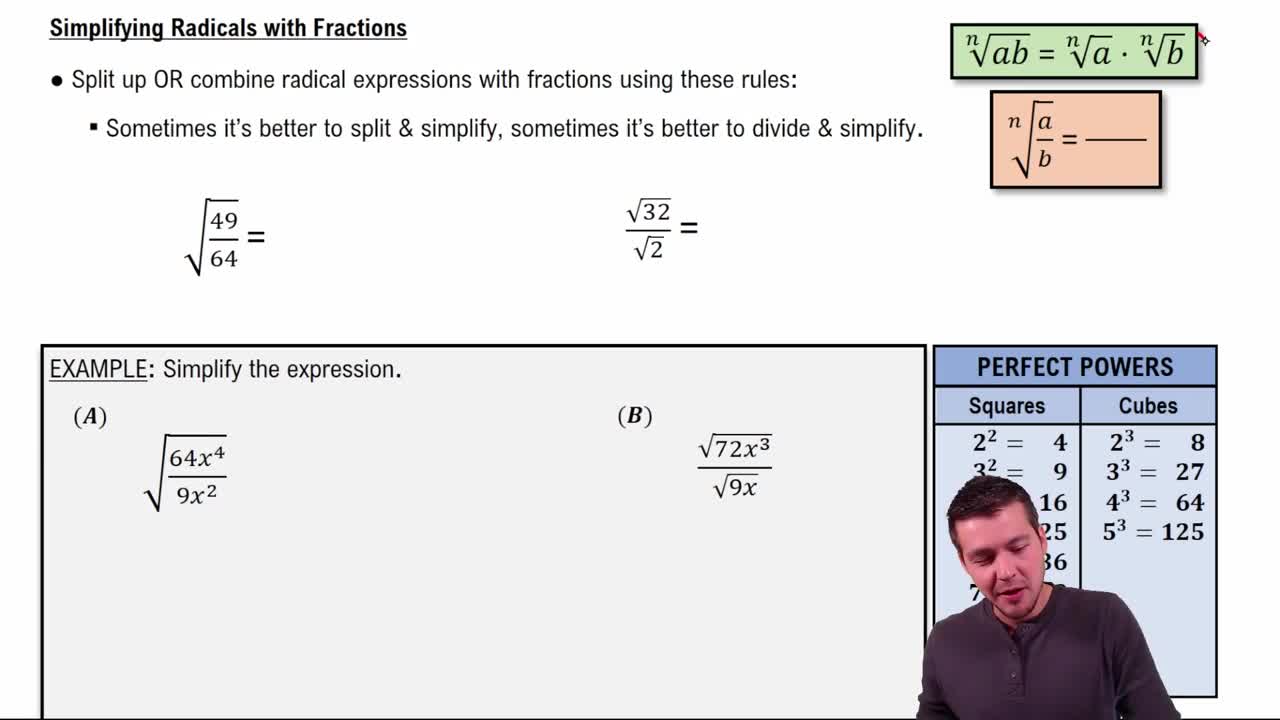
Radical Expressions with Fractions

Converting Improper Fractions to Mixed Numbers

If the product is an improper fraction (numerator larger than denominator), convert it back to a mixed number by dividing the numerator by the denominator. The quotient becomes the whole number, and the remainder over the denominator forms the fractional part.
Recommended video:
04:22
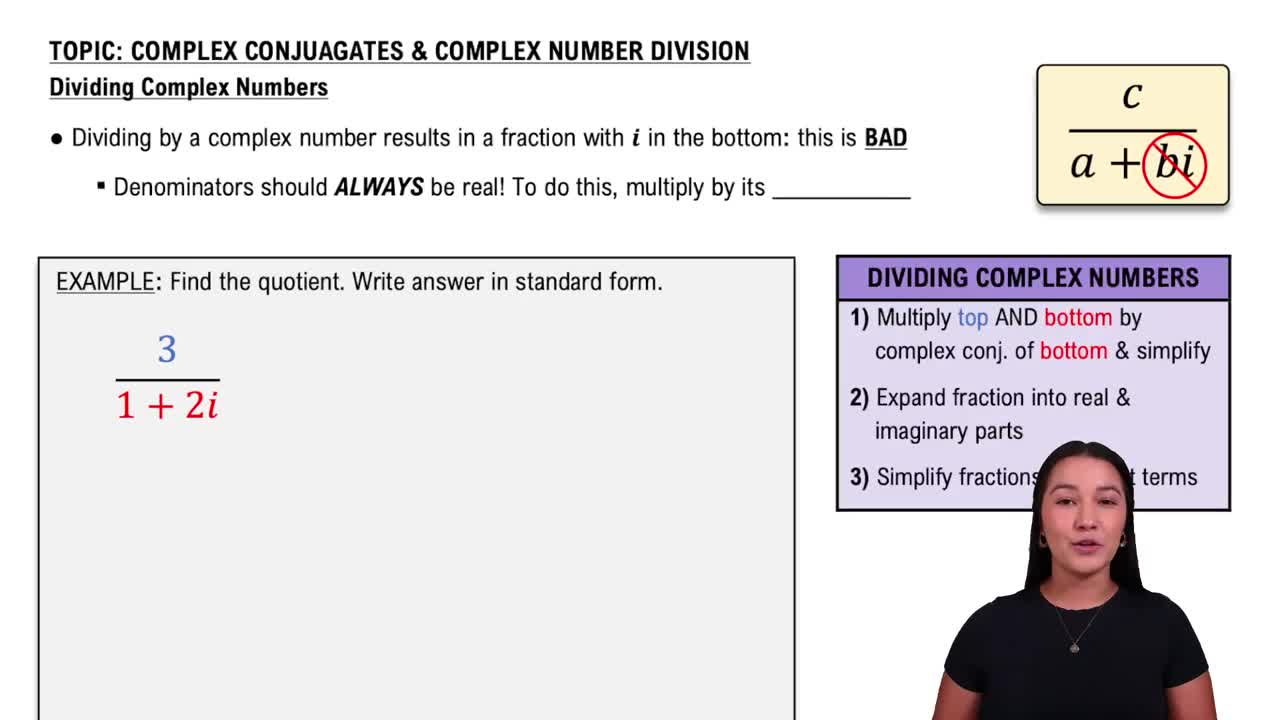
Dividing Complex Numbers