Perform the indicated operations. Assume all variables represent positive real numbers.
Ch. R - Review of Basic Concepts

Chapter 1, Problem 107
Factor by any method. See Examples 1–7. 64+(3x+2)3
Verified step by step guidance1
Recognize that the expression is a sum of two terms: \(64\) and \((3x+2)^3\). Notice that \(64\) is a perfect cube since \$64 = 4^3$.
Rewrite the expression as a sum of cubes: \$4^3 + (3x+2)^3$.
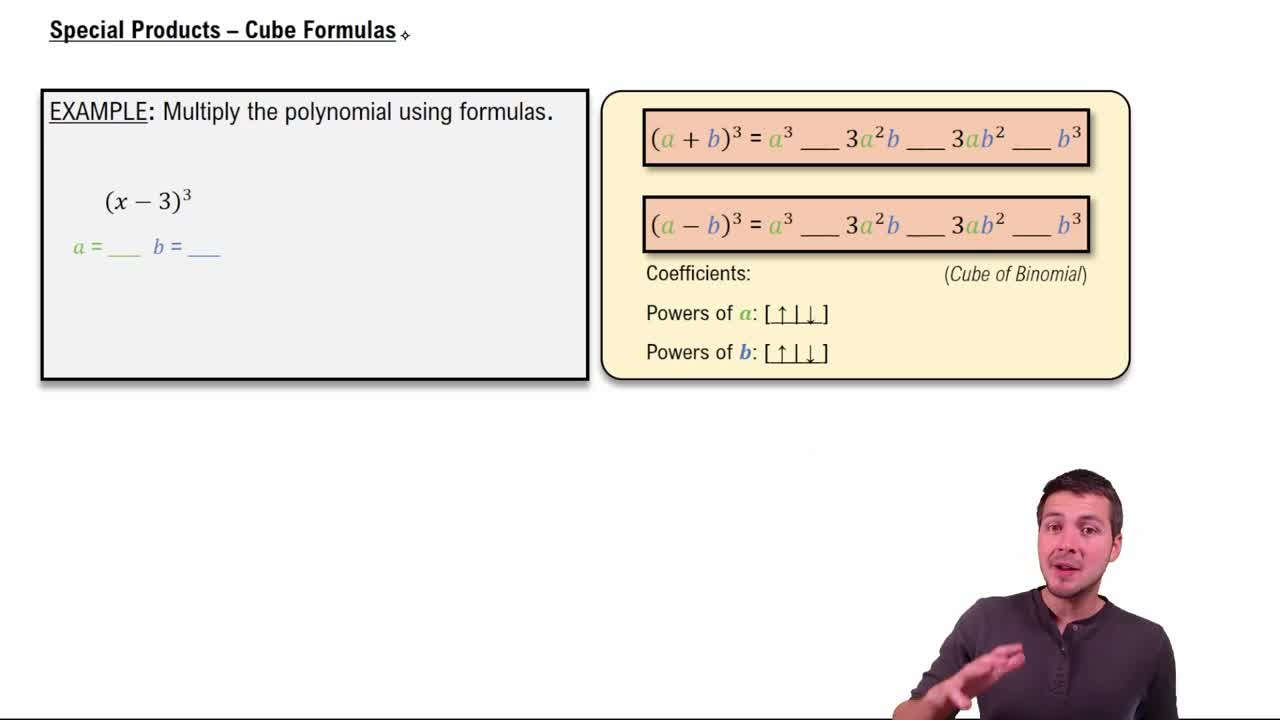
Recall the sum of cubes factoring formula: \(a^3 + b^3 = (a + b)(a^2 - ab + b^2)\).
Identify \(a = 4\) and \(b = (3x+2)\), then apply the formula: \((4 + (3x+2)) \left(4^2 - 4(3x+2) + (3x+2)^2\right)\).
Simplify the first factor and expand the terms inside the second factor to write the fully factored form.

Verified video answer for a similar problem:
This video solution was recommended by our tutors as helpful for the problem above.
Video duration:
4mWas this helpful?
Key Concepts
Here are the essential concepts you must grasp in order to answer the question correctly.
Sum of Cubes Formula
The sum of cubes formula states that a³ + b³ = (a + b)(a² - ab + b²). It is used to factor expressions where two terms are each perfect cubes added together. Recognizing the expression as a sum of cubes allows for straightforward factoring.
Recommended video:
Guided course
Special Products - Cube Formulas
Identifying Perfect Cubes
To apply the sum of cubes formula, each term must be a perfect cube. For example, 64 is 4³, and (3x + 2)³ is already a cube. Recognizing these cubes is essential to rewrite the expression in a form suitable for factoring.
Recommended video:
Guided course
Special Products - Cube Formulas
Polynomial Factoring Techniques
Factoring polynomials involves rewriting expressions as products of simpler polynomials. Techniques include factoring by grouping, special formulas like sum/difference of cubes, and recognizing patterns. Choosing the correct method simplifies solving or further manipulation.
Recommended video:
Guided course
Introduction to Factoring Polynomials
Related Practice
Textbook Question
591
views
Textbook Question
Let U = {0, 1, 2, 3, 4, 5, 6, 7, 8, 9, 10, 11, 12, 13}, M = {0, 2, 4, 6, 8}, N = {1, 3, 5, 7, 9, 11, 13}, Q = {0, 2, 4, 6, 8, 10, 12}, and R = {0, 1, 2, 3, 4}.Use these sets to find each of the following. Identify any disjoint sets. {x | x ∈ M and x ∈ Q}
948
views
Textbook Question
Multiply or divide as indicated. 34.04 × 0.56
1001
views
Textbook Question
Let U = {0, 1, 2, 3, 4, 5, 6, 7, 8, 9, 10, 11, 12, 13}, M = {0, 2, 4, 6, 8}, N = {1, 3, 5, 7, 9, 11, 13}, Q = {0, 2, 4, 6, 8, 10, 12}, and R = {0, 1, 2, 3, 4}.Use these sets to find each of the following. Identify any disjoint sets. {x | x ∈ U, x ∉ R}
991
views
Textbook Question
Multiply or divide as indicated. 22.41 × 33
1054
views
Textbook Question
Simplify each expression. Write answers without negative exponents. Assume all variables represent positive real numbers. (z1/3z-2/3z1/6)/(z-1/6)3
1190
views