Solve each problem. Dimensions of a Square. If the length of each side of a square is decreased by 4 in., the perimeter of the new square is 10 in. more than half the perimeter of the original square. What are the dimensions of the original square?

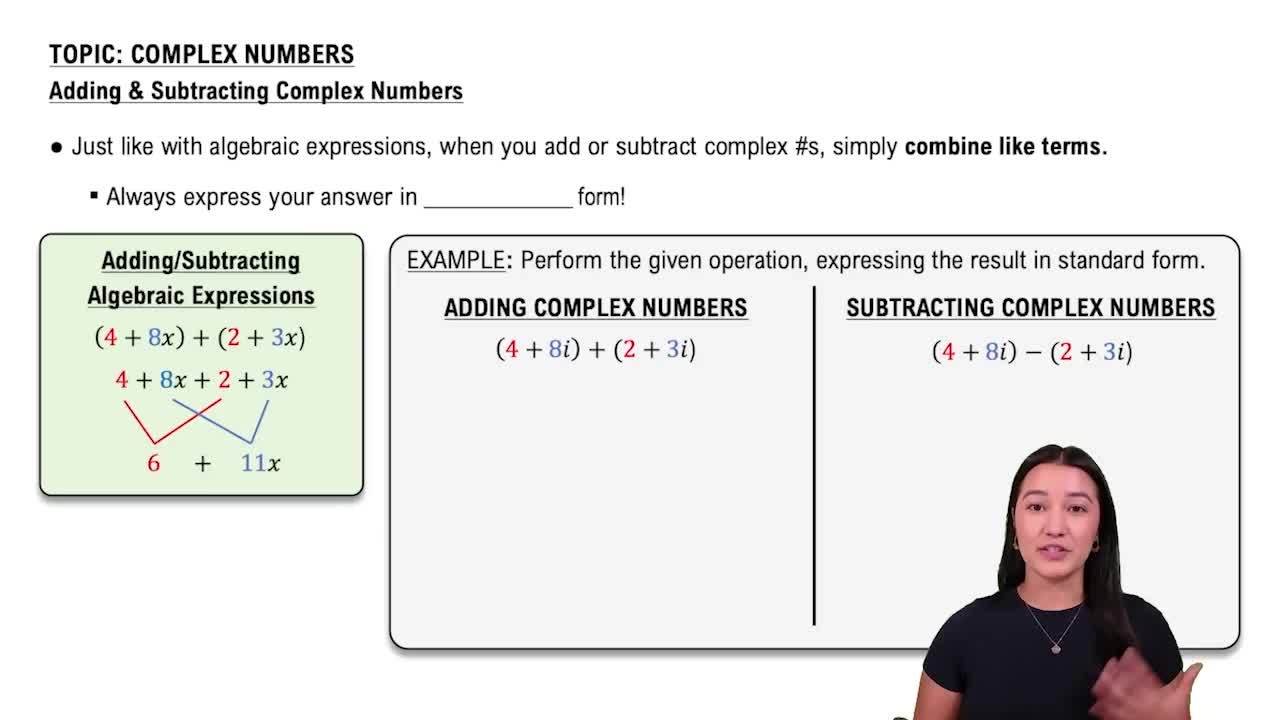
Decide whether each statement is true or false. If false, correct the right side of the equation. (-2+7i) - (10-6i)= -12+i
Verified step by step guidance
Verified video answer for a similar problem:
Key Concepts
Complex Number Arithmetic
Subtraction of Complex Numbers
Verification of Equations Involving Complex Numbers
Use Choices A–D to answer each question. A. 3x2 - 17x - 6 = 0 B. (2x + 5)2 = 7 C. x2 + x = 12 D. (3x - 1)(x - 7) = 0 Which equation is set up for direct use of the square root property? Solve it.
Use Choices A–D to answer each question. A. 3x2 - 17x - 6 = 0 B. (2x + 5)2 = 7 C. x2 + x = 12 D. (3x - 1)(x - 7) = 0 Which equation is set up for direct use of the zero-factor property? Solve it.
Match each equation in Column I with the correct first step for solving it in Column II. (x+5)2/3 - (x+5)1/3 - 6 = 0
Solve each equation. | 4x + 2 | = 5
Solve each problem. Which one or more of the following cannot be a correct equation to solve a geometry problem, if x represents the length of a rectangle? (Hint: Solve each equation and consider the solution.) A. 2x+2(x- 1) = 14 B. -2x+7(5-x) = 52 C. 5(x+2)+5x = 10 D. 2x+2(x-3) = 22
