Solve each equation. Then state whether the equation is an identity, a conditional equation, or an inconsistent equation. 3-5(2x + 1) - 2(x-4) = 0
Ch. 1 - Equations and Inequalities

Chapter 2, Problem 33a
Exercises 27–40 contain linear equations with constants in denominators. Solve each equation. 3x/5 - x = x/10 - 5/2
Verified step by step guidance1
Combine all terms involving x on one side of the equation. Start by subtracting \( \frac{x}{10} \) from both sides: \( \frac{3x}{5} - x - \frac{x}{10} = -\frac{5}{2} \).
Find a common denominator for the fractions involving x on the left-hand side. The least common denominator (LCD) of 5, 1, and 10 is 10. Rewrite each term with this denominator: \( \frac{6x}{10} - \frac{10x}{10} - \frac{x}{10} = -\frac{5}{2} \).
Simplify the terms on the left-hand side by combining the fractions: \( \frac{6x - 10x - x}{10} = -\frac{5}{2} \), which simplifies further to \( \frac{-5x}{10} = -\frac{5}{2} \).
Eliminate the fractions by multiplying through by the least common denominator of the denominators on both sides. The LCD of 10 and 2 is 10. Multiply through by 10: \( 10 \cdot \frac{-5x}{10} = 10 \cdot -\frac{5}{2} \), resulting in \( -5x = -25 \).
Solve for x by dividing both sides of the equation by -5: \( x = \frac{-25}{-5} \). Simplify the result to find the value of x.

Verified video answer for a similar problem:
This video solution was recommended by our tutors as helpful for the problem above.
Video duration:
2mWas this helpful?
Key Concepts
Here are the essential concepts you must grasp in order to answer the question correctly.
Linear Equations
Linear equations are mathematical statements that express the equality of two linear expressions. They typically take the form ax + b = c, where a, b, and c are constants, and x is the variable. Understanding how to manipulate these equations is essential for solving them, as it involves isolating the variable on one side of the equation.
Recommended video:
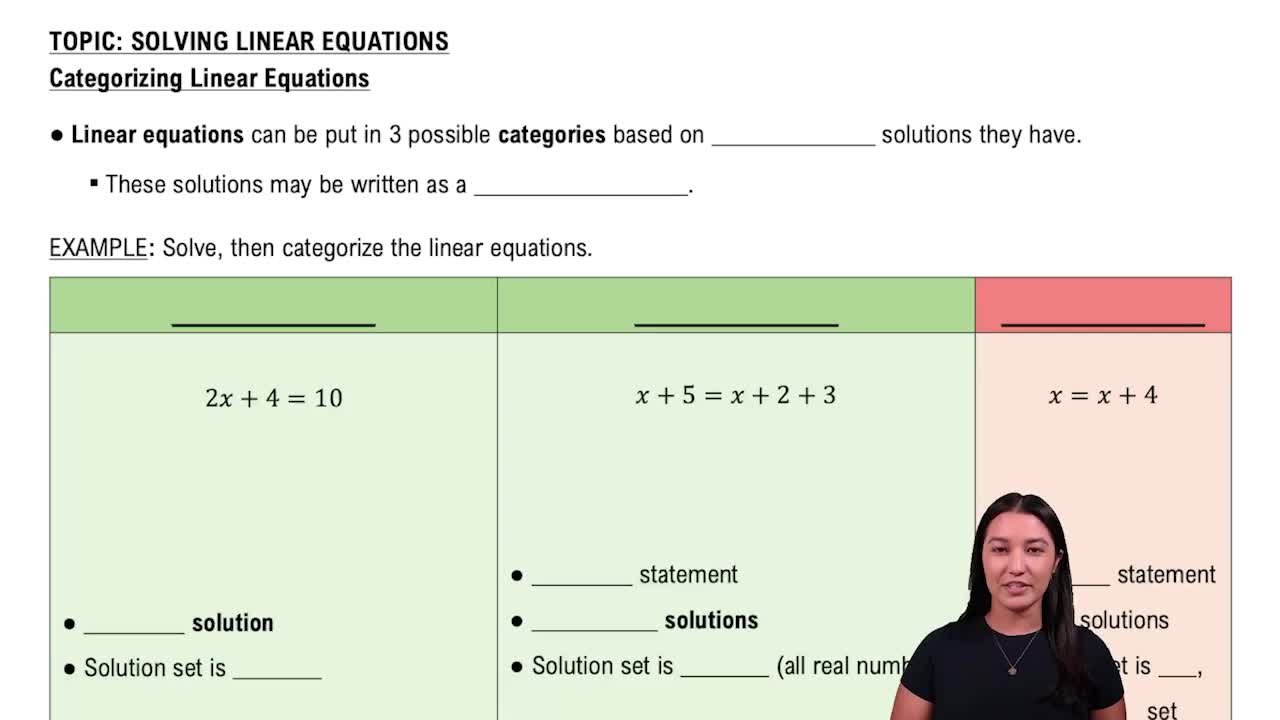
Categorizing Linear Equations
Fractions and Denominators
Fractions represent a part of a whole and consist of a numerator and a denominator. In equations involving fractions, it is crucial to understand how to find a common denominator to simplify the equation. This process often involves multiplying through by the least common multiple of the denominators to eliminate fractions, making the equation easier to solve.
Recommended video:
Guided course
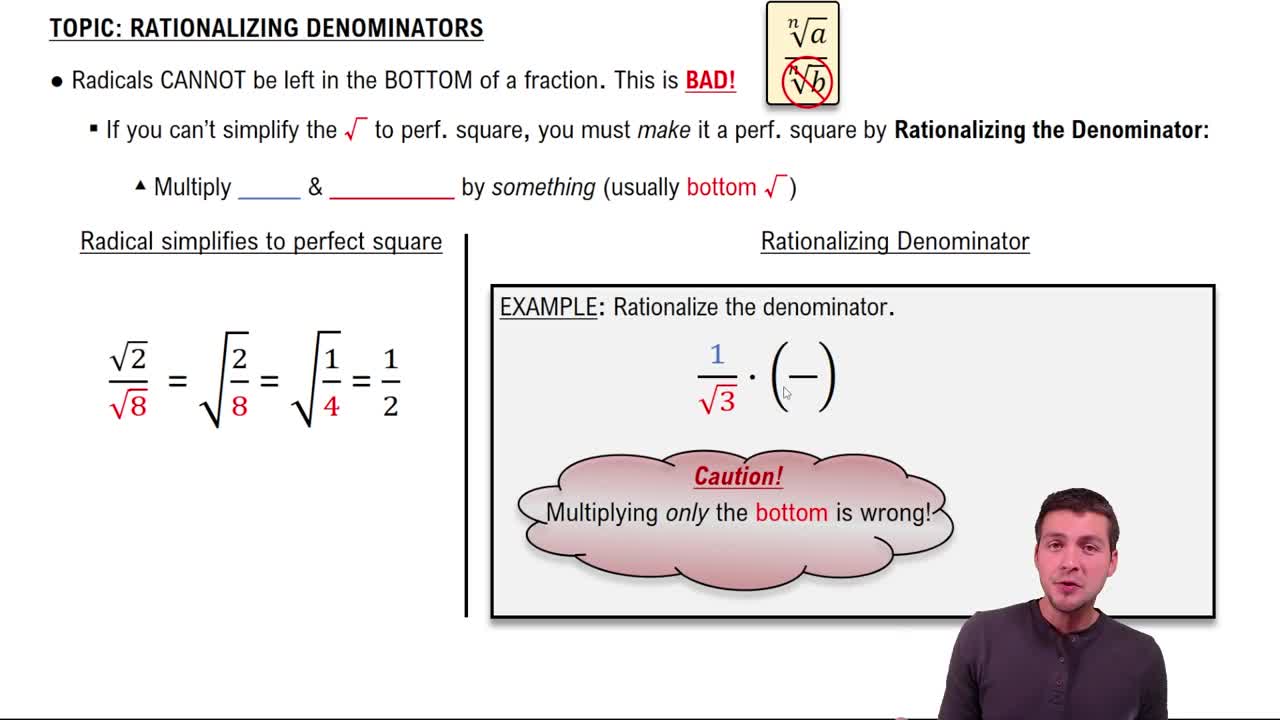
Rationalizing Denominators
Isolating the Variable
Isolating the variable is a fundamental technique in solving equations, where the goal is to get the variable (e.g., x) alone on one side of the equation. This often involves performing inverse operations, such as addition, subtraction, multiplication, or division, to both sides of the equation. Mastery of this concept allows for the effective simplification and solution of linear equations.
Recommended video:
Guided course
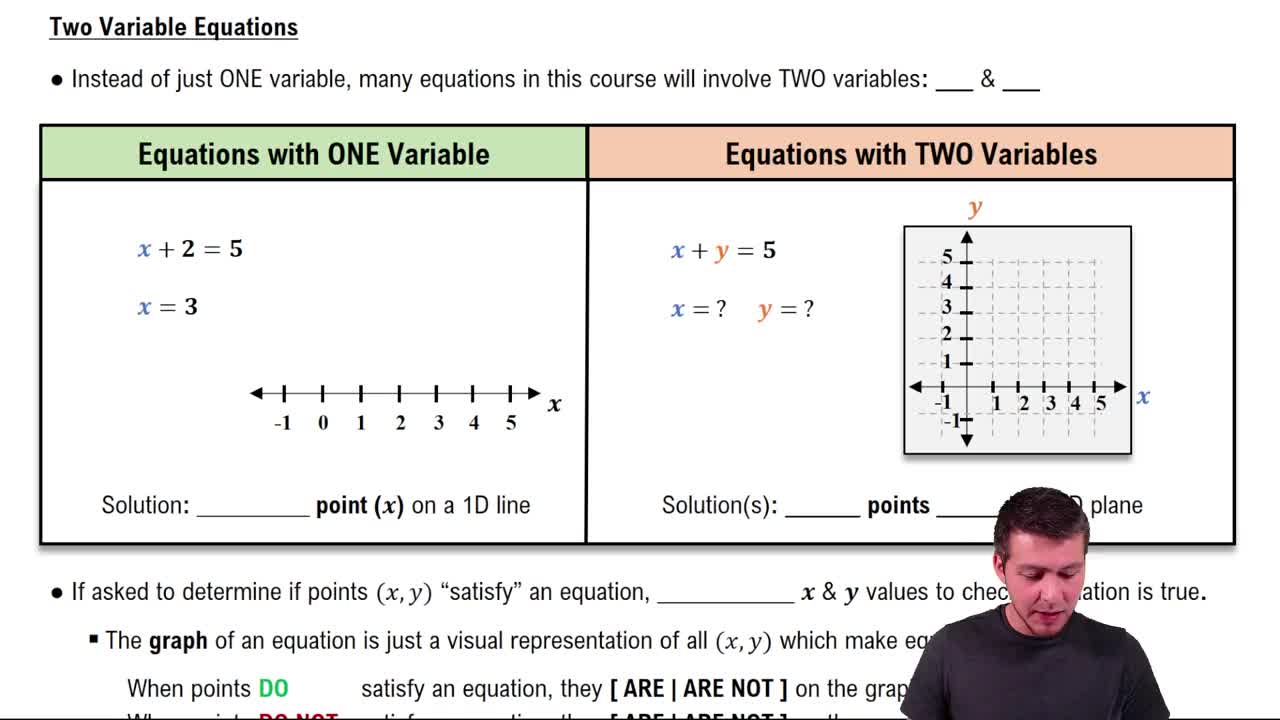
Equations with Two Variables
Related Practice
Textbook Question
1214
views
Textbook Question
In all exercises, other than exercises with no solution, use interval notation to express solution sets and graph each solution set on a number line. In Exercises 27–50, solve each linear inequality. 8x - 11 ≤ 3x - 13
805
views
Textbook Question
Solve each equation in Exercises 15–34 by the square root property. (2x + 8)2 = 27
994
views
Textbook Question
A job pays an annual salary of \$57,900, which includes a holiday bonus of \$1500. If paychecks are issued twice a month, what is the gross amount for each paycheck?
631
views
Textbook Question
In Exercises 29–36, simplify and write the result in standard form. √(32 - 4 × 2 × 5)
815
views
Textbook Question
Solve each equation with rational exponents in Exercises 31–40. Check all proposed solutions. (x - 4)3/2 = 27
177
views