Ch. 1 - Equations and Inequalities
Lial - College Algebra 13th Edition
Lial13th EditionCollege AlgebraISBN: 9780136881063Not the one you use?Change textbook
Chapter 2, Problem 34

Solve each equation. (x+4)/2x = (x-1)/3

Verified step by step guidance
1
Start with the given equation: \(\frac{(x+4)}{2x} = \frac{(x-1)}{3}\).
To eliminate the denominators, multiply both sides of the equation by the least common denominator (LCD), which is \$6x$.
After multiplying, the equation becomes: \(6x \times \frac{(x+4)}{2x} = 6x \times \frac{(x-1)}{3}\).
Simplify both sides by canceling common factors: on the left, \$2x\( cancels with part of \)6x\(, and on the right, \(3\) cancels with part of \)6x\(, resulting in \)3(x+4) = 2x(x-1)$.
Next, expand both sides: distribute \(3\) on the left to get \$3x + 12\(, and distribute \)2x\( on the right to get \)2x^2 - 2x$. Then, set the equation to zero by bringing all terms to one side.

Verified video answer for a similar problem:

This video solution was recommended by our tutors as helpful for the problem above.
Video duration:
5m
Was this helpful?

Key Concepts

Here are the essential concepts you must grasp in order to answer the question correctly.

Solving Rational Equations

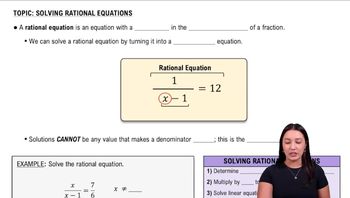
A rational equation involves fractions with polynomials in the numerator and denominator. To solve, find a common denominator or cross-multiply to eliminate fractions, then solve the resulting polynomial equation. Always check for excluded values that make denominators zero.
Recommended video:
05:56
Introduction to Rational Equations

Cross-Multiplication

Cross-multiplication is a method used to solve equations where two fractions are set equal. Multiply the numerator of each fraction by the denominator of the other, creating a simpler equation without fractions. This technique is valid when denominators are nonzero.
Recommended video:
03:42
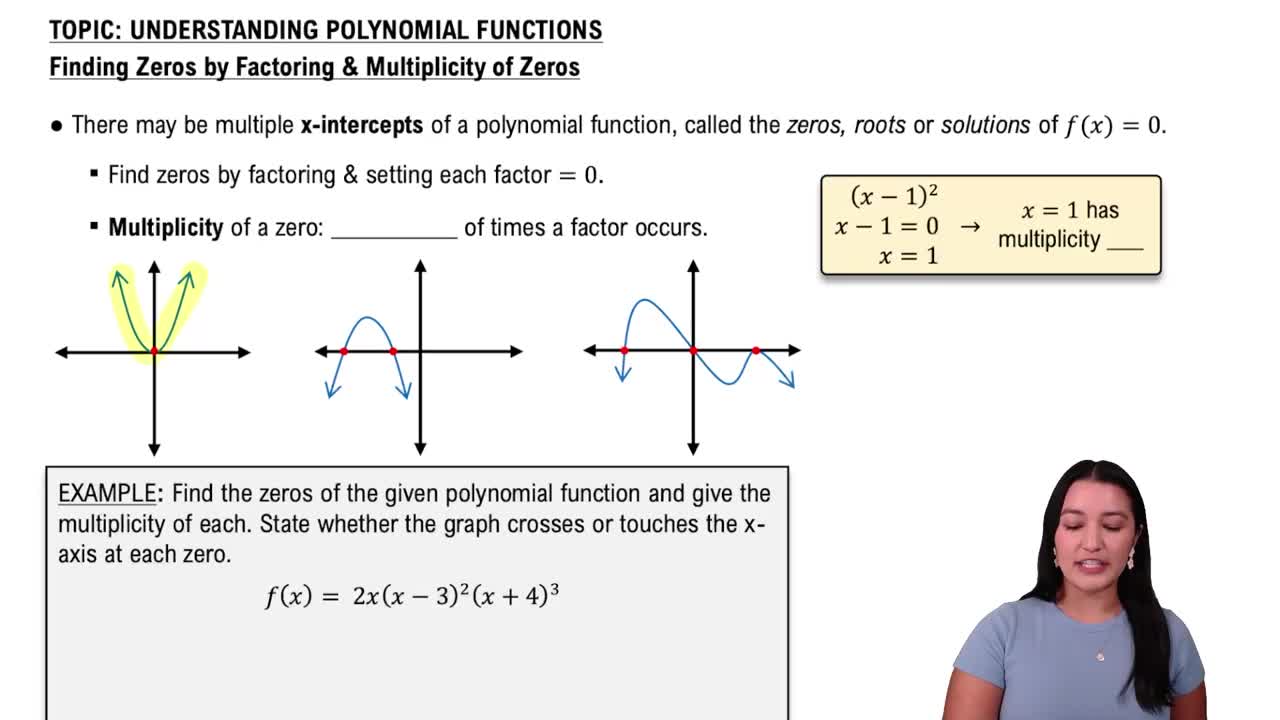
Finding Zeros & Their Multiplicity

Checking for Extraneous Solutions

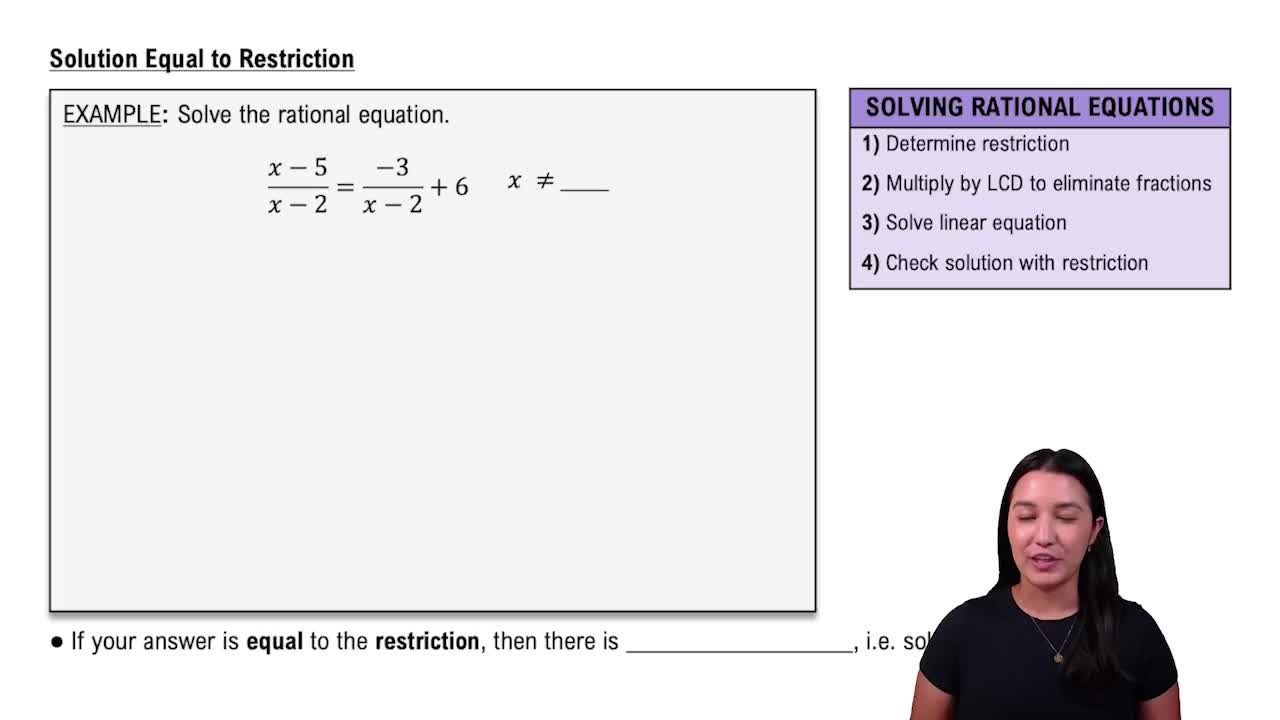
After solving an equation, substitute solutions back into the original to ensure they don't make any denominator zero. Solutions that do are extraneous and must be discarded. This step ensures the final answer is valid within the equation's domain.
Recommended video:
05:21
Restrictions on Rational Equations