Start by rewriting the equation clearly: \(\frac{5}{6}x - 2x + \frac{4}{3} = \frac{5}{3}\).
Combine the like terms involving \(x\) on the left side. To do this, express \(-2x\) as a fraction with denominator 6: \(-2x = -\frac{12}{6}x\). Then combine \(\frac{5}{6}x - \frac{12}{6}x\).
Simplify the combined \(x\) terms to get a single fraction coefficient times \(x\). The equation now looks like \(\left(\frac{5}{6} - \frac{12}{6}\right)x + \frac{4}{3} = \frac{5}{3}\).
Isolate the \(x\) term by subtracting \(\frac{4}{3}\) from both sides: \(\left(\frac{5}{6} - \frac{12}{6}\right)x = \frac{5}{3} - \frac{4}{3}\).
Simplify the right side and then solve for \(x\) by dividing both sides by the coefficient of \(x\). This will give you the solution for \(x\).
Verified video answer for a similar problem:
This video solution was recommended by our tutors as helpful for the problem above
Video duration:
3m
Play a video:
0 Comments
Key Concepts
Here are the essential concepts you must grasp in order to answer the question correctly.
Solving Linear Equations
Solving linear equations involves finding the value of the variable that makes the equation true. This typically requires isolating the variable on one side by performing inverse operations such as addition, subtraction, multiplication, or division.
Combining like terms means adding or subtracting terms that have the same variable raised to the same power. This simplifies the equation and makes it easier to solve by reducing the number of terms.
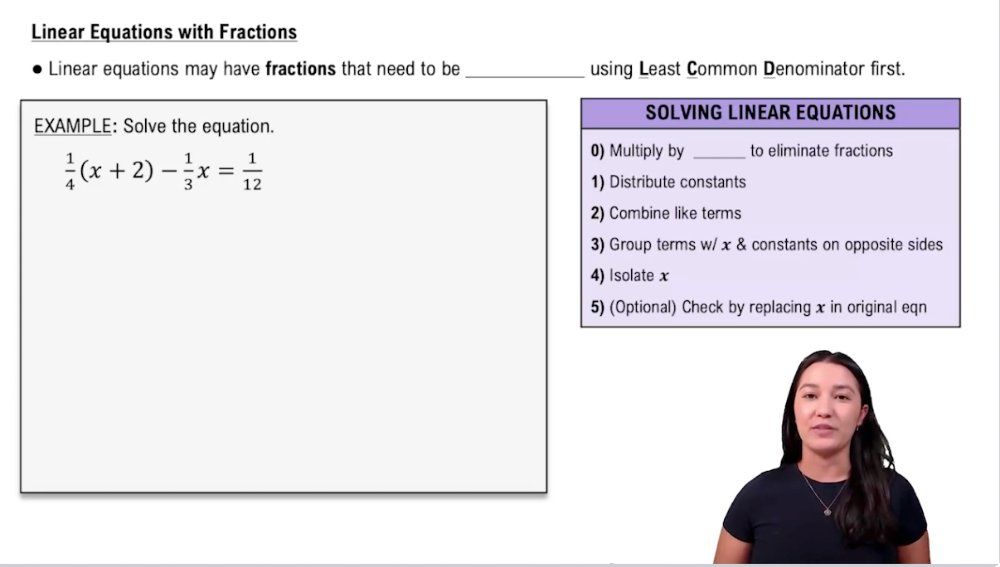
When solving equations with fractions, it is important to find a common denominator or multiply through by the least common denominator to eliminate fractions. This simplifies calculations and helps isolate the variable more efficiently.

 3:23 minutes
 Verified step by step guidance
 04:02
04:02