Ch. 1 - Equations and Inequalities
Lial - College Algebra 13th Edition
Lial13th EditionCollege AlgebraISBN: 9780136881063Not the one you use?Change textbook
Chapter 2, Problem 36

Determine whether each equation is an identity, a conditional equation, or a contradiction. Give the solution set. -6(2x+1) - 3(x-4) = -15x+1

Verified step by step guidance
1
Start by expanding both sides of the equation. Use the distributive property to remove the parentheses: expand \(-6(2x+1)\) and \(-3(x-4)\) on the left side.
After expanding, combine like terms on the left side to simplify the expression into the form \(ax + b\).
Rewrite the equation with the simplified left side and the right side \(-15x + 1\).
Next, get all terms involving \(x\) on one side and constant terms on the other side by adding or subtracting terms accordingly.
Finally, analyze the resulting equation: if it simplifies to a true statement for all \(x\), it is an identity; if it is true for specific \(x\) values, it is a conditional equation with those solutions; if it results in a false statement, it is a contradiction with an empty solution set.

Verified video answer for a similar problem:

This video solution was recommended by our tutors as helpful for the problem above.
Video duration:
2m
Was this helpful?

Key Concepts

Here are the essential concepts you must grasp in order to answer the question correctly.

Types of Equations: Identity, Conditional, and Contradiction

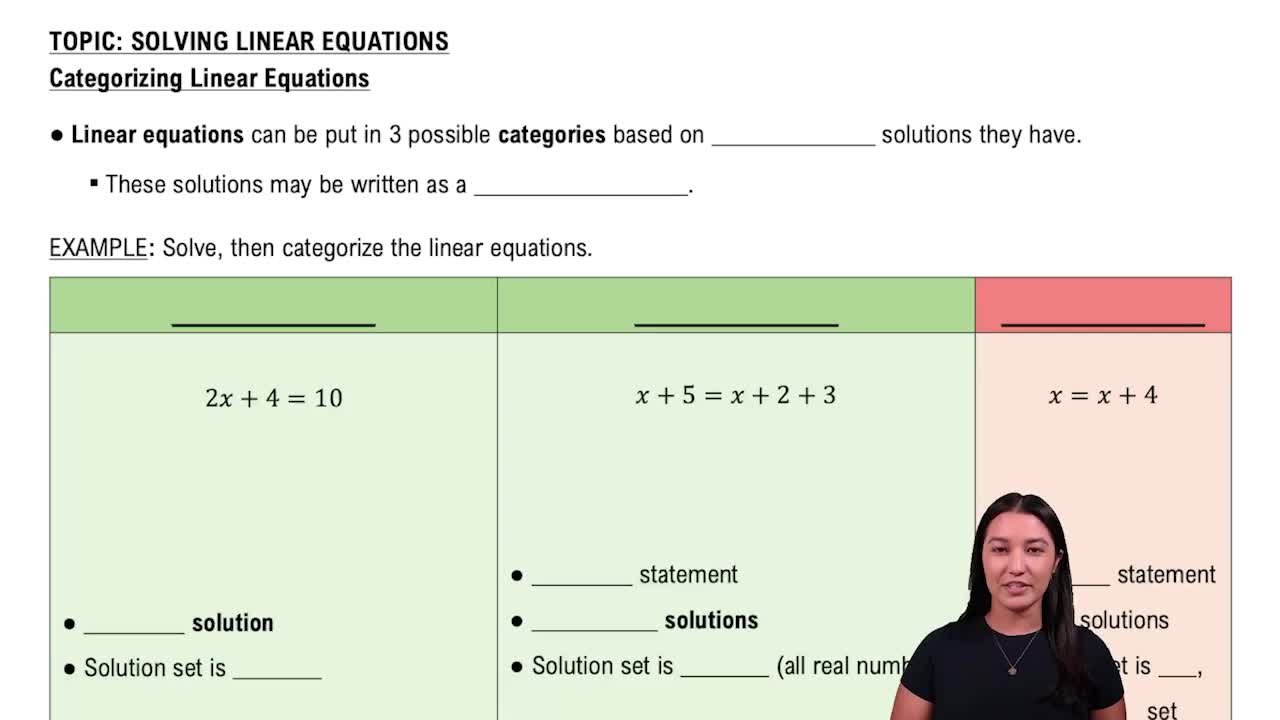
An identity is true for all values of the variable, a conditional equation is true for specific values, and a contradiction has no solution. Identifying the type helps determine the solution set and the nature of the equation.
Recommended video:
06:00
Categorizing Linear Equations

Solving Linear Equations

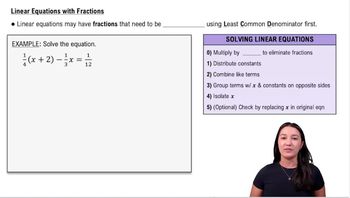
Solving linear equations involves simplifying both sides, combining like terms, and isolating the variable. This process helps find the values of the variable that satisfy the equation or determine if no or all values work.
Recommended video:
04:02
Solving Linear Equations with Fractions

Distributive Property

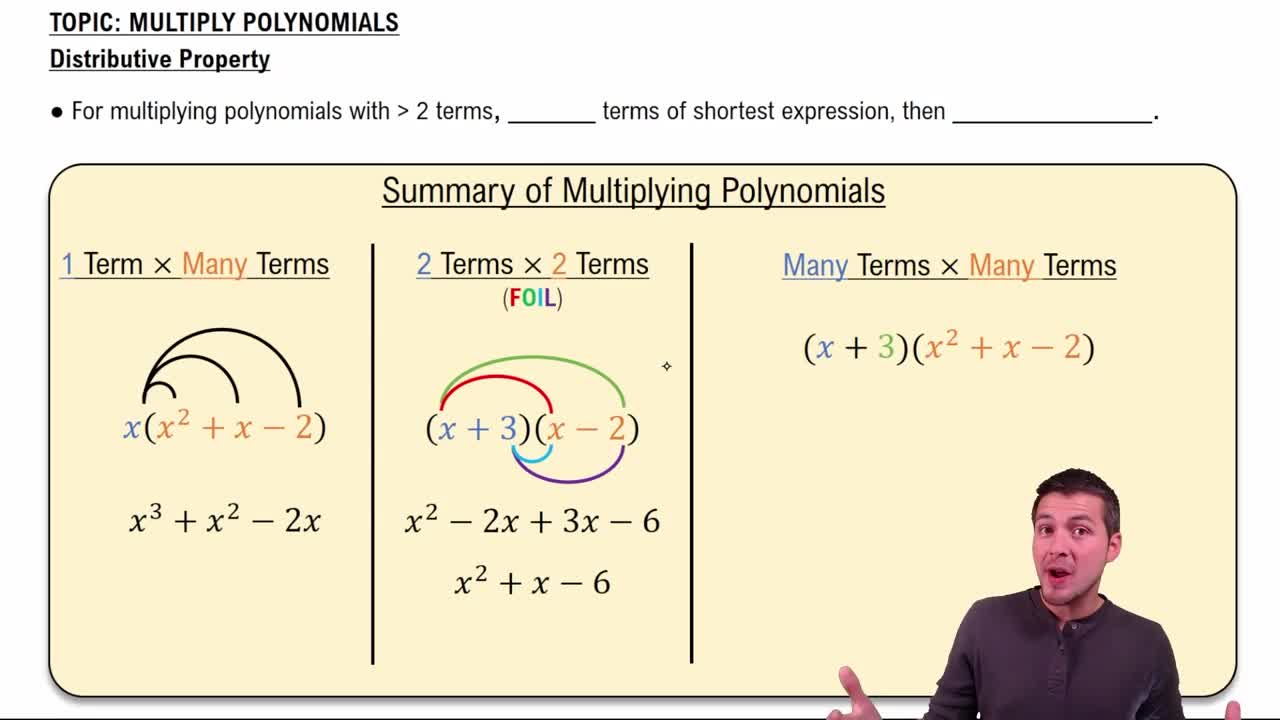
The distributive property allows multiplication over addition or subtraction, such as a(b + c) = ab + ac. Applying this property correctly is essential to simplify expressions and solve equations accurately.
Recommended video:
Guided course
04:15
Multiply Polynomials Using the Distributive Property